Must-Have Cat Breeds Chart Pictures For Identifying Your Feline Friend
Most house cats sitting on windowsills across the world are not purebred at all. Researchers estimate the vast majority of domestic cats are mixed breed, yet cat registries like The International Cat Association now recognize 73 distinct breeds. That gap between what people assume and what is actually true is exactly why visual identification tools matter so much. Anyone trying to figure out whether their cat is a Maine Coon, a Ragdoll, or simply a fluffy mixed-breed tabby needs reliable, image-based references. This guide breaks down the 6 must-have cat breeds chart pictures for identifying your feline friend that actually hold up to scrutiny in 2026, drawing on updated breed registries, AI identification tools, and expert visual guides.
Disclosure: This post contains affiliate links. As an Amazon Associate, we earn from qualifying purchases, and at no extra cost to you.
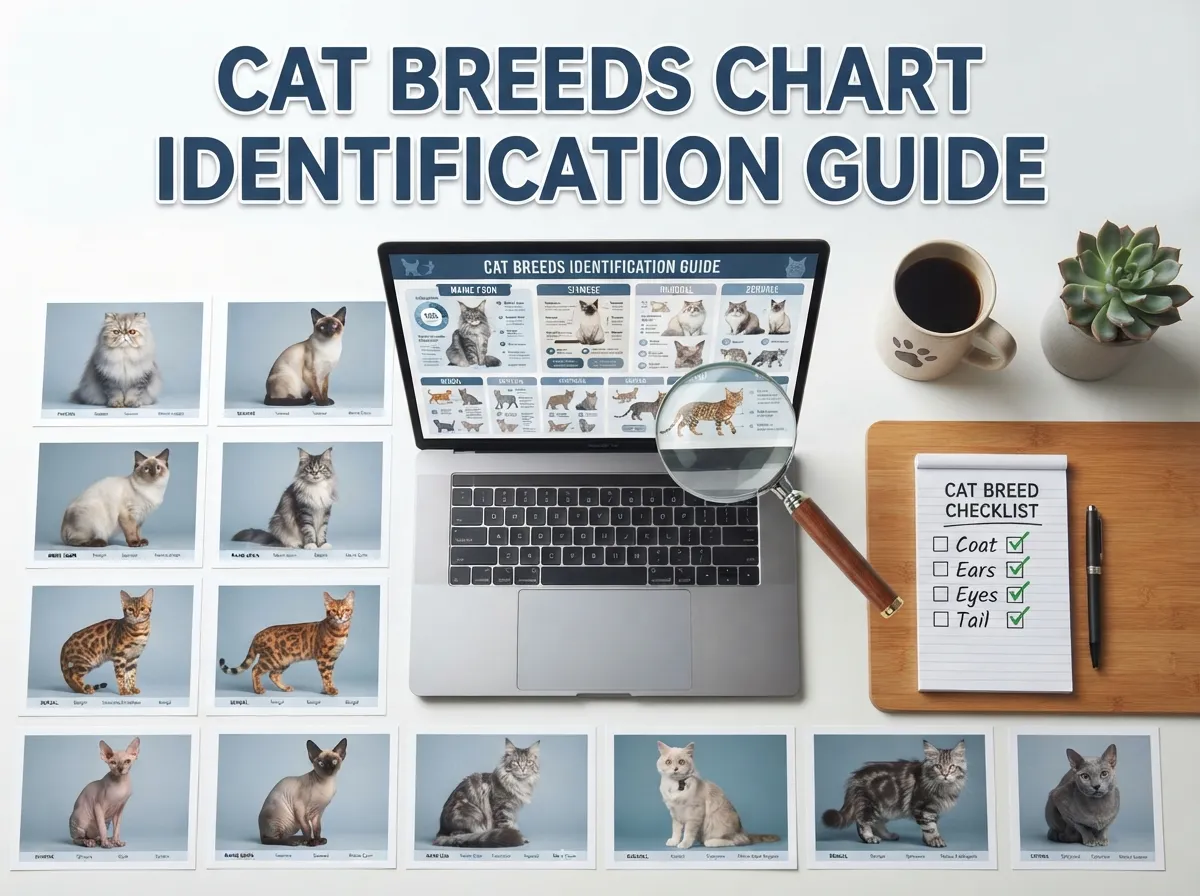
Rather than relying on a single flashy photo or a guess based on coat color, the charts featured here use structured, multi-trait comparisons. That approach matters because no single feature, not ear shape, not coat length, not eye color, is ever definitive on its own.
Key Takeaways
- The 6 must-have cat breeds chart pictures for identifying your feline friend combine official registry data, AI photo tools, and structured trait tables rather than relying on one eye-catching image.
- Reliable breed identification always examines multiple features together: coat, body size, ears, eyes, and tail shape.
- TICA recognizes 73 breeds and CFA maintains its own registry; both are treated as the gold standard behind nearly every credible chart or app.
- Photo-based tools such as CatScanner and Furriq’s image-upload feature let owners upload a picture and compare it against curated breed profiles instantly.
- Most domestic cats are mixed breed, so charts should be used for general identification and fun, not as a substitute for DNA testing or veterinary confirmation.
Why These 6 Must-Have Cat Breeds Chart Pictures For Identifying Your Feline Friend Matter
There is no single official product called a “6 must-have cat breeds chart.” Instead, the strongest resources available in 2026 are broader visual breed charts, official registry directories, and AI-powered identification tools that cover dozens of breeds at once. What makes a chart genuinely useful is not the number of breeds it lists, but how it organizes visual evidence. A well-built chart pulls apart coat density, ear tufting, tail length, body proportions, and temperament, then lays them side by side so an owner can compare a real cat against several reference points at once.
This matters because casual breed guessing is often wrong. A short-haired brown tabby might look like an Abyssinian at a glance, but body shape, ear placement, and eye shape usually tell a different story. The six chart resources below were selected because they represent the most current, well-sourced, and practically useful tools available for anyone trying to match a photo of their cat to a real breed profile.
1. The Furriq 61-Breed Identification Chart

Furriq’s September 2026 update delivers one of the most detailed identification charts currently available, covering 61 distinct breed profiles in a single structured reference. Each entry includes size, weight range, key visual markers, temperament notes, and health considerations, giving owners a full picture rather than just a photo and a name.
What sets this chart apart is its methodology. Instead of asking users to match a single trait, it walks through a five-point visual checklist: coat texture and pattern, body shape and size, ear shape and placement, eye color and shape, and tail length and thickness. The guide explicitly warns that no single trait should be treated as conclusive. A cat with tufted ears is not automatically a Maine Coon, and a cat with a bobbed tail is not automatically a Japanese Bobtail without confirming other features too. This layered approach makes the Furriq chart one of the most dependable entries among the 6 must-have cat breeds chart pictures for identifying your feline friend available today.
The chart also includes an image-upload feature, allowing users to submit a photo and receive suggested matches based on visible characteristics rather than manual comparison alone.
2. The TICA and CFA Official Breed Registry Chart
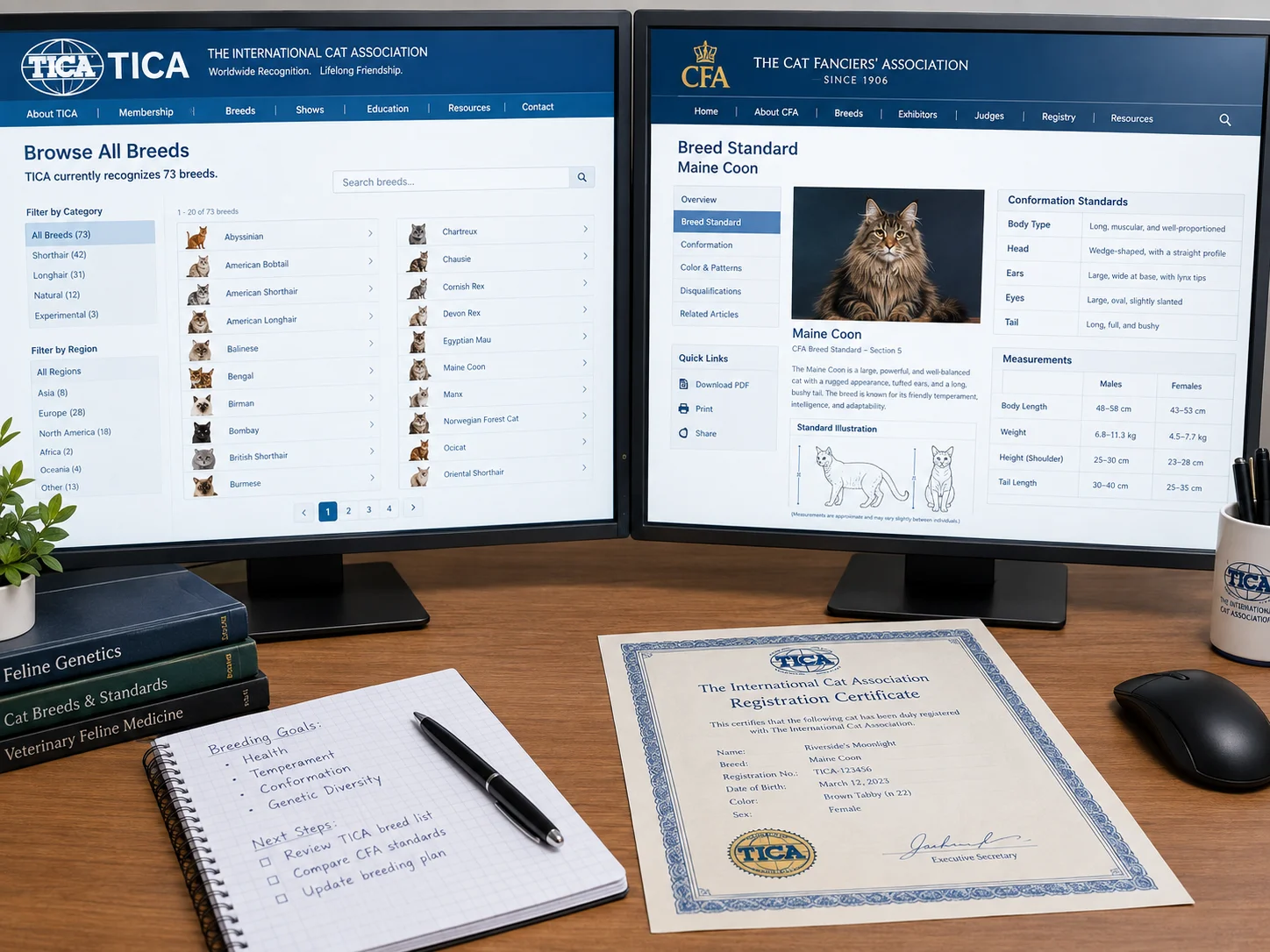
Any serious breed chart eventually traces back to two organizations: The International Cat Association and the Cat Fanciers’ Association. TICA’s “Browse All Breeds” directory, last refreshed in July 2026, currently lists 73 recognized breeds and functions as a primary reference point for nearly every third-party chart, app, or guide in circulation. CFA maintains a parallel registry with its own standards and breed descriptions.
Many popular AI tools and consumer guides state outright that their breed lists are derived from or aligned with these two registries. That lineage matters because it separates authoritative charts from informal lists compiled from random internet photos. When a chart cites TICA or CFA as its data source, it generally means:
- Breed standards reflect officially judged conformation traits, not casual observation.
- Physical descriptions include precise measurements for size, coat type, and coloration.
- Temperament notes come from breed clubs and long-term owner reporting rather than guesswork.
For anyone building or comparing charts, checking whether a resource references TICA or CFA is one of the fastest ways to judge its reliability.
3. The AI-Powered Photo Breed Identifier Chart

A July 2026 tool called “What Breed Is My Cat?” combines a structured chart of ten common breeds with a free photo-based identifier. The chart itself pulls directly from official TICA and CFA data, blending visual traits such as coat, eye color, ear shape, and tail type with temperament and health tendencies for each breed.
What makes this tool particularly useful is the pairing of static reference material with active photo scanning. Users upload an image, and the system compares visible markers against its curated database rather than relying on the user’s own judgment. This is a meaningful shift from older breed guides, which simply displayed photos and asked readers to eyeball similarities.
Similarly, CatScanner, updated in September 2026, expands this concept with a large traits table behind its photo upload feature. Instead of guessing from memory, users get a data-backed comparison. Together, these AI-driven tools represent a fast-growing category among the 6 must-have cat breeds chart pictures for identifying your feline friend, because they remove much of the subjectivity from visual matching.
4. The Coat, Ear, and Tail Trait Comparison Chart
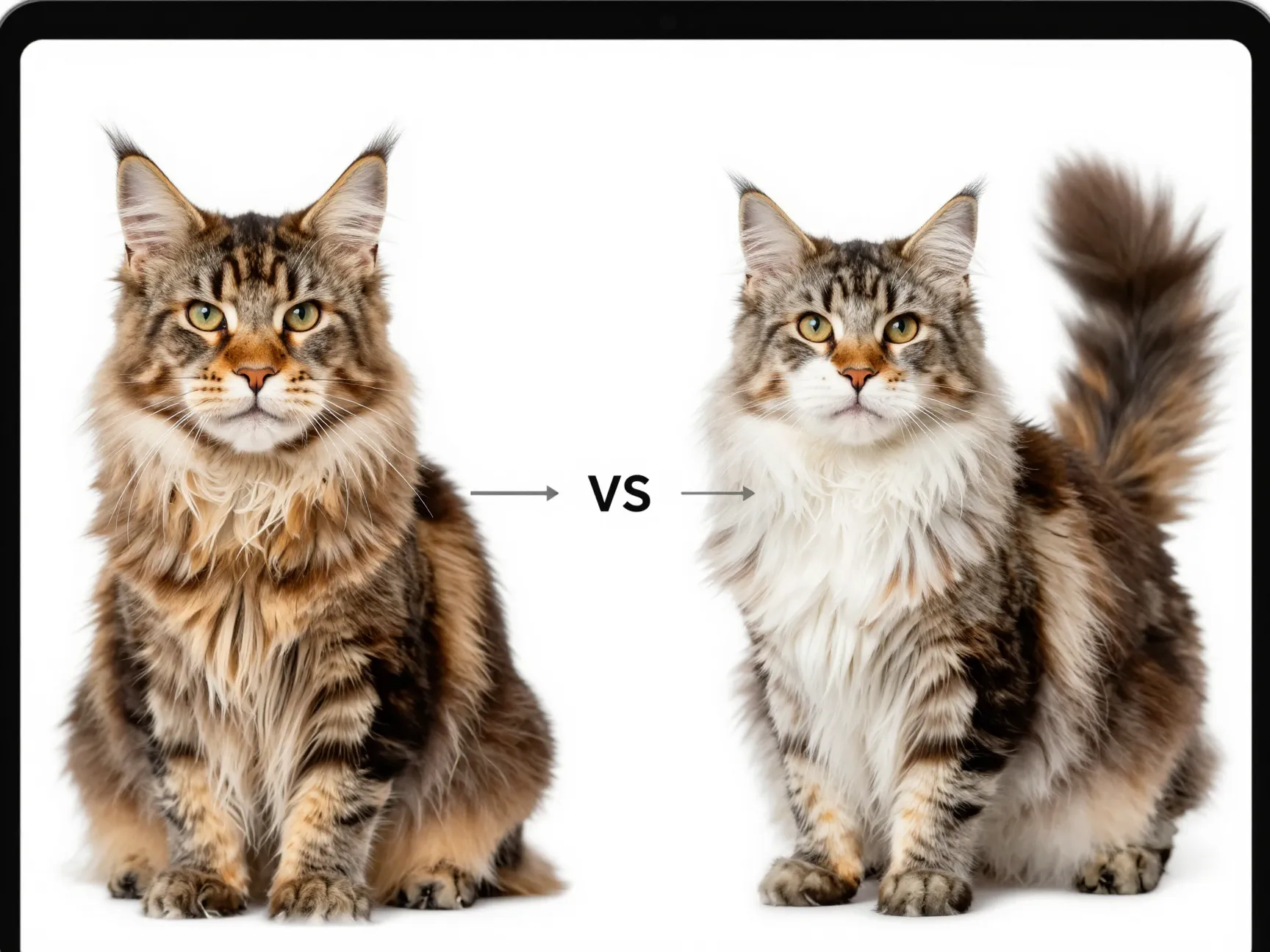
Some of the most practical charts skip flashy design entirely and focus on side-by-side trait comparisons. Furriq’s blog guide, also updated in September 2026, is a strong example. It compares features like ear tufts, coat density, and body length directly, using pairs of similar-looking breeds to highlight subtle differences. The Maine Coon versus Norwegian Forest Cat comparison is a favorite example, since both breeds share long fur and large frames but differ in facial structure, ear shape, and coat texture.
A simplified version of this kind of comparison looks like this:
| Feature | Maine Coon | Norwegian Forest Cat |
|---|---|---|
| Face shape | Square muzzle, high cheekbones | Triangular face, straight profile |
| Coat texture | Shaggy, water-resistant undercoat | Dense double coat, slightly coarser |
| Ear shape | Tall with lynx-tip tufts | Rounded tips, heavy tufting |
| Tail | Long, bushy, tapered | Long, bushy, evenly thick |
This trait-by-trait method avoids the common mistake of judging a breed from a single photo angle. It forces a closer look at structural details that hold steady across lighting, grooming, and age, which is exactly what makes a chart reliable rather than just decorative.
5. The Ten Common Breeds Visual Spotlight Chart
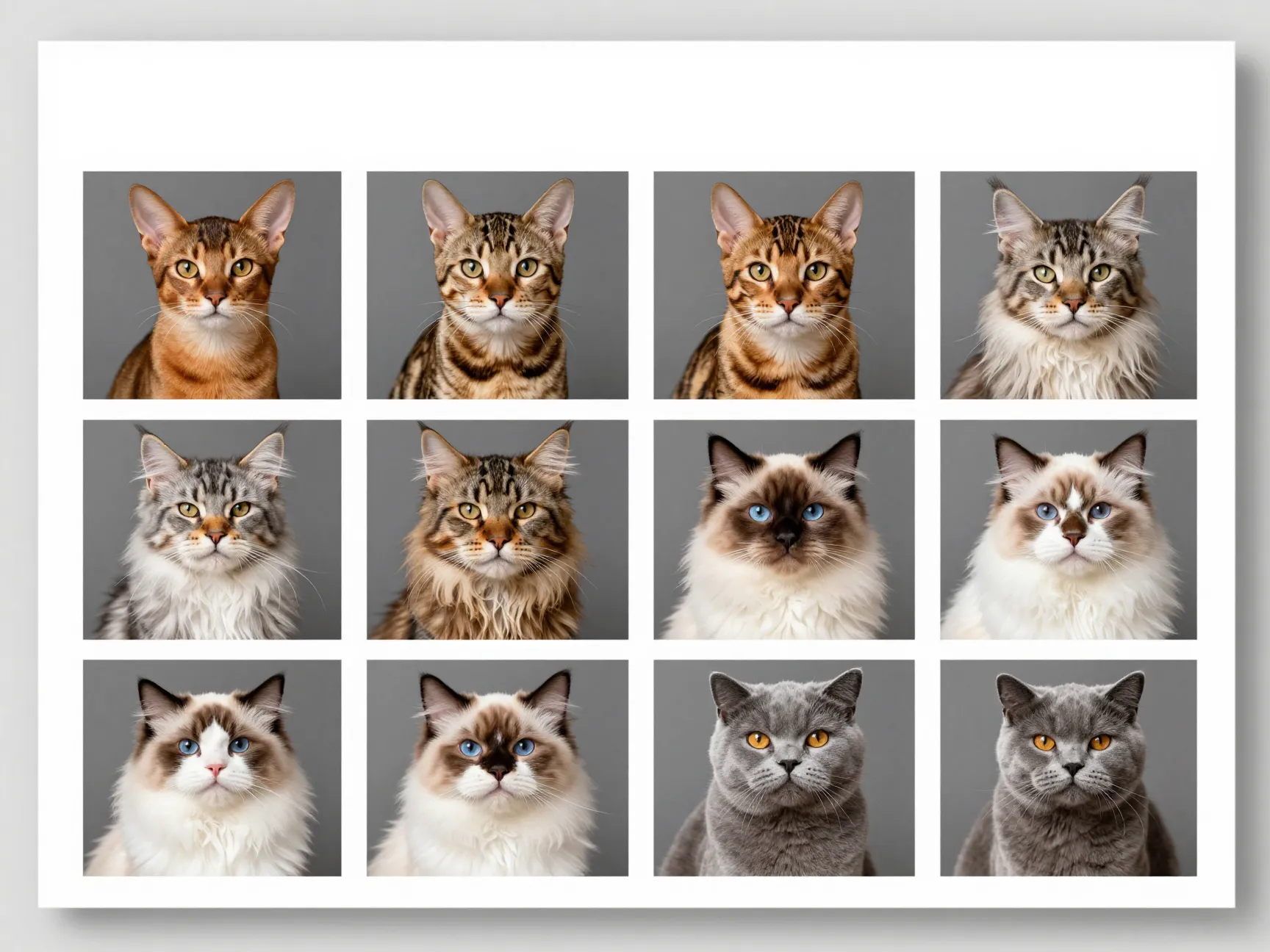
Not every owner needs a chart covering 60 or 70 breeds. Many simply want to know whether their cat resembles one of the breeds people encounter most often. Several 2026 guides distill broader breed lists into a smaller, high-frequency set. Across these curated lists, a consistent group of ten breeds keeps appearing due to their distinctive looks and broad popularity:
- Abyssinian, known for its ticked coat and alert, wedge-shaped face.
- American Shorthair, valued for a sturdy build and rounded features.
- Bengal, recognized by bold spotted or marbled rosettes.
- British Shorthair, famous for a plush coat and round “teddy bear” face.
- Maine Coon, the largest common breed with a shaggy mane and tufted ears.
- Norwegian Forest Cat, similar in size but with a straighter profile.
- Persian, defined by a flat face and extremely long, dense coat.
- Ragdoll, known for striking blue eyes and a docile temperament.
- Russian Blue, identified by a silvery-blue coat and emerald eyes.
- Scottish Fold, instantly recognizable by its folded ears.
Cats.com’s refreshed breed list from August 2026 and CatBreedsList.com’s catalog of more than 70 breeds, updated in July 2026, both reinforce this same core group as the most searched and most photographed breeds online. Because of that consistency, a chart built around these ten breeds functions as a practical entry point before moving on to rarer or more specialized types.
6. The Most Beautiful and Popular Breeds Gallery Chart

The final chart style leans into visual impact rather than pure data. Chewy’s 2026-updated feature on the 28 most beautiful cat breeds highlights strikingly photogenic types, with Persian, Ragdoll, and Siamese repeatedly singled out for their coloring, coat texture, and facial structure. This kind of gallery-style chart works well for owners who are drawn in by appearance first and want to confirm identification afterward using a more detailed trait table.
Pairing a beauty-focused gallery with a practicality-focused guide gives a fuller picture. The “Most Common Domestic Cat Breeds” visual guide, for example, groups cats by coat length and temperament, then adds structured notes on activity level and grooming needs. That combination, striking photos plus practical structure, is what separates a genuinely useful chart from one that is simply attractive to look at.
Together, these six chart types cover the full range of what someone needs when trying to identify a cat breed. From the exhaustive 61-breed Furriq reference to the beauty-driven Chewy gallery, each one adds a different layer of insight to the same underlying goal: matching a real cat to real breed data.
How to Use These 6 Must-Have Cat Breeds Chart Pictures For Identifying Your Feline Friend
Charts are only as useful as the method behind them. Experts across nearly every updated guide in 2026 agree on one core principle: examine several features together rather than fixating on one trait.
A dependable process looks like this:
- Start with coat length and pattern, since this immediately narrows the field between long-haired and short-haired breed groups.
- Check body size and shape, comparing against reference weights and frame descriptions from a trusted chart.
- Look closely at ear shape, noting tufting, folding, or unusually large or small proportions.
- Study eye color and shape, since certain colors like deep blue or emerald green are strongly associated with specific breeds.
- Examine tail length and thickness, which can separate visually similar breeds like the Maine Coon and Norwegian Forest Cat.
- Cross-reference temperament and behavior patterns, since some breeds share appearances but differ noticeably in personality and activity level.
Photo-based tools like CatScanner and Furriq’s image-upload feature can speed up this process significantly, but they work best as a second opinion rather than the only step. Uploading a clear, well-lit photo that shows the face, ears, and body in profile gives these tools the best chance at an accurate match.
It is also worth remembering that most pet cats are mixed breed. A chart might reveal that a cat shares several traits with a Russian Blue, for example, without that cat being a purebred Russian Blue. Charts are best treated as educational tools for spotting resemblance and learning breed characteristics, not as a replacement for genetic testing when certainty truly matters.
Frequently Asked Questions
Is there an official “6 must-have cat breeds chart” published by a cat registry?
No single official product carries that exact name. Instead, the strongest resources are broader charts and AI tools from sources like Furriq, TICA, and CFA, which this guide condenses into six practical categories.
Which breeds show up most often across current breed charts?
Abyssinian, American Shorthair, Bengal, British Shorthair, Maine Coon, Norwegian Forest Cat, Persian, Ragdoll, Russian Blue, and Scottish Fold appear repeatedly across major 2026 guides due to their distinctive appearance and popularity.
Can a photo alone confirm a cat’s breed?
Not reliably. Even the most advanced AI photo tools recommend comparing multiple traits, since coat color and pattern alone can closely resemble several different breeds.
Are AI cat breed identifiers accurate?
They can be a helpful starting point, especially when built on official TICA or CFA data, but accuracy improves significantly when combined with manual trait comparison rather than used in isolation.
Do these charts work for mixed-breed cats?
Yes, though results should be read as resemblance rather than confirmed lineage. Most domestic cats are mixed breed, so a chart match indicates shared visual traits, not a guaranteed pedigree.
Conclusion
Identifying a cat’s breed accurately takes more than a quick glance at one photo. The 6 must-have cat breeds chart pictures for identifying your feline friend outlined here, spanning the detailed Furriq reference, official TICA and CFA registries, AI-powered photo tools, trait comparison charts, common breed spotlights, and beauty-focused galleries, each bring something different to the table. Used together, they turn guesswork into a structured process built on real data rather than assumptions.
The next step is simple. Pull up a clear photo of the cat in question, work through coat, body, ears, eyes, and tail one at a time, and then check that observation against at least two of the charts above. That combination of careful observation and cross-referenced data is the most reliable way to move from “probably a tabby mix” to a confident, well-supported breed identification.