Essential Steps For Raising Healthy And Confident Cane Corso Puppies
A Cane Corso puppy can gain more than 80 pounds in its first year. That single fact explains why so many owners of this breed end up dealing with hip dysplasia, fear-based aggression, or a dog that drags them down the street by age one. The mistakes are rarely genetic. They almost always trace back to the first few months of life, when feeding, exercise, and socialization choices quietly set the trajectory for the next decade.

Disclosure: This post contains affiliate links. As an Amazon Associate, we earn from qualifying purchases, and at no extra cost to you.
This guide breaks down the 6 Essential Steps For Raising Healthy And Confident Cane Corso Puppies, drawing on current veterinary nutrition guidance, breed-specific training research, and 2026 socialization science. Each step is designed to work together, because a Cane Corso puppy raised with structure, controlled growth, and smart exposure to the world becomes a calm, stable adult guardian rather than an unpredictable liability.
Key Takeaways
- Feed 3 to 4 small meals daily using large or giant breed puppy formula until 6 to 8 months, then move to two meals for life; controlled growth protects developing joints.
- Limit exercise to short 10 to 20 minute leash walks and low-impact games until 18 months to avoid stressing hips and elbows during rapid growth.
- Start crate training and household boundaries in the first week home to prevent entitlement and support impulse control in this naturally dominant breed.
- Prioritize the 3 to 16 week socialization window with structured daily exposure to people, dogs, sounds, and surfaces, then continue socializing through 12 to 18 months of social maturity.
- Treat grooming and handling practice as confidence-building exercises, not just hygiene tasks, so vet visits and nail trims never become a battle.
Why The 6 Essential Steps For Raising Healthy And Confident Cane Corso Puppies Matter So Much
Cane Corsos are guardian dogs bred to think independently, protect territory, and physically dominate large prey. Those instincts do not disappear just because a puppy is living in a suburban home. Without deliberate management, a Cane Corso’s natural confidence can curdle into suspicion, reactivity, or resource guarding by the time the dog reaches social maturity around 12 to 18 months.
At the same time, this is a giant breed with a skeleton that is still cartilage-heavy well into its second year. Growth plates in the legs typically do not close until somewhere between 12 and 18 months, meaning any misstep in nutrition or exercise during puppyhood can cause lifelong orthopedic damage. Raising a healthy, confident Cane Corso is not one task. It is a coordinated set of decisions made every single day, which is exactly why breeders and veterinary behaviorists now frame puppy-raising around a structured sequence of steps rather than isolated tips.
The table below summarizes how these six steps map onto a Cane Corso puppy’s first 18 months.
| Age Range | Primary Focus | Key Actions |
|---|---|---|
| 8 to 16 weeks | Socialization foundation | Structured daily exposure, crate introduction, handling practice |
| 4 to 6 months | Nutrition and gentle routine | Large-breed formula, short walks, house rules reinforced |
| 6 to 12 months | Growth management | Two meals daily, joint-safe play, continued socialization |
| 12 to 18 months | Social maturity | Ongoing exposure, adolescence behavior monitoring, full exercise cleared by vet |
1. Build A Feeding And Nutrition Foundation That Protects Growing Joints

Nutrition is the single biggest lever an owner has over how a Cane Corso puppy’s skeleton develops. Because this breed can weigh over 100 pounds as an adult, uncontrolled growth spikes place enormous strain on hips, elbows, and spinal joints before they are structurally ready to handle the load.
The starting point is a large- or giant-breed puppy formula, fed consistently until the puppy is 6 to 8 months old. These formulas are formulated with lower, more controlled calcium and phosphorus ratios than standard puppy food, which slows bone growth just enough to reduce the risk of hip dysplasia and elbow dysplasia later in life. Free-feeding, where food is left out all day, should be avoided entirely. Instead, puppies under 6 months do best on 3 to 4 small, measured meals spread across the day, which keeps blood sugar stable and prevents the rapid weight spikes linked to orthopedic problems.
After 6 months, most Cane Corsos can transition to two meals a day, a schedule that typically continues for the rest of the dog’s life. Portion control matters more than raw calorie count. A visible waist and easily felt ribs under a light layer of fat are better indicators of healthy growth than following a feeding chart blindly, since every puppy’s metabolism differs slightly.
Owners should also resist the temptation to supplement calcium or add extra protein “for growth.” Overfeeding and unnecessary supplementation are two of the most common contributors to skeletal problems in large-breed puppies, according to current veterinary nutrition guidance. A slow, steady growth curve, not a fast one, is the goal.
2. Establish Joint Safe Exercise Habits During The Growth Phase
Exercise is where well-meaning owners most often cause irreversible damage. A Cane Corso puppy’s growth plates remain open and vulnerable until roughly 12 to 18 months, and repetitive high-impact activity during this window is strongly linked to later hip and elbow dysplasia.
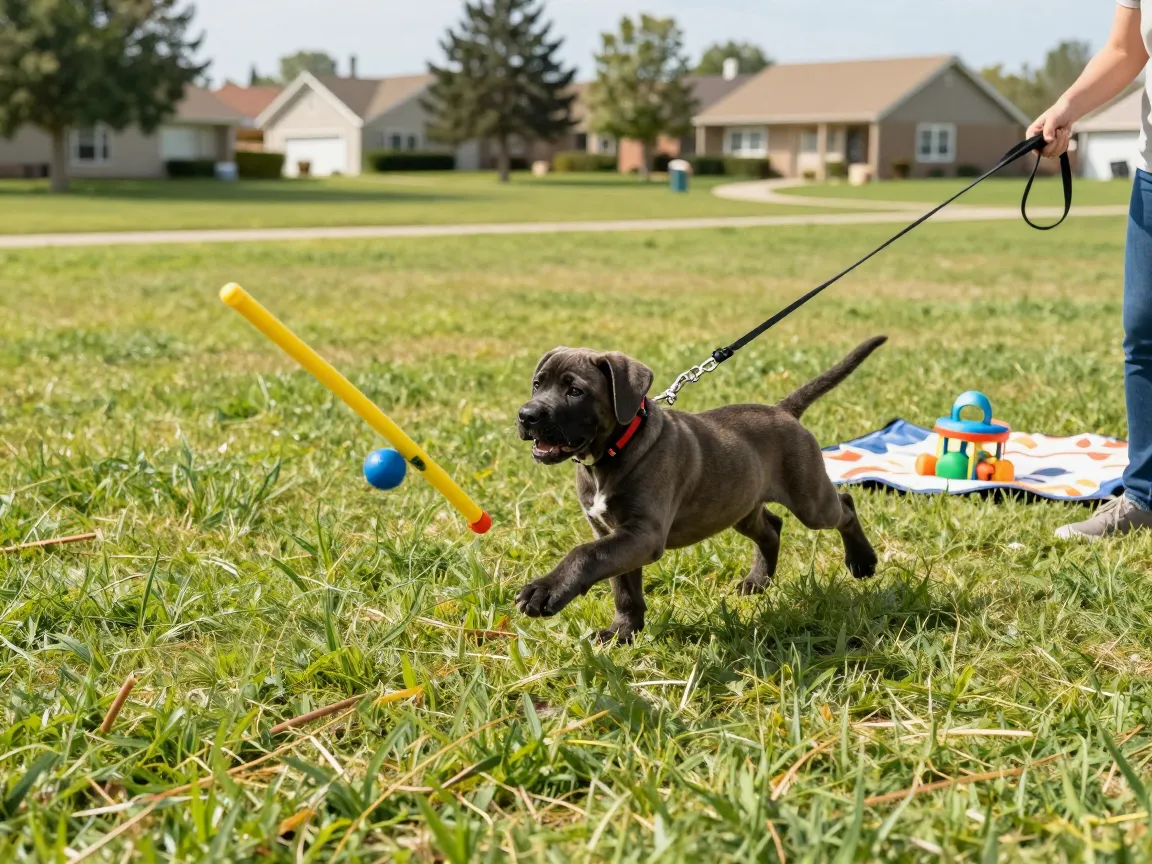
The safest approach is several short walks rather than one long outing. Most guidance recommends 10 to 20 minute leash walks, two to three times daily, rather than extended hikes or jogging sessions. Forced running alongside a bike, repeated stair climbing, and jumping from heights should all be avoided until a veterinarian confirms the growth plates have closed, generally after the 18-month mark.
This does not mean puppies should sit still. Mental stimulation matters just as much as physical activity for a working breed this intelligent. Flirt-pole games in short bursts, scent-based searching exercises, and food puzzle toys give a Cane Corso puppy an outlet for energy without pounding on developing joints. A tired brain produces a calmer puppy just as effectively as a tired body, often with far less orthopedic risk.
A simple rule many trainers now recommend: five minutes of structured exercise per month of age, twice a day, is a safe ceiling for puppies under a year old. A four-month-old puppy, for example, would top out around 20 minutes per session. This keeps activity proportional to physical development rather than to the dog’s apparent enthusiasm, which is almost always higher than its joints can safely support.
3. Start Crate Training And Household Boundaries Early
A Cane Corso that has never been taught boundaries in puppyhood becomes very difficult to manage once it weighs 100 pounds. This is why current AKC-aligned training guidance treats crate training and clear household rules as non-negotiable steps that should begin the first week a puppy comes home, not months later once problem behaviors appear.
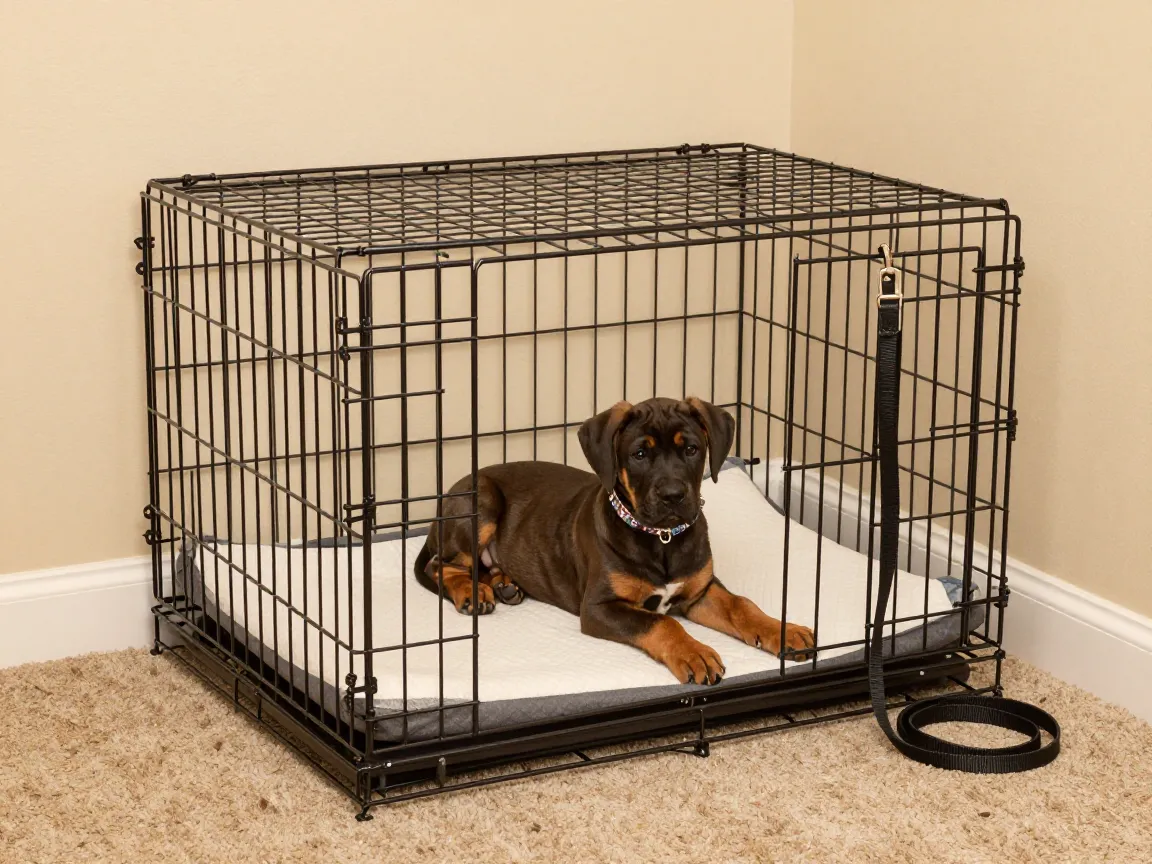
Crate training gives a puppy a predictable, secure space and speeds up house-training, but its real value with a dominant guardian breed is teaching impulse control. A puppy that learns to settle calmly in a crate, wait for meals, and walk politely on a leash internalizes an important lesson: the humans in the household set the pace, not the dog. Breed-specific trainers describe over-coddling, meaning letting a puppy demand attention, jump on furniture uninvited, or push through doorways first, as one of the fastest routes to an entitled, hard-to-handle adult Cane Corso.
Practical household setup supports this from day one. Current safety checklists recommend a heavy-duty 48 to 54 inch crate with a divider panel that grows with the puppy, a properly fitted martingale collar, and a standard 6-foot leash rather than a retractable lead, which offers far less control over a breed capable of significant pulling force even at five months old. A securely fenced yard, ideally at least 6 feet high, is equally important given how quickly a young Cane Corso can clear lower barriers once it gains confidence and muscle.
Interactions with children deserve special attention. Even a friendly, well-socialized Cane Corso puppy is physically strong enough to knock over a small child during normal play, so supervision during every child-puppy interaction is essential, not optional.
4. Master The Critical Socialization Window Between 3 And 16 Weeks
If there is one non-negotiable among the 6 Essential Steps For Raising Healthy And Confident Cane Corso Puppies, it is socialization during the earliest weeks of life. Behavioral scientists and breed experts consistently place the critical socialization window between 3 and 16 weeks of age, with some breeder references narrowing the most sensitive period to 3 through 14 weeks.
During this window, a puppy’s brain is unusually open to forming positive associations with new experiences. Exposure that happens now, when paired with treats and calm body language, tends to stick for life. The same exposure introduced at two years old often triggers suspicion instead of curiosity. That is why guardian breeds specifically need deliberate, front-loaded socialization rather than the casual “they’ll get used to it” approach that works fine for more easygoing breeds.
A well-rounded socialization list for this age should include:
- People of varied ages, ethnicities, and appearances, including individuals wearing hats, uniforms, sunglasses, or carrying umbrellas.
- Other dogs of different sizes and energy levels, always screened for stability and gentleness before any interaction.
- Environments ranging from quiet residential streets to busier urban sidewalks, parking lots, and rural settings.
- Sounds such as traffic noise, thunder recordings, vacuum cleaners, and construction equipment, introduced at low volume first.
- Surfaces including grass, gravel, tile, metal grates, and stairs, since novel footing is a common source of adult-dog anxiety.
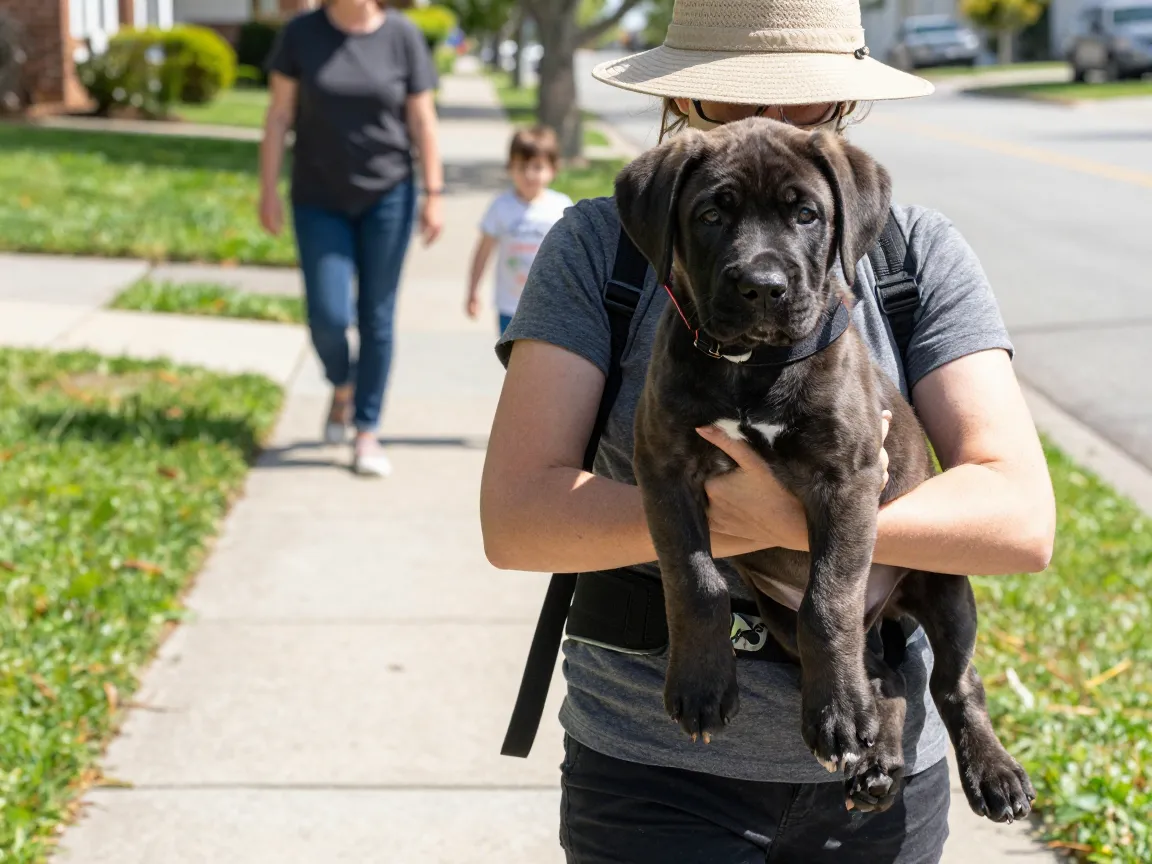
Because full vaccination is not complete until around 16 weeks, current guidance recommends a practical compromise: carry puppies in public spaces using a wagon or by holding them, rather than letting them walk where unknown dogs frequent. This allows exposure to sights, sounds, and low-risk social contact without gambling on disease exposure at a vulnerable age.
5. Follow A Structured Daily Socialization Schedule
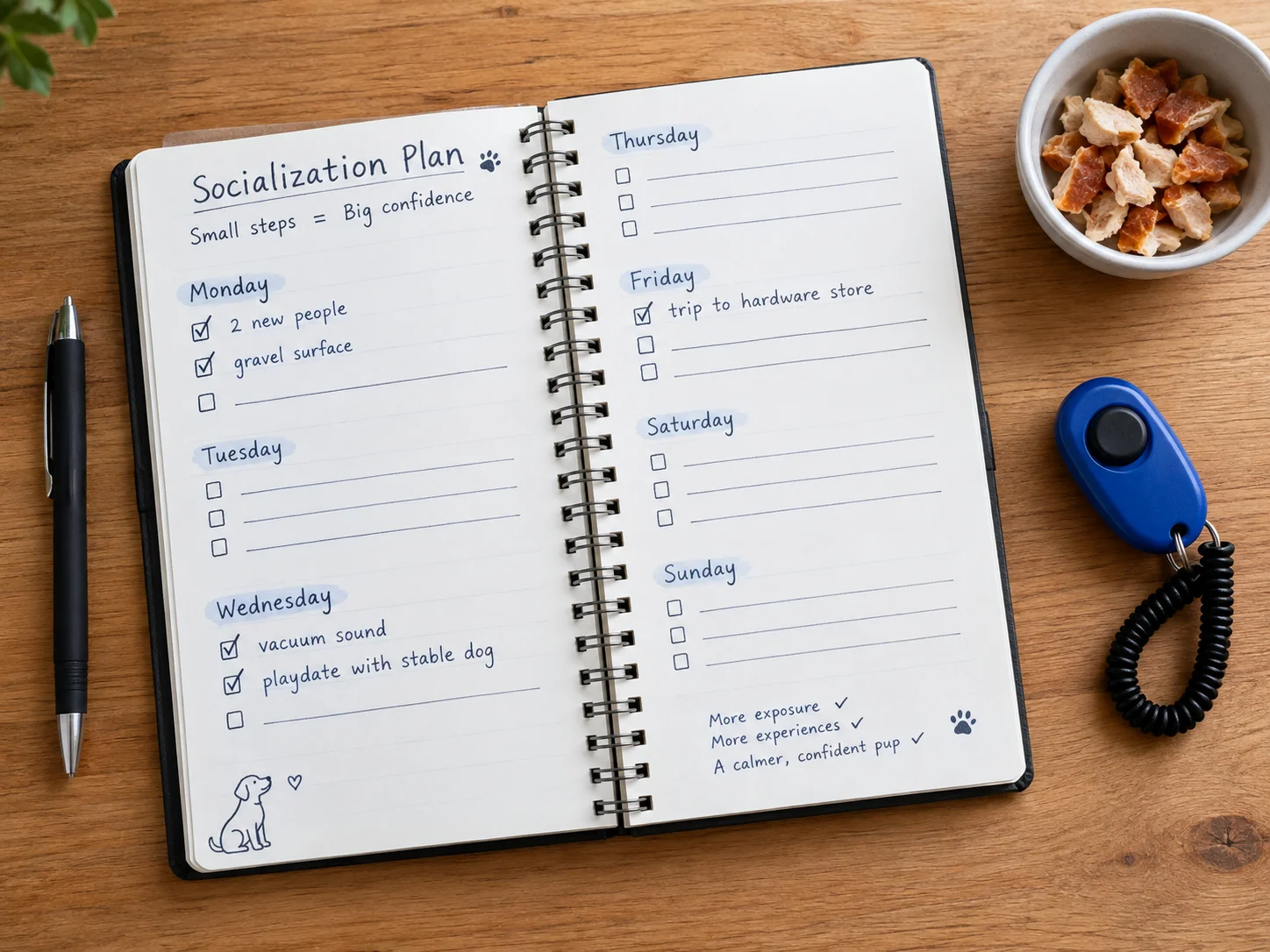
Random outings are better than nothing, but 2025 and 2026 socialization research points toward something more effective: a structured, measurable daily plan. Instead of hoping a puppy encounters enough new things, owners are now encouraged to set concrete daily targets.
A commonly recommended target is 3 to 5 new people, surfaces, or sounds per day between roughly 8 and 16 weeks. This turns socialization into a checklist rather than a vague intention, which matters enormously during the narrow window when it counts most. High-value treats, meaning something more exciting than regular kibble, such as small pieces of chicken or cheese, should be used to pair each new experience with a positive feeling.
Just as important as hitting a daily quota is avoiding the opposite mistake: flooding. Flooding happens when a puppy is overwhelmed with too much novelty at once, such as a chaotic dog park visit or a crowded festival, and shuts down or becomes fearful instead of curious. The goal is controlled, positive exposure, not maximum exposure.
A simple weekly structure might look like this:
- Structured01 Monday and Tuesday. Two new people and one new surface, introduced calmly at home or on a quiet walk, paired with treats.
- Structured02 Wednesday and Thursday. One new sound played at low volume indoors, plus a short supervised interaction with a stable, vaccinated dog.
- Structured03 Friday through Sunday. A short outing to a new but calm environment, such as a hardware store or a quiet park, carried or kept on leash depending on vaccination status.
This kind of threshold-based approach also applies to reactivity prevention. Trainers now emphasize finding the exact distance at which a puppy notices a person or dog but can still take a treat and respond to its name. Working within that comfortable zone, then gradually shrinking the distance over repeated sessions, builds calm confidence far more reliably than forcing close contact before the puppy is ready.
6. Continue Socialization And Grooming Handling Through Adolescence
Socialization does not end at 16 weeks. This is perhaps the most overlooked of the 6 Essential Steps For Raising Healthy And Confident Cane Corso Puppies, and the one most likely to be dropped once a puppy starts looking like an adult dog. Guardian breeds mature slowly, and social maturity in a Cane Corso typically arrives between 12 and 18 months, sometimes later.
Territorial and guarding instincts often resurface during adolescence, even in puppies that seemed perfectly friendly at four months old. A dog that happily greeted strangers as a baby may suddenly bark at the mail carrier or stiffen around unfamiliar dogs at eight months. This is a normal developmental stage, not a sign that early socialization failed, but it does mean neutral, reward-based exposure needs to continue well past puppyhood. Vet visits, dog-friendly cafes, calm playdates with known stable dogs, and regular walks through varied environments should remain part of the routine through at least the first 18 months.
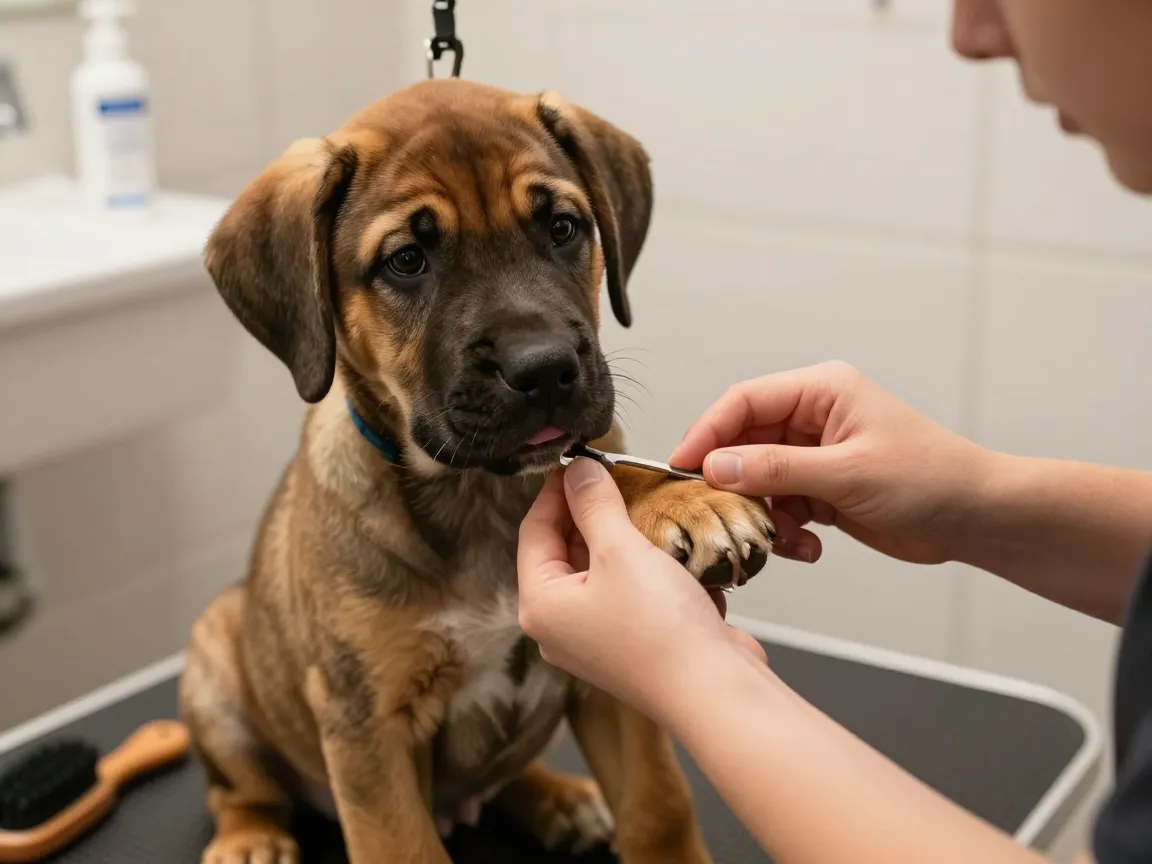
Grooming and physical handling deserve equal attention during this stretch, because they double as confidence-building exercises. Starting around 8 to 12 weeks, owners should practice gently handling paws, ears, and the mouth, so the puppy learns that touch and light restraint predict good things rather than conflict. This pays off directly in the grooming routine a Cane Corso needs for life:
| Grooming Task | Frequency | Purpose |
|---|---|---|
| Brushing | Weekly | Removes loose hair, distributes skin oils |
| Ear cleaning | Weekly | Prevents infection in deep drop ears |
| Bathing | Every 4 to 8 weeks | Maintains coat and skin health |
| Nail trims | Every 2 to 3 weeks | Prevents joint stress from overgrown nails |
| Wrinkle cleaning (blue or fawn dogs) | 2 to 3 times weekly | Prevents skin fold irritation |
A puppy that has been handled calmly and often will tolerate these routine tasks as an adult without a struggle, which matters considerably once the dog weighs more than most household members.
Frequently Asked Questions About Raising Cane Corso Puppies
How much exercise does a Cane Corso puppy actually need?
Short, frequent sessions beat long ones. Two to three walks of 10 to 20 minutes daily, plus brief mental enrichment games, is generally sufficient until 18 months, when a veterinarian can confirm the growth plates have closed and higher-impact activity is safe.
When should socialization start?
As early as possible within the breeder’s or shelter’s health guidelines, ideally beginning at 8 weeks and continuing intensively through 16 weeks, then tapering into ongoing maintenance through 18 months of age.
Is crate training necessary for such a large breed?
Yes. A crate gives a growing Cane Corso a secure space and directly supports house-training and impulse control, both of which become significantly harder to teach once the dog reaches full adult size and strength.
What is the biggest health risk during puppyhood?
Uncontrolled growth from overfeeding or excessive high-impact exercise is the leading contributor to hip and elbow dysplasia in this breed, making portion control and joint-safe activity two of the most important preventive measures available to owners.
Conclusion: Putting The 6 Essential Steps For Raising Healthy And Confident Cane Corso Puppies Into Action
Raising a Cane Corso well is less about any single dramatic decision and more about consistent, informed choices repeated daily during a fairly narrow window of opportunity. Controlled nutrition protects the skeleton. Joint-safe exercise prevents lifelong orthopedic pain. Crate training and household boundaries build a dog that respects structure rather than one that demands its own way. Early, structured socialization, continued through adolescence, produces a Cane Corso that meets the world with curiosity instead of suspicion.
None of these six steps works in isolation, and skipping any one of them tends to undermine the rest. A physically healthy puppy that was never socialized often becomes fearful or reactive. A well-socialized puppy raised on poor nutrition may still end up lame by age three. The strongest outcomes come from treating all six steps as parts of a single system.
The next move is straightforward. Set a feeding schedule with a large-breed formula before the puppy comes home, buy a properly sized crate and a 6-foot leash in advance, and build a written daily socialization checklist for the first 16 weeks. Small, consistent actions taken now are what separate a nervous, unpredictable adult Cane Corso from a stable, confident guardian that a family can trust for the next decade.