Things To Know Before Adopting A Rare White Golden Retriever Puppy
Search interest in “white golden retriever puppies” has climbed sharply over the past several years, yet no major kennel club has ever recognized white as an official golden retriever coat color. That gap between marketing language and breed reality is exactly why anyone considering this popular pet needs a clear-eyed guide. This article covers 6 things to know before adopting a rare white golden retriever puppy, from color genetics and true rarity to health testing, pricing, and how to spot a responsible breeder in a crowded market.

Disclosure: This post contains affiliate links. As an Amazon Associate, we earn from qualifying purchases, and at no extra cost to you.
Pale, cream-coated golden retrievers are everywhere in 2026, often advertised with words like “rare,” “imported,” or “English cream” to justify premium price tags. Some of that language is accurate description. Much of it is sales strategy aimed at buyers who do not know the difference between a legitimate coat variation and an invented rarity claim. Understanding the facts before signing a deposit check protects both the wallet and, more importantly, the long-term wellbeing of the dog.
Key Takeaways
- “White” golden retrievers are not a separate breed or a genuine rarity; they are golden retrievers at the pale end of the breed’s natural color range.
- Official breed standards do not recognize white as an acceptable color, and extreme paleness is considered a fault in the show ring.
- Health risks, including a high lifetime cancer rate and an average 10 to 12 year lifespan, are the same for pale and standard-colored goldens.
- Reputable breeders prove health commitment through OFA hip, elbow, heart, and eye clearances, not through coat color claims.
- High demand has created long waitlists and premium pricing in 2025 to 2026, making careful breeder vetting essential before adopting.
6 Things To Know Before Adopting A Rare White Golden Retriever Puppy: Color, Rarity, and Breed Standards
Coat color confusion sits at the center of most white golden retriever marketing. Before evaluating a litter or reserving a puppy, it helps to understand what the color actually represents genetically and how kennel clubs classify it. The three points below make up the first half of the 6 things to know before adopting a rare white golden retriever puppy, and they focus squarely on separating fact from sales pitch.
1. White Golden Retrievers Are Not A Separate Breed

A golden retriever with a very pale, near-white coat is genetically identical to any other golden retriever in every meaningful way except shade of fur. The color comes from natural variation within the breed’s pigment genetics, not from crossbreeding, a rare mutation, or a distinct bloodline. Many of these pale-coated dogs are marketed as “English cream golden retrievers,” a term that refers loosely to lines bred in Europe with historically lighter coats, but it does not describe a scientifically distinct type of dog.
Buyers sometimes assume a lighter coat signals a purer or older bloodline. That assumption is not supported by breed history. Golden retrievers have always displayed a range of shades from cream to deep red, and breeders on both sides of the Atlantic have selected for different points on that spectrum for decades. A pale puppy from an American breeder and a pale puppy from a European import program can be equally healthy, equally well-bred, or equally poorly bred. Coat shade alone reveals nothing about the quality of the breeding program behind the dog.
2. Breed Standards Do Not Recognize White As A Color

Every major kennel club that maintains a golden retriever breed standard describes acceptable coat colors using terms like light golden, golden, and dark golden. None of them list white as a standard or acceptable shade. In fact, most standards specifically caution against colors that are “extremely pale” or “extremely dark,” treating both ends of the spectrum as departures from the ideal rather than desirable variations.
This matters for two practical reasons. First, a dog advertised as “white” that is later shown in conformation competition may be penalized by judges for falling outside the accepted color range, even if the dog is structurally excellent. Second, breeders who lean heavily on “white” as a selling point are often prioritizing a marketable trait over the traits breed standards actually reward, such as structure, movement, and temperament. Anyone planning to show a puppy competitively should ask directly how a pale coat might be judged before falling in love with the color alone.
“Extremely pale or extremely dark colors are undesirable” is standard breed-standard language across major golden retriever clubs, a detail many marketing pages leave out entirely.
3. These Puppies Are Not Genuinely Rare In 2026

Despite the word “rare” appearing constantly in listings, pale golden retrievers are being bred in large numbers across the country and internationally. Numerous breeding programs specialize almost exclusively in producing light-coated litters, and waitlists exist not because the color is scarce but because demand has outpaced the number of litters born at any given time. A true rarity implies limited genetic availability. What actually exists here is high consumer demand meeting a widely available, easily produced coat variation.
Recognizing this distinction changes how a buyer should approach pricing and urgency. A breeder who frames a litter as “extremely rare, act fast” is using a persuasion tactic, not stating a biological fact. Comparing several breeders, checking how frequently they produce litters, and asking how many similar puppies have been placed in the past year usually reveals a much less scarce situation than the marketing suggests.
Once the color and rarity myths are addressed, attention should shift to the factors that actually determine a puppy’s quality of life: health testing, realistic cost expectations, and breeder due diligence. These final three points complete the 6 things to know before adopting a rare white golden retriever puppy and are arguably the most important for long-term outcomes.
4. Health Risks Are Identical Regardless Of Coat Shade

Golden retrievers as a breed carry one of the highest lifetime cancer rates of any dog breed, with studies putting the figure well above 50 percent across the breed’s lifespan. Average life expectancy sits around 10 to 12 years. These statistics apply to every golden retriever, whether the coat is deep red or nearly white. There is no credible veterinary or genetic evidence showing that pale or “English cream” goldens are healthier, longer-lived, or less prone to cancer than any other shade within the breed.
This point deserves emphasis because some sellers imply the opposite, suggesting that imported or cream-line dogs come from “healthier European stock.” Health outcomes are driven by individual bloodline genetics, breeder health testing practices, and environmental factors like diet and weight management, not by coat pigment. A buyer choosing a pale puppy for perceived health advantages is making a decision based on a myth rather than data.
5. Genetic Testing And OFA Clearances Matter More Than Color
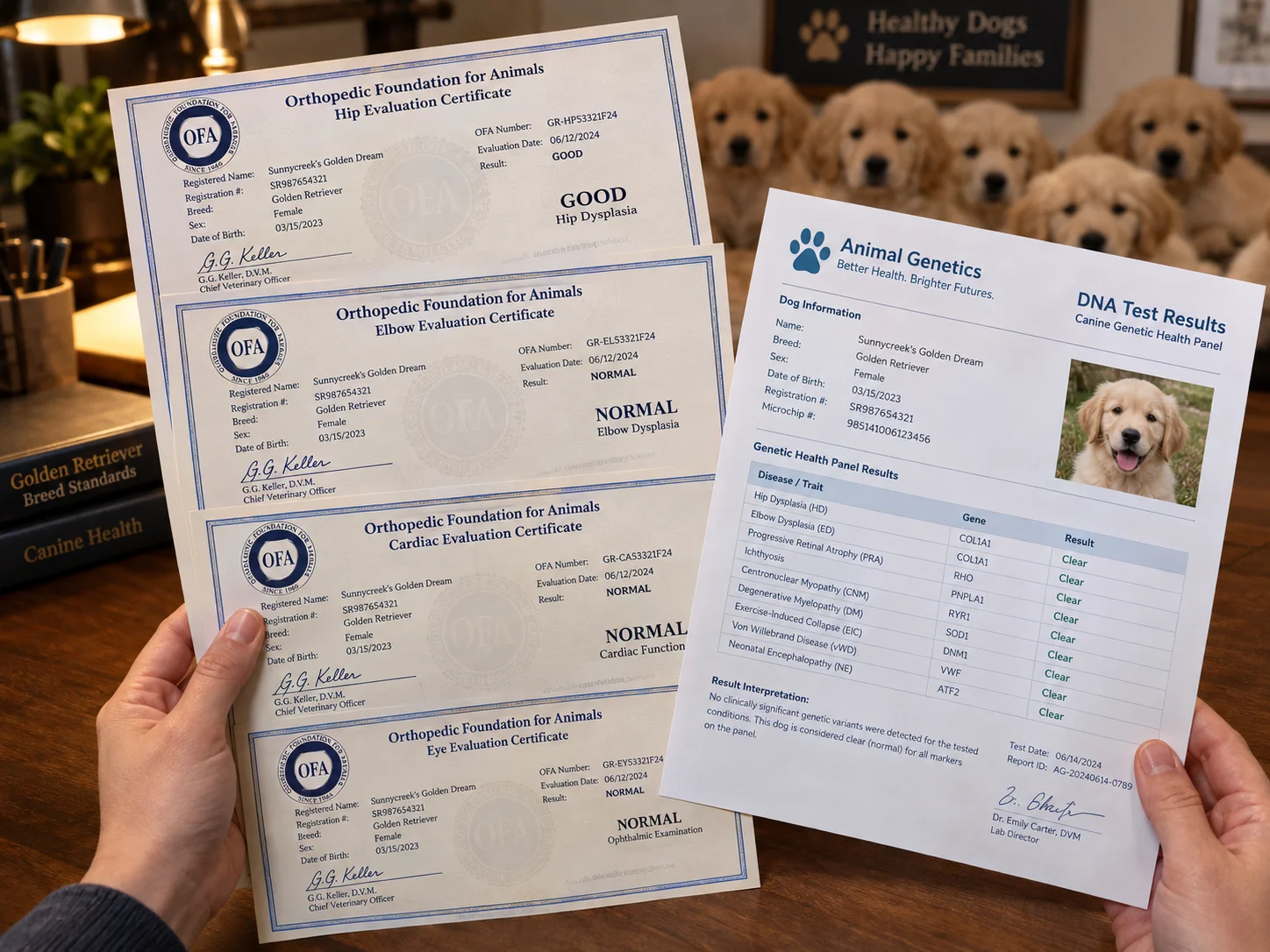
The single most reliable signal of a responsible breeder is proof of health testing, not coat description. Reputable breeders, including those specializing in pale or English cream lines, prominently display documentation from the Orthopedic Foundation for Animals (OFA) covering hips, elbows, heart, and eyes. Many also test for genetic conditions common in the breed, such as progressive retinal atrophy and ichthyosis, through DNA panels.
The table below outlines what to expect from a health-conscious breeder versus a breeder relying mainly on color marketing.
| Factor | Responsible Breeder | Color-Focused Marketing |
|---|---|---|
| Health documentation | OFA hip, elbow, heart, and eye clearances shown publicly | Vague claims like “healthy lines” with no paperwork |
| Genetic testing | DNA panels for known breed conditions | Rarely mentioned or offered on request only |
| Coat color language | Described accurately as light or cream, not “rare white” | “Rare white” or “extremely rare” used as selling point |
| Litter frequency | Reasonable spacing between litters, limited breeding females | Frequent litters marketed as constantly available |
| Buyer transparency | Willing to share parent health records and vet contacts | Reluctant to provide documentation or references |
A buyer who receives copies of OFA certificates, sees the sire and dam’s clearance numbers, and can independently verify them through the OFA database is dealing with a breeder who prioritizes the dog’s wellbeing over a color trend. A breeder who cannot or will not provide this documentation should be treated as a red flag, regardless of how appealing the puppy photos look.
6. Expect Premium Pricing, Waitlists, And Careful Vetting

Between 2025 and 2026, pale and English cream golden retriever puppies have consistently commanded higher prices than standard-colored littermates from comparable breeding programs, often due to the perceived exclusivity discussed earlier. High demand has also produced long waitlists, with some reputable breeders booking litters six months to a year in advance. This environment makes it easier for opportunistic sellers to charge premium prices without offering premium health practices.
Before committing a deposit, prospective owners should take several concrete steps.
Ask for OFA clearance numbers and verify them independently rather than accepting a breeder’s word alone.
Request to see the puppy’s living environment, either in person or through a live video call, to confirm clean, humane conditions.
Compare pricing across several breeders in the same region to identify whether a quote reflects genuine health investment or simply color-based markup.
Ask how many litters the breeding female has had and how much rest time exists between litters, since responsible programs limit breeding frequency.
Confirm a written contract exists covering health guarantees, spay or neuter expectations, and a return policy if the puppy cannot be kept.
Speaking with previous buyers, checking breed club referral lists, and visiting in person whenever feasible remain the most effective ways to separate a well-run program from one simply capitalizing on a popular color trend.
Temperament Claims Deserve The Same Scrutiny As Color Claims
Marketing for pale and English cream golden retrievers frequently describes the temperament as calmer, gentler, or more laid-back than standard golden retrievers. This claim is not supported by controlled behavioral research. Temperament in golden retrievers is shaped primarily by individual genetics, early socialization, training consistency, and the specific parent dogs involved, not by coat shade. A hyperactive or anxious pale golden retriever is just as possible as a calm, easygoing red-coated one.
That does not mean temperament is unpredictable or unimportant. Meeting the puppy’s parents, asking the breeder detailed questions about each parent’s personality, and observing how puppies interact with people and littermates all provide far more useful information than any coat-related marketing language. Buyers who prioritize temperament should ask breeders about early neurological stimulation exercises, exposure to varied sounds and environments, and how puppies are handled in the first eight weeks of life.
Registration, Showing, And Breeding Considerations
Anyone with ambitions beyond companionship, such as conformation showing or future breeding, should think carefully about how a pale coat interacts with breed standards. Registration with a national kennel club does not require a specific coat color, so a white-coated puppy can typically still be registered as a golden retriever without issue. Competitive showing is a different matter, since judges evaluate dogs against the written breed standard, and an extremely pale coat may be marked down even when every other trait is exceptional.
Owners interested in breeding down the line should also understand that pairing two extremely pale parents does not guarantee pale puppies, nor does it improve health outcomes. Color genetics in golden retrievers involve multiple interacting genes, and litters from pale parents can still include a range of shades. Anyone considering breeding should prioritize health clearances and structural soundness over chasing a specific coat color, both for the sake of the breed standard and the wellbeing of future litters.
What The Future Likely Holds For White Golden Retriever Popularity
Demand for pale and English cream golden retrievers shows no signs of slowing heading further into 2026 and beyond. Social media visibility, aesthetic appeal, and continued marketing around “rare” coloring all point toward sustained interest. At the same time, ongoing cancer research within the breed, including large-scale lifetime studies tracking health outcomes across coat colors and bloodlines, is likely to keep reinforcing an important message: coat shade is cosmetic, while genetic health testing is the factor that actually protects a dog’s quality of life.
Buyers who internalize this distinction now are better positioned to make informed decisions regardless of where color trends go next. A breeder’s commitment to OFA testing, transparent documentation, and responsible litter spacing will remain relevant even if a different coat color becomes fashionable in future years.
Frequently Asked Questions
Are white golden retrievers a recognized breed or variety?
No. They are golden retrievers with a naturally pale coat. No major kennel club recognizes white as a separate breed, variety, or official color classification.
Do pale or English cream golden retrievers live longer than standard golden retrievers?
There is no credible evidence supporting this claim. Lifespan and cancer risk are consistent across the breed regardless of coat shade, averaging around 10 to 12 years with a high lifetime cancer incidence.
Why do white golden retriever puppies cost more?
Pricing is driven primarily by demand and marketing around perceived rarity, not by documented health or genetic superiority. Reputable breeders’ pricing should still reflect real costs like health testing, not color alone.
Can a white golden retriever be shown in conformation competitions?
Yes, but judges evaluate dogs against the written breed standard, which considers extremely pale coats undesirable. A very light coat may affect placement even if other traits are strong.
How can a buyer verify a breeder’s health testing claims?
Ask for OFA clearance numbers for hips, elbows, heart, and eyes, then verify them directly through the OFA’s public database rather than relying on the breeder’s description alone.
Conclusion
Choosing a pale-coated puppy can absolutely be a wonderful decision, but it should be made with accurate information rather than marketing language. Reviewing the 6 things to know before adopting a rare white golden retriever puppy shows that coat color reflects natural breed variation, not a separate breed or a guaranteed health or temperament advantage. What genuinely matters is breeder transparency, documented OFA and genetic health clearances, realistic pricing tied to responsible practices, and honest expectations about lifelong health risks like cancer that affect every golden retriever regardless of shade.
Prospective owners should move forward deliberately: request and verify health documentation, meet the puppy’s parents whenever possible, compare multiple breeders rather than settling for the first available litter, and resist urgency created by “rare” marketing claims. A well-informed approach protects both the new owner’s investment and, most importantly, sets a beloved future companion up for the healthiest possible life.