Black Labrador Retriever Traits That Make Them The Perfect Family Dog
Nearly one in four dogs registered with major kennel clubs each year is a Labrador Retriever, and black remains the breed’s original, dominant coat color. That popularity is not an accident of fashion. Families keep choosing this breed generation after generation because of a specific combination of temperament traits that rarely shows up together in one dog. This article breaks down the 6 Black Labrador Retriever Traits That Make Them The Perfect Family Dog, explains why each one matters in a real household, and offers practical guidance for families deciding whether this breed fits their home.

Disclosure: This post contains affiliate links. As an Amazon Associate, we earn from qualifying purchases, and at no extra cost to you.
A black Labrador is not simply a yellow or chocolate Lab with a different coat. The color carries no separate personality profile, but the traits that make Labradors the most recommended family breed by veterinarians and trainers alike are on full display in black-coated dogs, many of whom dominate working, service, and companion roles worldwide. Understanding these traits helps prospective owners set realistic expectations and helps current owners get the most out of the relationship.
Key Takeaways
- Black Labradors combine friendliness, intelligence, and patience in a way that few breeds match, making them consistently ranked among the best family dogs.
- Their high trainability supports safety around children, faster obedience learning, and smoother integration into busy households.
- Daily physical activity is not optional; without it, their playful energy can turn into restlessness or destructive behavior.
- Their social, non-aggressive nature makes them poor guard dogs but exceptional companions for first-time owners, multi-pet homes, and children.
- Coat color does not change core temperament, but black Labradors are heavily represented in family, therapy, and working roles, proving the traits hold up in real-world use.
The 6 Black Labrador Retriever Traits That Make Them The Perfect Family Dog
Every trait below has been observed consistently by breed clubs, veterinary behaviorists, and long-term owner surveys. Together, they explain why this breed has topped family dog recommendation lists for decades.
1. Exceptionally Friendly and Social Temperament With Kids and Other Pets

The single most cited reason families choose a black Labrador Retriever is its instinctive friendliness. This is not a trained behavior; it is baked into the breed’s genetic history as a companion and retrieving dog bred to work closely alongside people rather than independently guard territory.
Black Labradors typically greet strangers, children, and unfamiliar dogs with curiosity rather than suspicion. This social openness makes them remarkably easy to introduce into homes with existing pets, visiting relatives, or a rotating cast of children’s friends. Multi-pet households in particular benefit from this trait, since a Lab’s easygoing nature reduces the friction that often comes with introducing a new animal into an established pack.
Families with toddlers or young children often report that their black Lab seems to instinctively soften its play style around smaller humans, a behavior consistent with the breed’s long history as a gentle, people-focused companion.
2. High Trainability and Intelligence That Support Family Safety

Labrador Retrievers consistently rank among the top five most trainable dog breeds according to canine intelligence rankings based on working and obedience trials. Black Labs share this trait fully, and it translates into real safety benefits at home.
A highly trainable dog learns basic commands like sit, stay, and leave it faster, which matters enormously when small children are nearby or when the dog needs to be called away from a hazard. This intelligence also means black Labradors respond well to structured routines, crate training, and leash manners, reducing the everyday friction that comes with dog ownership.
Trainability also supports long-term family harmony. A dog that reliably respects boundaries around food, furniture, and personal space causes far fewer household conflicts than one that must be constantly managed. Because black Labs are eager to please and food-motivated, positive reinforcement methods tend to work exceptionally well, making them a good match even for first-time dog owners who lack advanced training experience.
3. Strong Family Bonding and a People-Oriented Personality
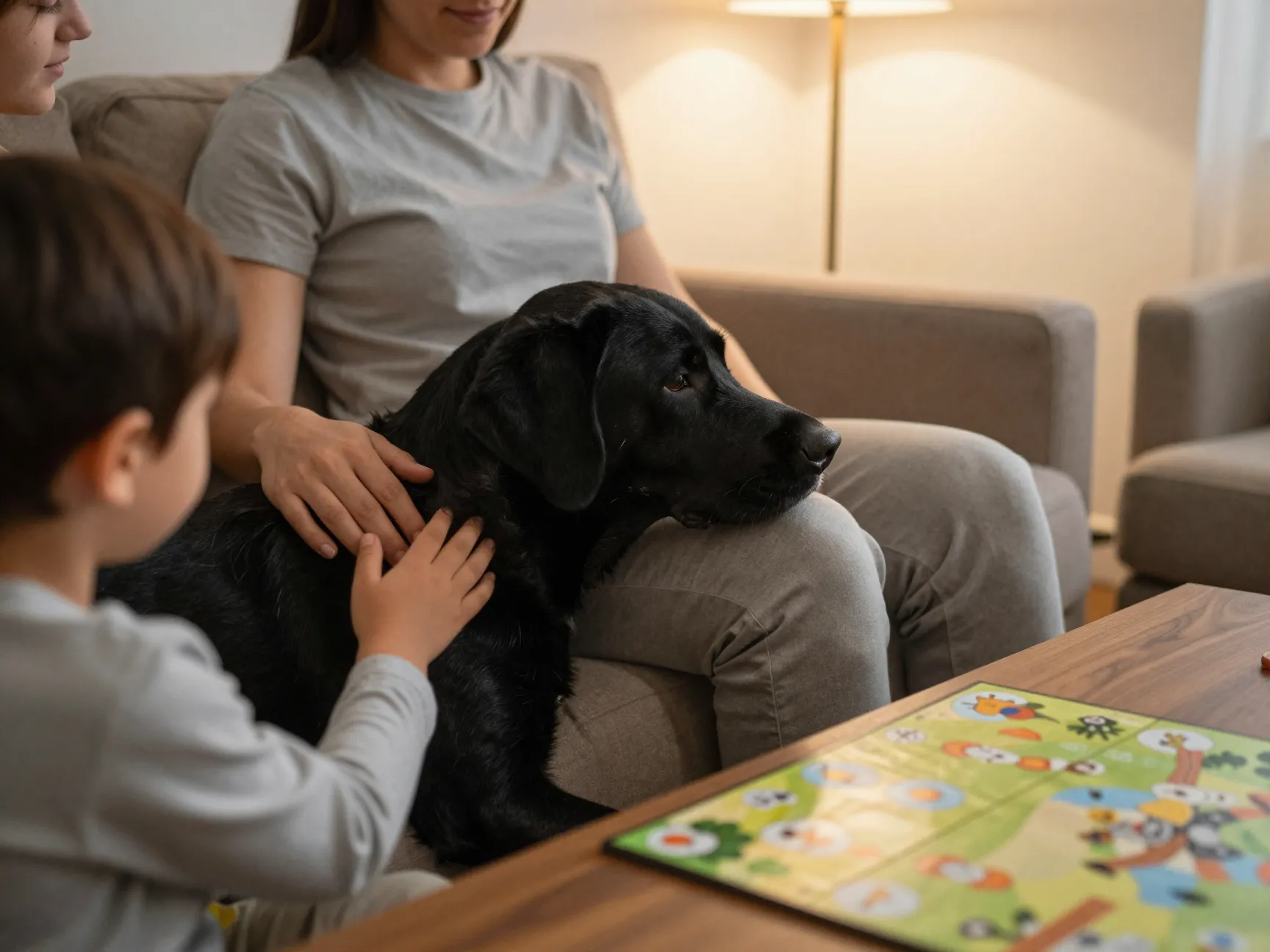
Labradors were developed to work in close partnership with humans, first as fishing and retrieving companions in Newfoundland and later as gundogs in England. That history shows up today as an intense, people-oriented personality. Black Labradors tend to bond deeply with every member of the household rather than fixating on a single owner, which is common in more one-person breeds.
This loyalty manifests as a dog that wants to be present for family activities, from car rides to backyard barbecues to quiet evenings on the couch. Owners frequently describe their black Lab as a genuine member of the family rather than simply a pet, a sentiment reinforced by the breed’s tendency to check in visually with family members and seek physical closeness.
“A well-adjusted Labrador does not just tolerate family life. It actively seeks it out, following household members from room to room simply to stay close.”
This bonding also supports emotional benefits for children. Kids who grow up with a loyal, affectionate dog often develop stronger empathy and responsibility skills, and a black Labrador’s consistent affection provides a steady emotional anchor during the ups and downs of childhood.
4. Playful, Energetic Nature Suited to Active Families

Black Labradors are working dogs at heart, and that means real physical energy. Most adult Labs need 60 to 90 minutes of exercise daily, split between walks, fetch sessions, and off-leash play when possible. This trait is a double-edged strength: it makes them ideal companions for families who hike, run, swim, or simply have an active household with children who want a playmate, but it becomes a liability for families expecting a low-maintenance couch dog.
The table below outlines what this energy level typically requires versus what happens when exercise needs go unmet.
| Exercise Provided Daily | Typical Behavior Outcome |
|---|---|
| 60 to 90 minutes of activity | Calm, settled, well-mannered indoors |
| 30 minutes or less | Restlessness, excessive chewing, jumping |
| Structured play plus mental tasks | Faster obedience, reduced anxiety |
| Irregular or inconsistent activity | Unpredictable energy spikes, poor focus |
Families with a fenced yard, nearby park access, or an active outdoor lifestyle tend to see the best results from this trait. Black Labradors also excel at retrieving games, swimming, and dog sports like agility, giving families a built-in structure for burning off energy while strengthening the human-dog bond.
5. Gentle Mouth and Patience That Make Them Good With Children

Labrador Retrievers were bred specifically to retrieve waterfowl without damaging the bird, a task that requires an unusually soft, controlled bite known in the breed world as a “soft mouth.” This trait carries directly into family life. Black Labradors are known for using remarkably gentle pressure when taking treats from a hand, carrying toys, or even mouthing during play, compared to breeds without this specialized retrieving history.
That gentleness, combined with a naturally patient temperament, makes black Labs unusually tolerant of the unpredictable behavior of young children, including tail pulling, stumbling, or loud noises that might provoke a defensive reaction in a more sensitive breed. Patience should never replace supervision, however. Veterinary behaviorists consistently recommend that interactions between any dog and young children, regardless of breed reputation, be actively supervised by an adult. A gentle mouth reduces risk; it does not eliminate the need for careful oversight, especially with dogs under two years old that are still developing full impulse control.
6. Versatility and Adaptability to Many Roles and Living Situations

Few breeds move as fluidly between roles as the Labrador Retriever. Black Labs serve as hunting companions, search and rescue dogs, guide dogs for the visually impaired, therapy animals in hospitals, and simple household pets, often within the same bloodline. This adaptability reflects a temperament that is stable enough to handle new environments, new people, and shifting routines without becoming anxious or reactive.
For families, this versatility translates into practical flexibility. A black Labrador can adjust to apartment living with sufficient exercise, thrive in a large suburban house with a yard, travel well for family vacations, and adapt to changes like a new baby, a move, or a household schedule shift with relatively low stress compared to more rigid or anxious breeds. This adaptability is a major reason black Labradors appear so often as first-choice recommendations for families navigating major life transitions.
Calm Focus and Even Temperament Round Out the Family Dog Profile
Beyond the six core traits above, two supporting qualities deserve mention because they directly reinforce family harmony. Black Labradors display a notably calm, focused temperament once past the puppy and adolescent stages, particularly compared with higher-strung sporting breeds. This calmness under pressure, paired with genuine energy when it is time to play, gives families the best of both worlds: a dog that can settle quietly during homework time or dinner but switches on eagerly for a game of fetch.
Their even-tempered disposition also supports households navigating the challenges of a first pet, a new baby, or the introduction of another animal. Rescue organizations and breeders alike frequently point to this steadiness as the reason black Labradors succeed in homes where a more sensitive or reactive breed might struggle.
One trade-off is worth noting honestly. The same social openness that makes black Labradors wonderful family companions makes them poor guard dogs. A Lab is far more likely to greet an intruder with a wagging tail than a warning growl. Families seeking a protective or territorial dog should look elsewhere; families seeking a warm, trustworthy companion will find this trait to be a feature rather than a flaw.
Why Coat Color Does Not Change Core Family Dog Traits
A common question among prospective owners is whether coat color affects personality. Genetically, coat color in Labrador Retrievers is determined by a small set of pigment genes that have no established link to temperament, intelligence, or trainability. Black, yellow, and chocolate Labradors from the same litter can show the full range of personalities described above, and there is no scientific basis for claiming one color is calmer, friendlier, or smarter than another.
What is true is that black remains the historically dominant and most common color in the breed, and black Labradors are heavily represented among working dogs, service dogs, and field trial champions. This strong representation in demanding working roles offers indirect but meaningful evidence that the core family dog traits, trainability, focus, gentleness, and social ease, hold up consistently in black-coated individuals specifically, not just in the breed as a whole.
Some anecdotal owner reports suggest chocolate Labradors show slightly higher rates of certain behavioral quirks, though most veterinary behaviorists attribute this to breeding practices and popularity-driven overbreeding of chocolate lines rather than coat color itself. For families choosing specifically among coat colors, temperament testing of the individual puppy and a look at the breeder’s track record matter far more than color.
Is a Black Labrador Retriever the Right Family Dog for You
Understanding the 6 Black Labrador Retriever Traits That Make Them The Perfect Family Dog is only useful if a family can honestly assess whether their lifestyle matches what the breed needs in return. The traits above are strengths, but they come with real responsibilities.
Consider the following factors before bringing a black Labrador into a family home.
- Available time for daily exercise. A sedentary household without at least an hour of daily activity capacity will struggle to manage a Lab’s energy.
- Space considerations. Apartments can work with strict exercise routines, but houses with yards make daily management noticeably easier.
- Presence of young children. The breed’s gentleness is a major asset, but adult supervision during all dog-child interactions remains essential regardless of breed reputation.
- Long-term commitment. Labradors typically live 10 to 14 years and need consistent training, feeding, and veterinary care throughout that span.
- Grooming and shedding tolerance. Black Labs shed heavily twice a year and moderately year-round, requiring regular brushing to manage loose fur around the home.
Families who can meet these needs consistently tend to report extremely high satisfaction with black Labrador ownership, often citing the breed’s loyalty and easy temperament as the deciding factor in choosing another Lab after their first.
Practical Tips for Raising a Black Labrador in a Family Setting
Getting the most out of these six traits requires some intentional effort from the household. The following practices help families translate natural breed strengths into a well-adjusted adult dog.
Start obedience training early, ideally within the first few months of bringing a puppy home, to take advantage of the breed’s high trainability while habits are still forming. Use positive reinforcement methods such as treats and praise rather than punishment, since Labs respond far better to reward-based learning.
Establish a consistent daily exercise routine rather than sporadic bursts of activity. A predictable schedule of walks and play sessions helps regulate the breed’s energetic nature and prevents boredom-driven behaviors like chewing or excessive barking.
Supervise young children during every interaction, even with a dog known for gentleness and patience. Teach children early how to approach, pet, and play with the dog respectfully, since even the most tolerant dog has limits.
Introduce other pets gradually and in neutral spaces when possible, leveraging the black Lab’s naturally social disposition to smooth the transition. Provide mental stimulation through puzzle toys, scent games, or basic trick training to complement physical exercise, since intelligence without mental engagement can lead to boredom.
Frequently Asked Questions
Are black Labrador Retrievers more aggressive than other Lab colors?
No. There is no credible evidence linking coat color to aggression in Labrador Retrievers. Temperament is shaped far more by genetics from individual bloodlines, early socialization, and training than by pigment.
Do black Labradors make good guard dogs?
Generally no. Their social, friendly nature toward strangers makes them poor guard dogs, though their size and bark can still provide a mild deterrent effect for some intruders.
How much exercise does a black Labrador Retriever need daily?
Most adult Labs need 60 to 90 minutes of physical activity daily, combining walks, play, and ideally some off-leash or swimming time to fully satisfy their energetic nature.
Is a black Labrador a good choice for a first-time dog owner?
Yes, in most cases. Their high trainability, even temperament, and forgiving nature make them one of the more manageable breeds for owners without prior dog experience, provided exercise needs are met.
Do black Labradors shed a lot?
Yes. They shed year-round with heavier seasonal shedding twice a year, so regular brushing and vacuuming are part of realistic ownership expectations.
Conclusion
The 6 Black Labrador Retriever Traits That Make Them The Perfect Family Dog, friendliness, trainability, loyalty, playfulness, gentleness, and adaptability, explain why this breed has remained one of the most recommended family dogs for decades. These traits are not marketing claims; they are consistent, observable patterns rooted in the breed’s working history and reinforced by generations of family ownership experience.
Coat color does not change this equation. A black Labrador carries the same genetic blueprint for temperament as any other color in the breed, and the strong presence of black-coated dogs in working, therapy, and companion roles confirms that these traits translate reliably into real-world family life.
Families considering a black Labrador should honestly evaluate their capacity for daily exercise, supervision needs around children, and long-term commitment before bringing one home. Those who can meet the breed halfway typically find themselves with a loyal, trainable, and deeply affectionate companion for well over a decade. Anyone ready to take the next step should connect with a reputable breeder or local rescue organization, ask detailed questions about the puppy’s parent temperaments, and start basic training early to build the strongest possible foundation for family life together.