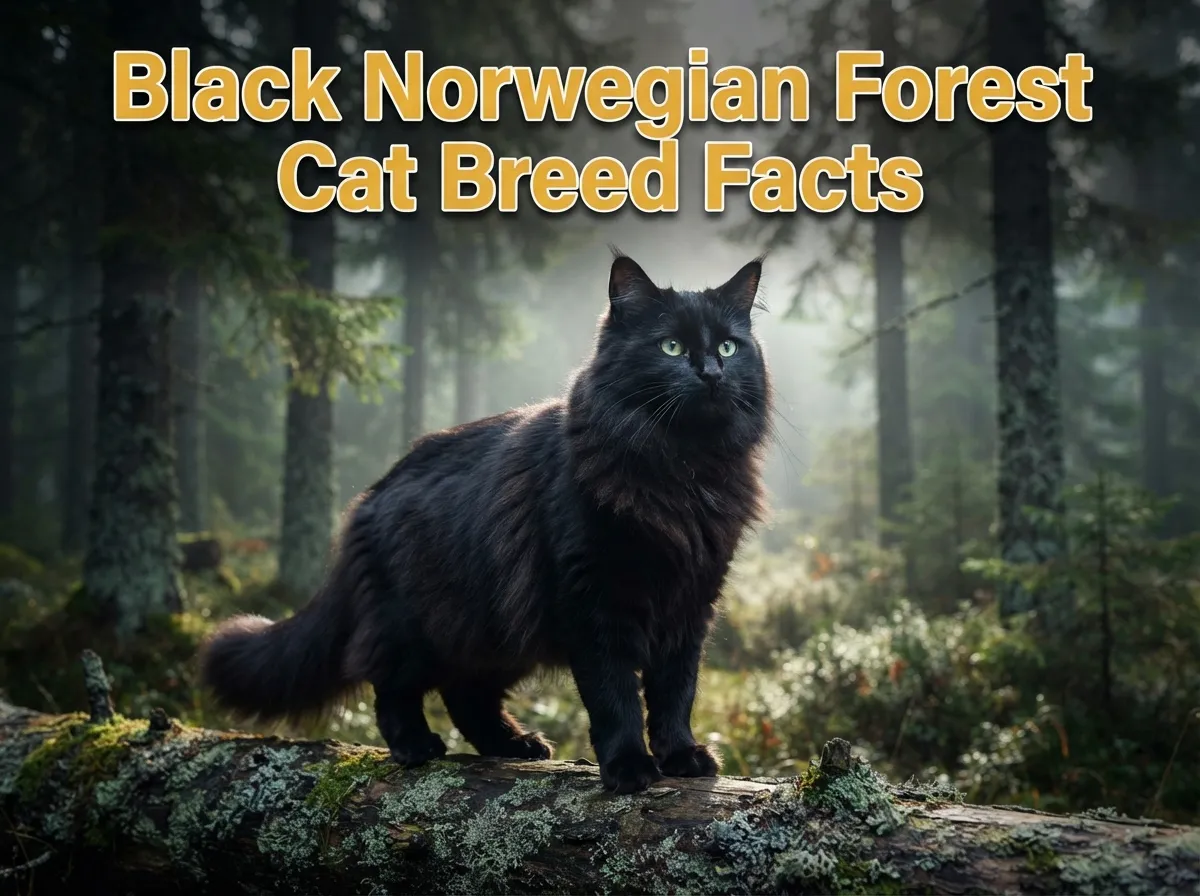
Majestic Facts About The Black Norwegian Forest Cat Breed
A single black Norwegian Forest Cat can weigh as much as a newborn human baby, wear a coat with three distinct layers, and still be mistaken by strangers for a small forest predator. That combination of size, texture, and mystery is exactly why breeders and cat registries report that black has become one of the most requested colors within this already popular Scandinavian breed. This article breaks down 6 Majestic Facts About The Black Norwegian Forest Cat Breed, covering everything from show-ring standards to the surprising color change some black kittens undergo as they mature.
Disclosure: This post contains affiliate links. As an Amazon Associate, we earn from qualifying purchases, and at no extra cost to you.
Whether the goal is choosing a kitten, entering a show, or simply understanding a beloved pet, these six facts offer a grounded, research-based look at what makes this coat color and breed combination so striking. Each section unpacks a different angle, from genetics to temperament, so the full picture of the black Norwegian Forest Cat becomes clear.
Key Takeaways
- Black is currently one of the most sought-after Norwegian Forest Cat colors, with strong demand reported into 2026.
- Show-quality black coats must be dense and evenly colored from root to tip, with no rust or fading.
- Solid black and black smoke are visually distinct patterns, both accepted by major registries as legitimate variations.
- Some black kittens naturally shift toward an amber tone as they mature, a transformation tied to coat genetics.
- The breed’s large build, weatherproof double coat, and calm-but-independent temperament all reinforce its “majestic” reputation, though ownership costs remain relatively high.
The 6 Majestic Facts About The Black Norwegian Forest Cat Breed You Need to Know
Understanding this breed starts with its color story. Black Norwegian Forest Cats are not a separate breed but a color variation within the larger Norwegian Forest Cat standard, prized for the way black fur interacts with the breed’s naturally thick, layered coat. The following three facts explain why black has surged in popularity, what judges look for in a show-quality coat, and how solid black differs from its smoky cousin.
1. Black Is Having a Major Moment in 2026
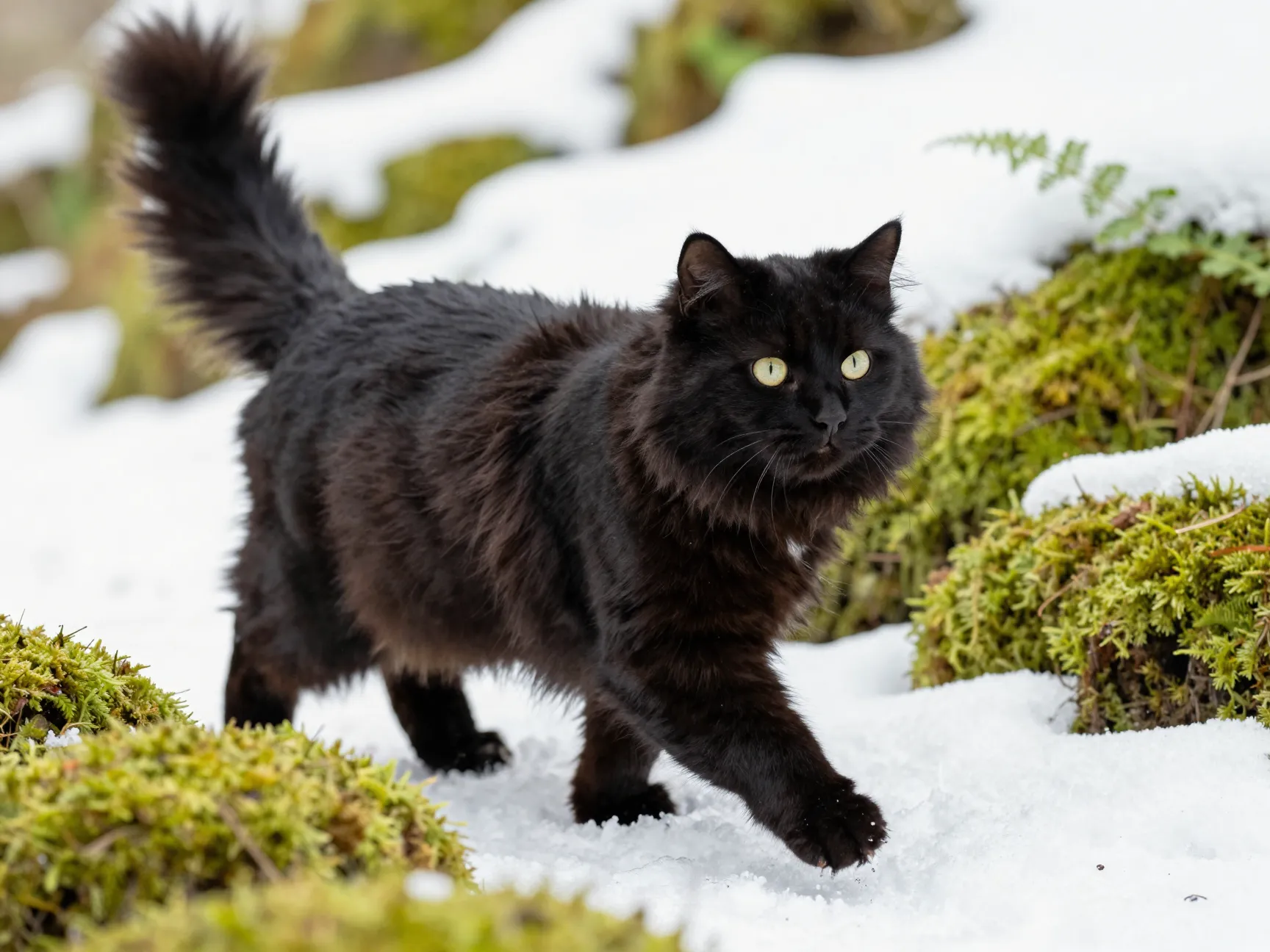
Color trends in the cat fancy shift over time, and black has quietly climbed to the top of many breeders’ waiting lists. Industry observers note that black is now one of the most sought-after Norwegian Forest Cat colors heading into 2026, a shift driven partly by social media and partly by the color’s dramatic contrast against the breed’s signature ruff and long guard hairs.
Several factors explain this rise. Black photographs strikingly well, especially in natural light against snow or greenery, which has made black Norwegian Forest Cats a recurring subject in modern pet photography and short-form video content. Breeders also point to a broader cultural fascination with black cats generally, paired with growing awareness that black is a fully natural, breed-standard color rather than a rare or artificial variant.
This popularity has real consequences for prospective owners. Waiting lists for black kittens from reputable breeders can stretch longer than for some other colors, and demand has kept prices firm even as overall kitten prices fluctuate. For anyone drawn to 6 Majestic Facts About The Black Norwegian Forest Cat Breed as a starting point for research, this trend is worth factoring into any adoption timeline.
“Black is no longer the overlooked color option. It has become one of the most requested looks in the breed, and that demand is reshaping how breeders plan their litters.”
2. Show-Quality Black Demands Coal-Black Perfection
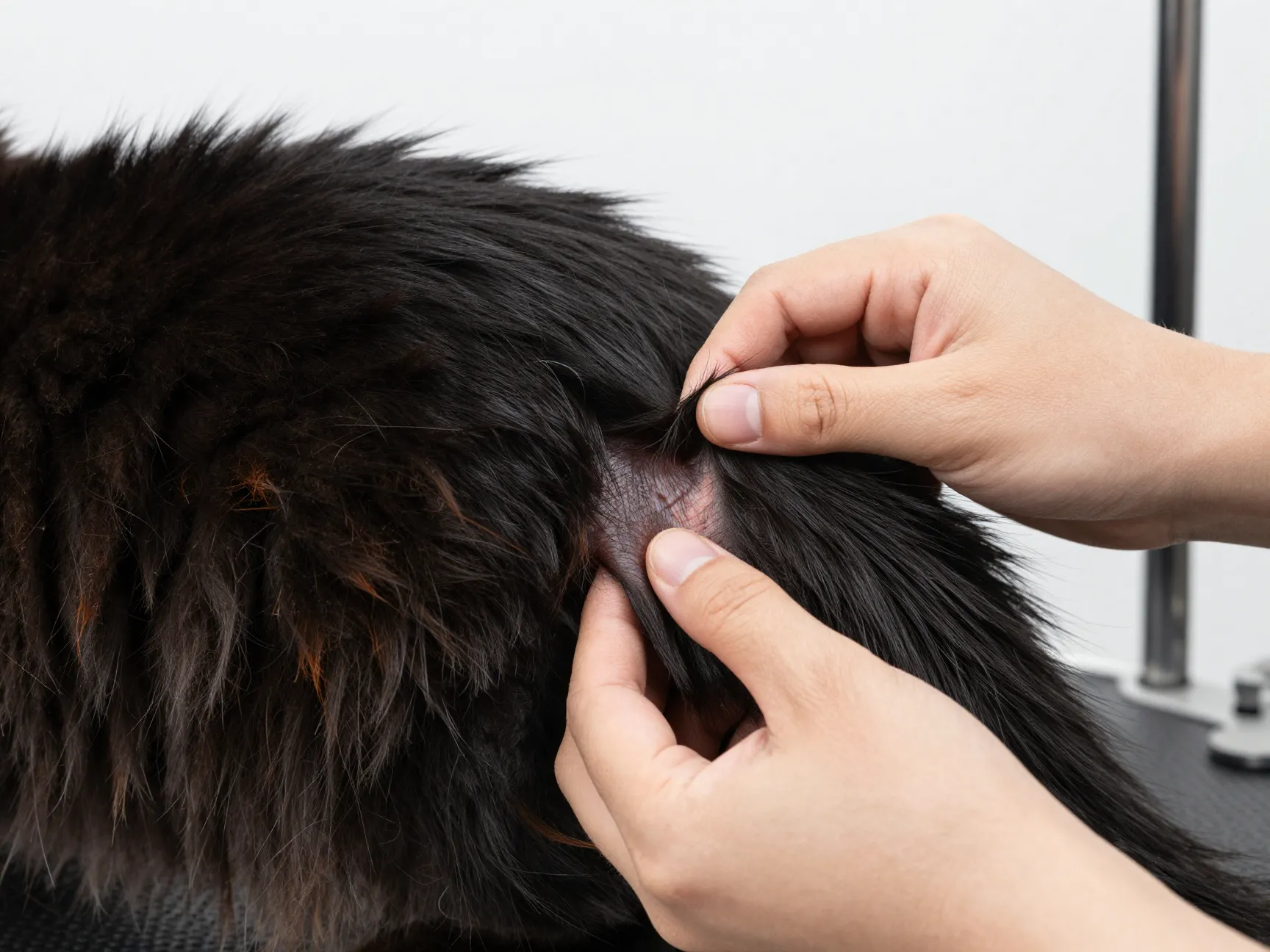
Not every black cat meets the bar for competitive showing. Official breed standards for black Norwegian Forest Cats are demanding, calling for a dense, coal-black color that runs from root to tip of every hair. Any hint of rust, brown tinge, or gray undertone is considered a fault by judges evaluating cats against the written standard.
This root-to-tip requirement matters because black pigment can fade unevenly, especially with sun exposure or certain diets. A show-quality black coat should look uniformly dark whether the fur is parted at the skin or viewed from a distance. Judges also assess coat texture and density alongside color, since the Norwegian Forest Cat standard rewards a coat that functions as well as it looks.
Breeders preparing cats for competition often manage several variables to protect coat quality:
- Limiting prolonged direct sunlight, which can cause a rusty or bronzed cast on black fur.
- Feeding a balanced diet with adequate protein and essential fatty acids to support pigment and shine.
- Grooming regularly to remove loose undercoat, which can make black fur look duller if left matted.
- Scheduling professional coat checks before shows to catch fading early.
For pet owners without show ambitions, these standards still offer a useful benchmark. A dense, evenly dark coat is generally a sign of good coat health, not just cosmetic perfection.
3. Solid Black and Black Smoke Are Not the Same Cat
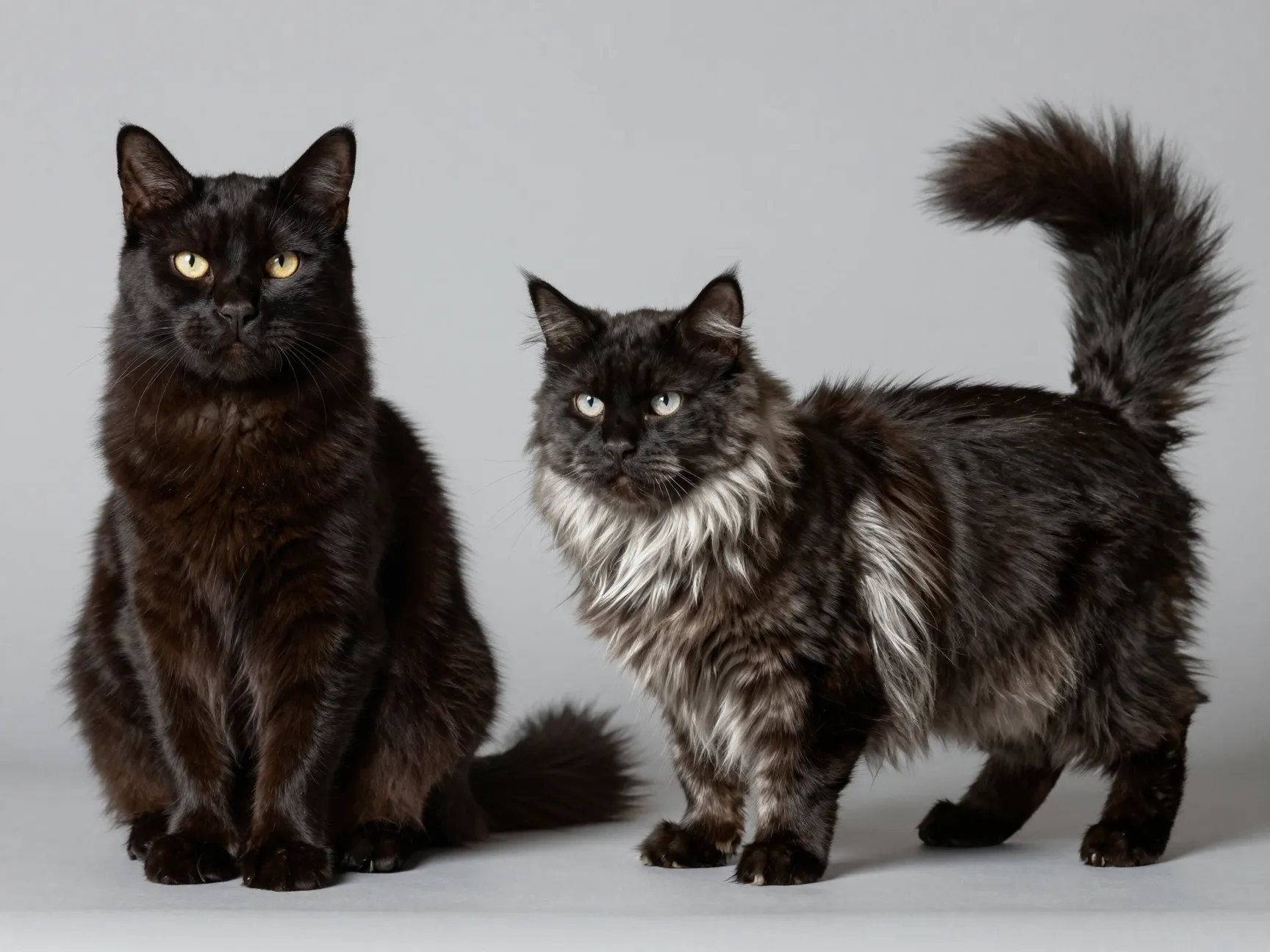
One of the most visually important distinctions within this color family is the difference between solid black and black smoke. Both are accepted patterns under major registries, but they look and behave quite differently, especially in motion or under strong light.
A solid black Norwegian Forest Cat has color pigment distributed evenly along the entire hair shaft, producing a coat that reads as uniformly dark from any angle. A black smoke cat, by contrast, has a pale, near-white undercoat at the base of each hair with black pigment concentrated only near the tips. When a black smoke cat is still, it can look almost solid black. The moment it moves, walks through grass, or is gently parted by hand, the lighter base color becomes visible, creating a shimmering, silvery effect that many owners describe as strikingly dramatic.
The table below summarizes the core differences:
| Feature | Solid Black | Black Smoke |
|---|---|---|
| Pigment distribution | Even, root to tip | Concentrated at tips only |
| Undercoat color | Black or near-black | Pale silver to white |
| Appearance at rest | Uniformly dark | Can appear solid black |
| Appearance in motion | Stays consistently dark | Reveals shimmering undertone |
| Registry status | Widely recognized classic color | Widely recognized classic color |
Both patterns are treated as legitimate, standard-recognized colors rather than novelties, which reinforces their status among the 6 Majestic Facts About The Black Norwegian Forest Cat Breed that serious owners and breeders track closely. Understanding which pattern a cat carries also helps owners set realistic expectations for how the coat will look as lighting and seasons change.
More 6 Majestic Facts About The Black Norwegian Forest Cat Breed Owners Should Understand
Beyond color classification, the black Norwegian Forest Cat’s appeal comes from a combination of genetics, physical build, and personality. The next three facts cover a surprising color transformation some black kittens undergo, the practical engineering behind the breed’s coat and size, and what daily life with this cat actually involves, including its financial demands.
4. Some Black Kittens Transform Into Amber Cats
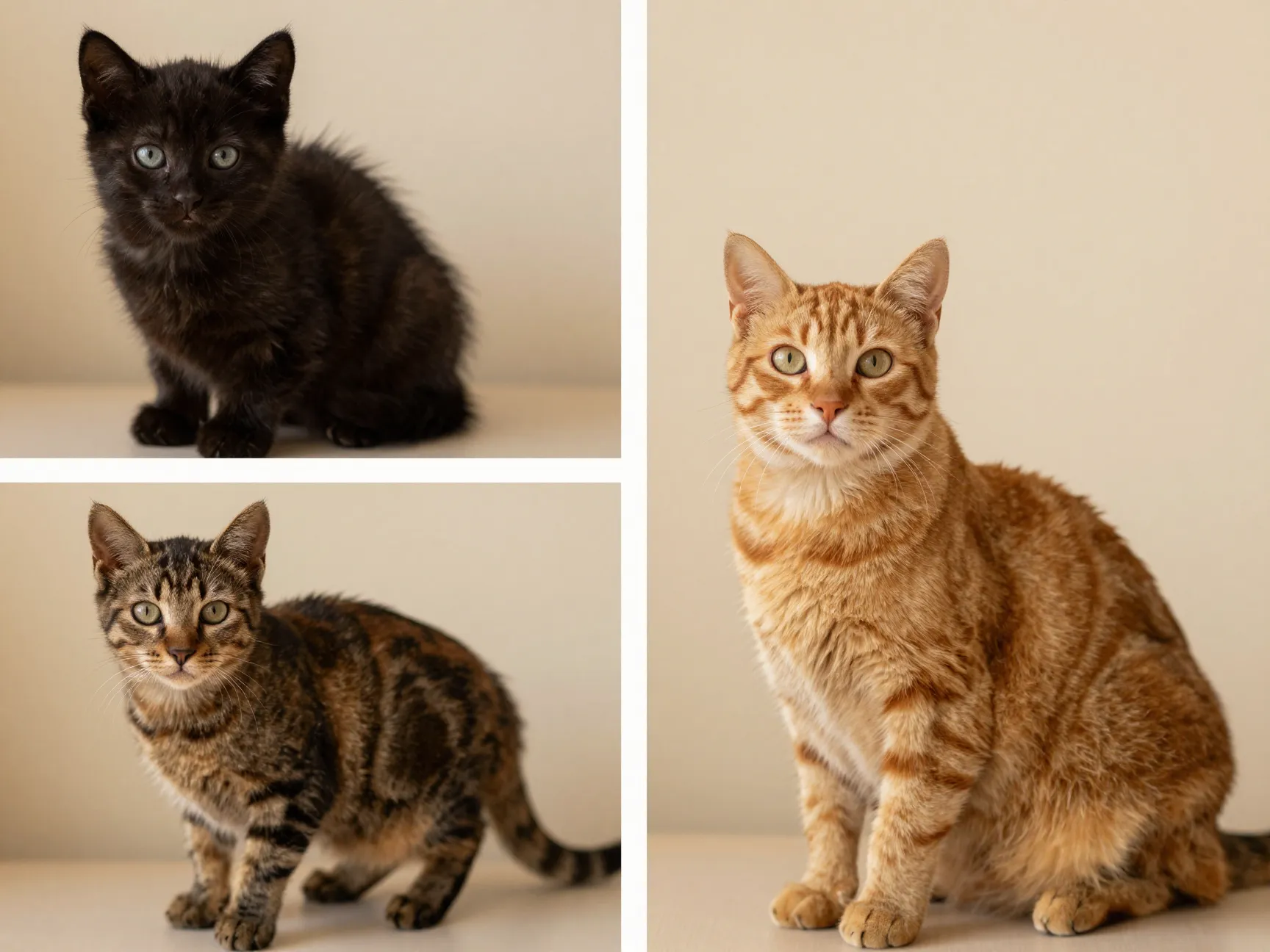
Perhaps the most surprising fact on this list involves a color that is not black at all. Amber is a coat color that originates specifically in cats born black. Kittens carrying the amber gene are born looking like ordinary black kittens, but as they mature, their coat gradually shifts toward warm reddish-brown or amber tones, often stabilizing into its final shade by one to two years of age.
This transformation happens because the amber gene affects how black pigment is processed over time, essentially causing the color to “age” into a lighter, warmer hue rather than staying fixed. It is a genetically distinct process from typical kitten coat changes, and it means two kittens from the same litter that both appeared black at birth can end up looking noticeably different as adults.
For prospective owners, this adds a layer of unpredictability that many find appealing rather than frustrating. A breeder familiar with the lines involved can often predict whether a black kitten carries the amber gene, but confirmation usually comes only as the cat grows. This transformation factor is part of why color education has become such a priority for the breed community heading into 2026, with updated guides helping owners tell the difference between true black, black smoke, blue, and amber at various life stages.
Key points about the amber transformation:
- Amber-gene kittens are born looking black, not amber.
- The color shift typically completes within the first one to two years of life.
- The final amber shade can range from warm bronze to deep rust.
- Amber is genetically linked to black, not a separate unrelated color.
5. Built Like a Forest Giant, With a Coat Engineered for Survival
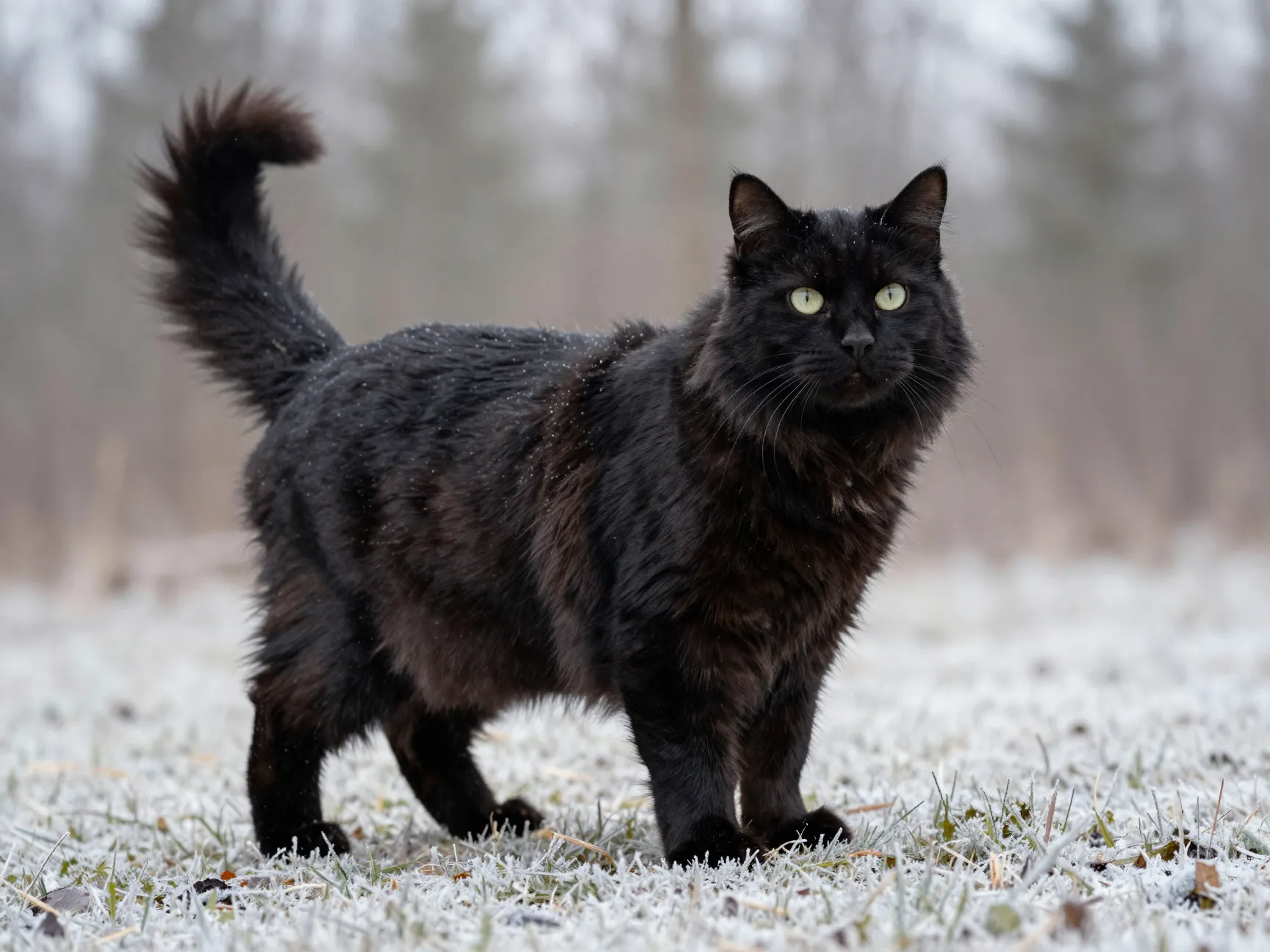
Part of what makes this cat feel majestic is simply its physical presence. Norwegian Forest Cats, regardless of color, are among the larger domestic cat breeds, with males often reaching substantial weights and a body structure built for climbing, jumping, and enduring cold climates. On a black cat, this size reads as especially imposing, since the dark, dense coat visually amplifies the animal’s already solid frame.
The breed’s double coat is not decorative. It evolved to handle harsh Scandinavian winters and consists of a soft, insulating undercoat topped by long, water-resistant guard hairs. On a black cat, this structure creates a striking visual layering effect: a slightly softer sheen from the undercoat beneath a glossy, almost slick outer layer of guard hairs. Functionally, this coat:
- Traps warm air close to the skin, insulating against cold.
- Repels moisture, helping the cat stay drier in snow or rain.
- Sheds seasonally, becoming noticeably thicker in colder months.
- Requires regular grooming to prevent matting, especially around the ruff and britches.
Combined with tufted paws that act almost like natural snowshoes and a long, bushy tail used for balance, the black Norwegian Forest Cat embodies a rare case where form and function align. The coat is not simply an aesthetic; it is a practical adaptation that happens to look dramatic in black.
6. Regal Temperament, Sturdy Health, and a Real Financial Commitment
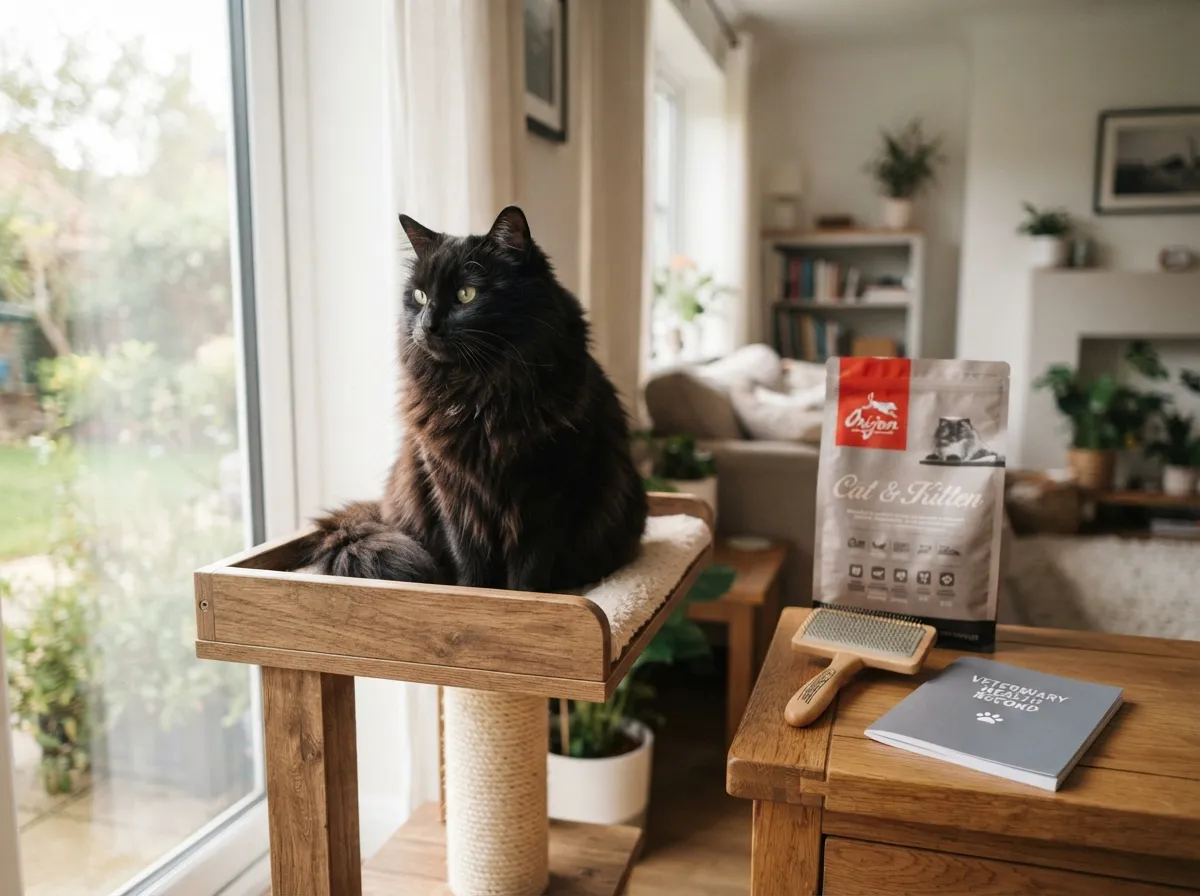
Appearance is only part of the story. Temperament rounds out the “majestic” impression in a way that matters for everyday life. Black Norwegian Forest Cats, like the breed generally, tend to be laid-back and even-tempered, rarely prone to excessive vocalization or clinginess. At the same time, they retain a strong streak of independence, a trait rooted in their working ancestry as farm and forest cats that hunted and roamed with minimal human oversight.
This combination means owners typically get a cat that is affectionate on its own terms rather than constantly demanding attention. Many owners describe the relationship as companionable rather than needy, with the cat choosing to sit nearby rather than insisting on laps or constant handling.
Health-wise, black Norwegian Forest Cats generally share the sturdy, robust profile associated with the breed as a whole. They are not typically linked to any color-specific health issues, meaning a black cat is not inherently more or less prone to illness than a cat of another accepted color. Routine veterinary care, a balanced diet, and regular grooming remain the primary factors influencing long-term health, just as with any Norwegian Forest Cat.
That robustness comes with a cost, however. Ownership expenses for Norwegian Forest Cats remain relatively high heading into 2026, driven by a mix of factors:
- Purchase price reflecting breed demand and pedigree quality
- Higher food volume needs due to large body size
- Regular professional grooming for the dense double coat
- Routine veterinary care suited to a large-breed cat
- Occasional show or registry fees for pedigreed animals
None of this makes the breed impractical, but it does mean prospective owners should budget realistically rather than focusing solely on the cat’s striking appearance. The economic side of ownership is, in its own way, part of what reinforces the breed’s premium, majestic reputation.
Why These 6 Majestic Facts About The Black Norwegian Forest Cat Breed Matter Together
Individually, each fact explains one slice of the breed’s appeal. Together, they form a coherent picture. Popularity trends explain why demand is high. Show standards and color genetics explain why not every black cat looks the same, and why some are not even destined to stay black. Physical build and coat function explain the practical engineering behind the dramatic appearance. Temperament, health, and cost round out what daily ownership actually looks like.
This holistic view matters because color alone does not determine whether a cat is a good fit for a household. A black Norwegian Forest Cat is, first and foremost, a large, independent, weather-adapted breed that happens to wear one of its most photogenic colors. Recognizing that distinction helps set realistic expectations, whether the goal is showing, breeding, or simply sharing a home with one of these animals.
Frequently Asked Questions
Is a black Norwegian Forest Cat a separate breed?
No. Black is a recognized color variation within the standard Norwegian Forest Cat breed, not a distinct breed on its own. The underlying body type, coat structure, and temperament match any other color variation within the breed.
How can someone tell solid black apart from black smoke at a glance?
Solid black cats look uniformly dark at rest and in motion. Black smoke cats often look black when still but reveal a pale, silvery undercoat when the fur is parted or the cat moves through light, creating a shimmering effect absent in solid black cats.
Will a black kitten definitely turn amber?
No. Amber only appears in cats that specifically carry the amber gene. Most black kittens remain black throughout life. Amber transformation is a distinct genetic trait, not a universal stage of development for all black kittens.
Are black Norwegian Forest Cats more prone to health problems than other colors?
There is no strong evidence linking black coat color specifically to increased health risk in this breed. General breed health considerations, such as maintaining a healthy weight and routine veterinary checkups, apply regardless of coat color.
Why do black Norwegian Forest Cats currently sell for a premium?
High demand, driven partly by social and visual media popularity, combined with limited litters from breeders producing show-quality black coats, has kept prices and waiting lists elevated into 2026.
Conclusion
The black Norwegian Forest Cat earns its majestic reputation through a rare combination of genetics, physical engineering, and temperament, not simply through a dramatic color. From the surging popularity documented heading into 2026, to the strict show standards demanding coal-black perfection, to the surprising amber transformation some kittens undergo, each of these 6 Majestic Facts About The Black Norwegian Forest Cat Breed reveals a different layer of what makes this animal so distinctive.
For anyone considering bringing one of these cats into a household, the practical next step is straightforward: research reputable breeders who can clearly explain a kitten’s expected adult coat, ask directly about amber-gene lineage if a permanent black coat is the goal, and budget realistically for the grooming, feeding, and veterinary needs of a large, double-coated breed. Approaching the decision with both admiration for the breed’s striking appearance and a clear understanding of its practical demands is the surest way to enjoy everything that makes the black Norwegian Forest Cat genuinely majestic.