
8 Reasons Why Your German Shepherd Dogs Barking (And How to Manage It)
German Shepherds rank among the top three most popular dog breeds in the United States — and they also rank among the most vocal. If your GSD sounds like a one-dog neighborhood watch program, you are not alone, and more importantly, you are not out of options. Understanding the 8 reasons why your German Shepherd dogs barking (and how to manage it) is the single most effective step you can take toward a calmer, happier household in 2026.

This guide breaks down every major cause of GSD barking, explains what each type of bark actually means, and gives you practical, evidence-backed strategies to manage the behavior without breaking your dog’s spirit.
Key Takeaways 🐾
- German Shepherds are naturally vocal dogs bred for communication and alertness — barking is normal, but excessive barking is manageable.
- Each type of bark (alert, fearful, bored, pain-related) has a distinct sound and body language cue that tells you exactly what your dog needs.
- Consistent training, adequate exercise, and mental stimulation resolve the majority of barking problems.
- Never punish barking without understanding its cause — you may accidentally reinforce anxiety or suppress a legitimate warning signal.
- When barking is sudden, unusual, or accompanied by physical symptoms, consult a veterinarian immediately.
Understanding Why German Shepherds Bark More Than Other Breeds
Before diving into the 8 reasons why your German Shepherd dogs barking (and how to manage it), it helps to understand why GSDs are wired this way. German Shepherds were originally bred as herding and protection dogs. Vocalization was a functional tool — alerting farmers to predators, communicating with handlers across long distances, and warning intruders away from livestock [3].
That genetic legacy does not disappear just because your GSD now lives in a three-bedroom house. Their vocal instincts are deeply embedded. According to Spirit Dog Training, German Shepherds are among the most vocal breeds precisely because their communication skills were selectively reinforced over generations [3].
Pull Quote: “A barking German Shepherd is not a broken dog — it’s a communicating dog. Your job is to learn the language.”
The key difference between a well-adjusted GSD and a problem barker is almost always environment, training, and unmet needs — not the dog’s fundamental character.
| Bark Type | Sound | Body Language | Likely Cause |
|---|---|---|---|
| Alert bark | Deep, repetitive | Stiff, ears forward | Territorial trigger |
| Fear bark | Sharp, quick bursts | Crouched, tail low | Anxiety or threat |
| Boredom bark | Monotone, continuous | Flat, disengaged | Under-stimulation |
| Playful bark | High-pitched yip | Loose, bouncy | Excitement |
| Pain whine | Unusual howl/whine | Guarding a body part | Illness or injury |
The 8 Reasons Why Your German Shepherd Dogs Barking (And How to Manage It)
1. Alert and Territorial Barking

Alert barking is the most common reason German Shepherds bark, and it is also the most misunderstood. When your GSD spots a stranger at the door, a squirrel crossing the yard, or an unfamiliar car parked outside, they issue a warning signal — a series of deep, repetitive barks paired with a stiff, upright body posture and forward-pointing ears [1][3].
This behavior is not aggression. It is your dog doing exactly what centuries of breeding prepared them to do: protect the pack.
How to manage it:
- Acknowledge, then redirect. Say “thank you” or “good dog” calmly, then give a firm “quiet” command. This tells your GSD their message was received without rewarding continued barking.
- Desensitize to triggers. If your dog barks at the mail carrier every day, controlled exposure exercises — pairing the trigger with treats — can reduce the intensity over time.
- Limit visual access. Window films or baby gates can reduce the number of triggers your dog sees from inside the house.
- Avoid yelling back. Raising your voice signals to your dog that you are also alarmed, which escalates the behavior.
2. Attention-Seeking Barking

Not every bark is a warning. Sometimes your German Shepherd just wants you to look at them. Attention-seeking barks are typically high-pitched, whiny, or repetitive and occur when your dog wants food, wants to go outside, or simply wants your focus [1].
The tricky part: the moment you respond — even to scold — you have rewarded the behavior. Your dog learns that barking = attention, and the cycle continues.
How to manage it:
- Ignore the bark entirely. Turn your back, leave the room, or use a calm “no” without eye contact.
- Reward silence. The instant your dog stops barking, immediately offer praise or a treat. You are teaching them that quiet gets results.
- Establish a routine. Many attention-seeking barks happen because feeding times, walks, and play sessions are unpredictable. A consistent daily schedule reduces demand barking significantly.
- Use a “place” command to redirect your dog to a designated mat or bed when barking starts.
3. Separation Anxiety and Isolation Distress
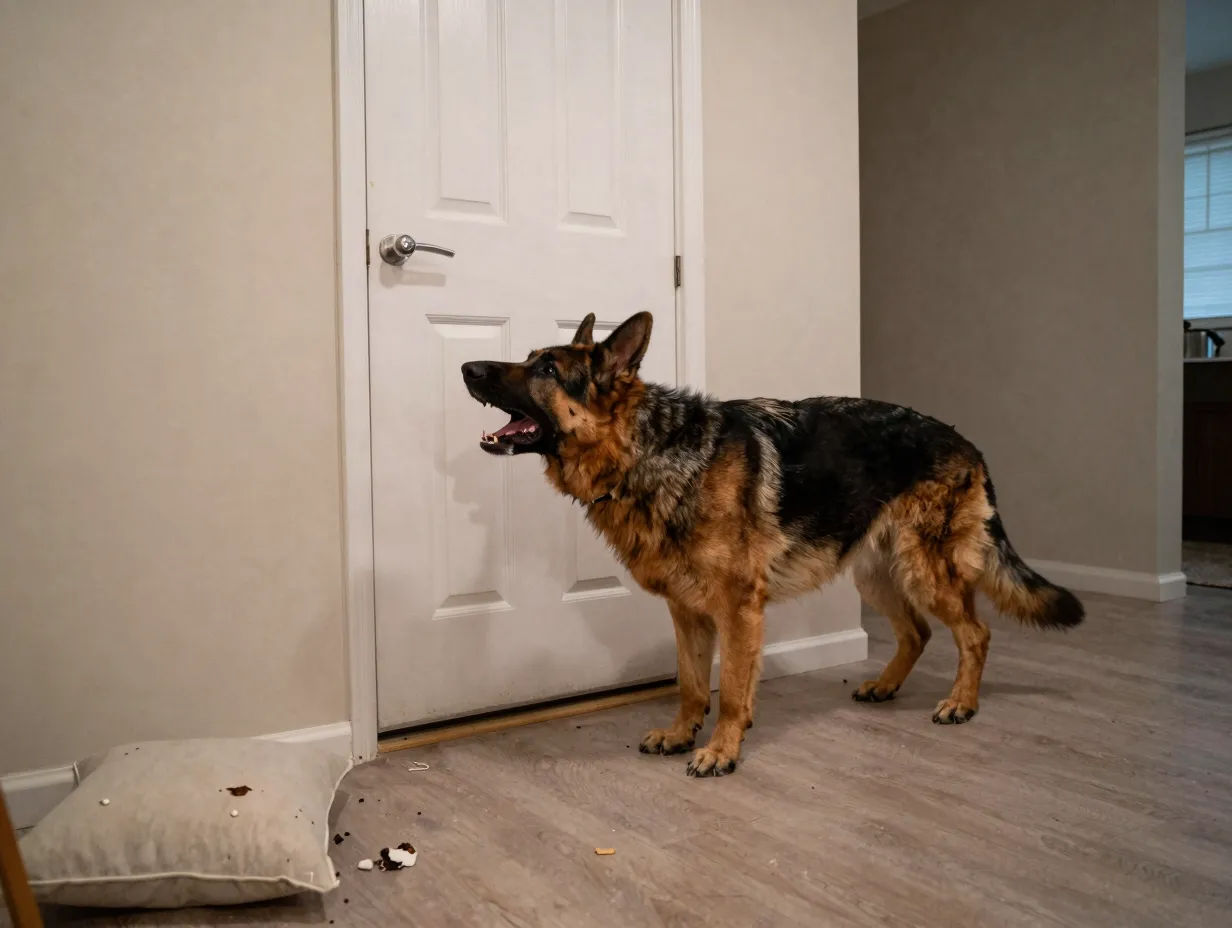
This is one of the most serious causes of GSD barking — and one of the most heartbreaking. Continuous, frantic barking that begins the moment you leave (or even when you prepare to leave) is a hallmark sign of separation anxiety [1][2][3].
German Shepherds form intense bonds with their owners. When that bond is suddenly severed — even for a few hours — some dogs experience genuine psychological distress. According to Dognutrio, GSD puppies are especially vulnerable to separation anxiety if they are not gradually conditioned to alone time early in life [2].
Signs beyond barking include destructive chewing, pacing, house soiling, and excessive drooling.
How to manage it:
- Practice graduated departures. Leave for 30 seconds, return calmly, then extend the time incrementally over days and weeks.
- Never make arrivals or departures dramatic. No long goodbyes or excited greetings — this amplifies the emotional spike.
- Provide enrichment before you leave. A stuffed Kong, a puzzle feeder, or a long-lasting chew can bridge the emotional gap.
- Consider professional help. Severe separation anxiety often requires a certified dog behaviorist or, in some cases, veterinary support including anxiety medication.
4. Playful Excitement Barking

Not all barking signals a problem. High-pitched yipping and short, staccato barks during play are your German Shepherd’s version of laughing [1]. This type of bark is accompanied by a loose, wiggly body, a play bow (front legs down, rear up), and a wagging tail.
Playful barking is healthy and normal. It only becomes an issue when it escalates into over-arousal, nipping, or jumping.
How to manage it:
- Teach an “off” or “enough” cue. When play barking gets too intense, pause the game completely. Resume only when your dog calms down. This teaches impulse control.
- Structured play sessions with a clear start and end signal help your GSD understand that excitement has limits.
- Channel energy into training games like fetch with a “drop it” command, tug with “out,” or nose work exercises that provide mental stimulation alongside physical activity.
5. Fear and Anxiety Barking

Fear-based barking sounds different from alert barking. It tends to come in sharp, quick bursts and is paired with avoidance body language: a lowered head, tucked tail, flattened ears, and wide eyes [1][3]. Your dog is not trying to threaten — they are trying to make a scary thing go away.
Common triggers include thunderstorms, fireworks, unfamiliar people, vet visits, and new environments.
How to manage it:
- Never force your dog to confront a fear. Flooding (forced exposure) can worsen anxiety and erode trust.
- Counter-conditioning is the gold standard: pair the scary trigger with something your dog loves (high-value treats, a favorite toy) at a distance where the dog notices but is not overwhelmed.
- Create a safe space. A crate covered with a blanket, a quiet room, or a dog bed in a low-traffic area gives your GSD somewhere to retreat.
- Calming aids such as compression wraps (Thundershirts), pheromone diffusers (Adaptil), or calming supplements may help in mild to moderate cases.
6. Boredom and Under-Stimulation Barking
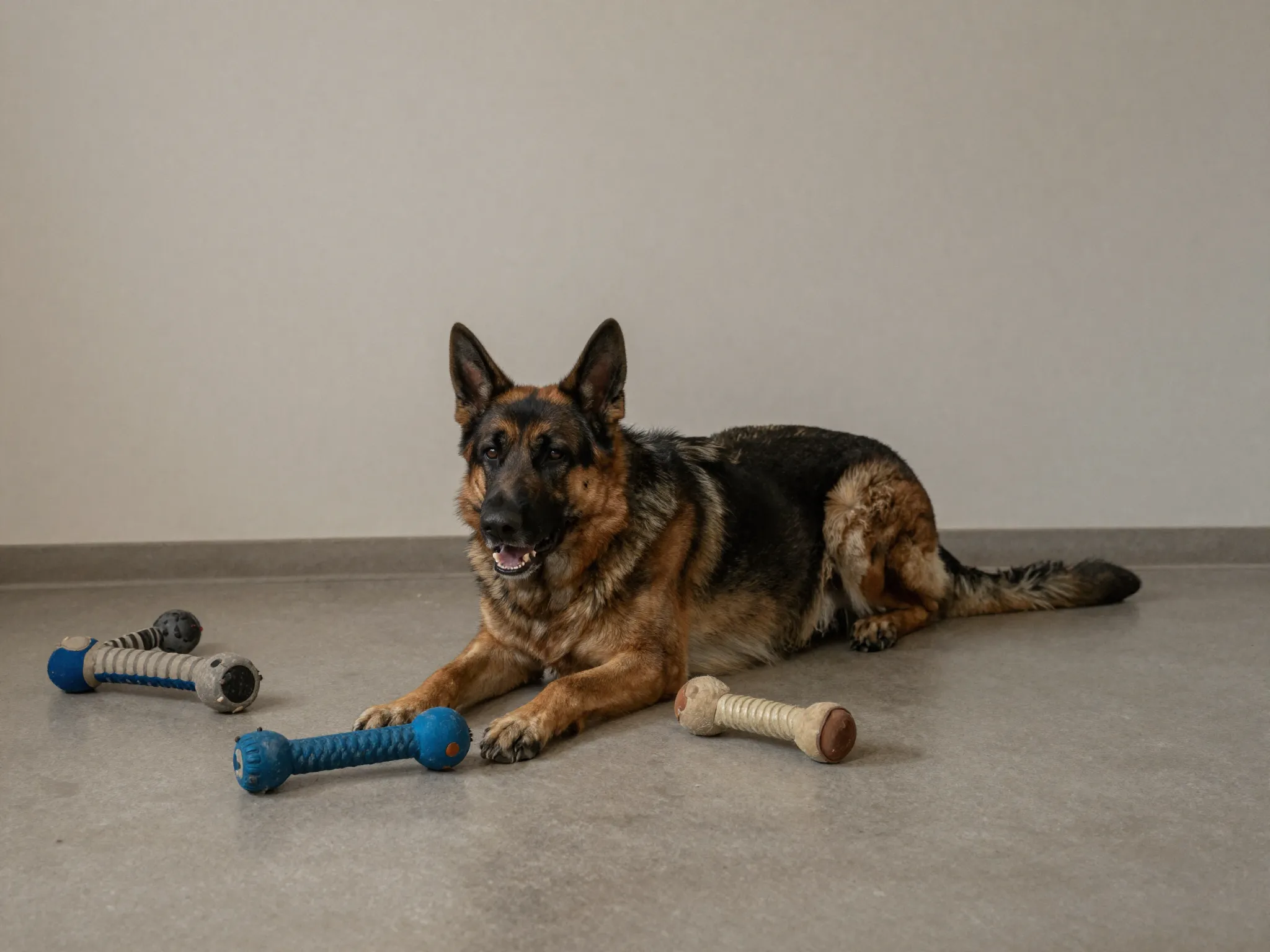
A bored German Shepherd is a loud German Shepherd. This breed was built to work — herding, tracking, search and rescue, protection. When that need for mental and physical engagement goes unmet, continuous, monotone barking often fills the void [1][3].
This type of bark has an almost mechanical quality. It is repetitive, rhythmic, and goes on seemingly forever. Your dog is not communicating a specific threat — they are simply running out of things to do.
How to manage it:
- Increase daily exercise. Adult GSDs need a minimum of 60–90 minutes of vigorous activity per day. A tired dog is a quiet dog.
- Add mental stimulation. Puzzle feeders, sniff walks, obedience training sessions, and trick training all tax the brain in ways that physical exercise alone cannot.
- Rotate toys. Novelty matters. Introduce new toys or rotate existing ones weekly to maintain interest.
- Consider dog sports. Activities like agility, Schutzhund, nose work, or dock diving give working-breed dogs a legitimate outlet for their drive.
🐕 Pro Tip: Even 10 minutes of focused obedience training (sit, stay, heel, place) can mentally exhaust a GSD more effectively than a 30-minute walk.
7. Pain or Illness Barking

When a German Shepherd barks or howls in a way that seems unusual — mournful, persistent, or impossible to comfort — pain or illness may be the cause [1][3]. This is especially true if the behavior appears suddenly in a dog that does not normally bark excessively, or if it is accompanied by limping, loss of appetite, lethargy, or changes in posture.
GSDs are prone to certain health conditions including hip dysplasia, degenerative myelopathy, bloat (GDV), and ear infections — all of which can cause significant discomfort.
How to manage it:
- Do not attempt to train away this type of barking. It is a symptom, not a behavior problem.
- Schedule a veterinary appointment immediately if you notice sudden behavioral changes paired with any physical symptoms.
- Monitor for secondary signs: changes in eating, drinking, elimination, gait, or energy levels.
- Once the underlying medical issue is treated, the barking typically resolves on its own.
⚠️ Important: If your German Shepherd suddenly starts barking excessively with no obvious environmental trigger, always rule out a medical cause first.
8. Barking in Response to Sounds

Some German Shepherds are triggered by specific sounds — sirens, doorbells, phone ringtones, musical instruments, or even certain television programs [3]. This type of barking often looks like howling, with the dog tilting their head back and producing a long, drawn-out vocalization that rises and falls with the sound.
This behavior has roots in pack communication. Howling in response to sound mimics the way wolves and wild dogs use group vocalizations to locate and communicate with each other.
How to manage it:
- Identify the specific trigger sounds by noting when the behavior occurs. Keep a simple log for one week.
- Desensitize systematically. Play recordings of the trigger sound at very low volume while feeding treats. Gradually increase the volume over multiple sessions as your dog remains calm.
- Use a “quiet” command paired with a treat the moment your dog stops howling. Consistency is critical — every household member must use the same cue.
- Manage the environment. If your dog howls at the TV, consider white noise machines or dog-specific music (species-appropriate music has been shown to have a calming effect on dogs).
General Barking Management Strategies That Work Across All Causes
Understanding the 8 reasons why your German Shepherd dogs barking (and how to manage it) is only half the equation. These universal principles apply regardless of the specific trigger:
1. Be consistent. Mixed signals — sometimes allowing barking, sometimes correcting it — teach your dog that persistence pays off.
2. Train “quiet” as a command. Ask for one bark (say “speak”), then immediately cue “quiet.” Reward silence. This gives you a verbal off-switch.
3. Never use punishment-based tools without professional guidance. Shock collars, citronella sprays, and ultrasonic devices may suppress barking short-term but rarely address the root cause and can increase anxiety.
4. Exercise before training. A physically tired dog is more receptive to learning. Walk or run your GSD before any training session.
5. Work with a certified professional. If barking is severe, persistent, or accompanied by aggression, a certified professional dog trainer (CPDT-KA) or veterinary behaviorist (DACVB) is your best investment [5].
| Strategy | Best For | Difficulty Level |
|---|---|---|
| Graduated desensitization | Fear, sound triggers | Moderate |
| Ignore + reward silence | Attention-seeking | Easy |
| Graduated departures | Separation anxiety | Moderate–Hard |
| Increased exercise | Boredom | Easy |
| Vet consultation | Pain/illness | Immediate |
| Counter-conditioning | Fear, territorial | Moderate |
When to Call a Professional 🚨
Some barking situations go beyond what self-directed training can resolve. Seek professional help if:
- Barking is accompanied by aggression (growling, snapping, lunging)
- Your dog cannot be left alone for any period without extreme distress
- Barking has escalated suddenly without a clear environmental trigger
- You have tried consistent training for 4–6 weeks with no measurable improvement
- Neighbors have filed noise complaints or local ordinances are at risk of being violated
A veterinary behaviorist can assess whether medication (such as fluoxetine or clomipramine) combined with behavior modification is appropriate for severe anxiety-based barking [4].
Conclusion: Turning Down the Volume Without Turning Off Your Dog
The 8 reasons why your German Shepherd dogs barking (and how to manage it) — from territorial alerts and attention-seeking to separation anxiety, boredom, fear, pain, excitement, and sound reactivity — all share one common thread: your dog is trying to communicate something. The goal is never to silence your GSD completely. It is to understand what they are saying and give them better tools to express it.
Your actionable next steps:
- Observe and log your dog’s barking for one week. Note the time, trigger, sound type, and body language.
- Match the bark to a cause using the table and descriptions in this guide.
- Choose one management strategy specific to that cause and apply it consistently for at least 30 days.
- Rule out medical causes with a vet visit if the barking is sudden or unusual.
- Invest in enrichment — more exercise, more mental stimulation, more structured training — regardless of the specific cause.
A well-exercised, mentally engaged, and securely attached German Shepherd is a calmer German Shepherd. You already took the most important step by seeking to understand rather than simply suppress. That is the foundation of every great dog-owner relationship.
References
[1] German Shepherd Vocalizations Interpreting Barks Whines And Growls To Understand Your Dogs Communication – https://germanshepherdshop.com/blogs/list/german-shepherd-vocalizations-interpreting-barks-whines-and-growls-to-understand-your-dogs-communication
[2] German Shepherd Puppy Barking – https://dognutrio.com/german-shepherd-puppy-barking/
[3] German Shepherds Vocal – https://spiritdogtraining.com/german-shepherds-vocal/
[4] German Shepherd Barking At Night – https://dogcarecompass.com/german-shepherd-barking-at-night/
[5] Why German Shepherds Bark Causes And How To Manage It – https://shepherdtips.com/posts/why-german-shepherds-bark-causes-and-how-to-manage-it