8 First-Time Owner Tips for Your Australian Sheep Dog Puppy
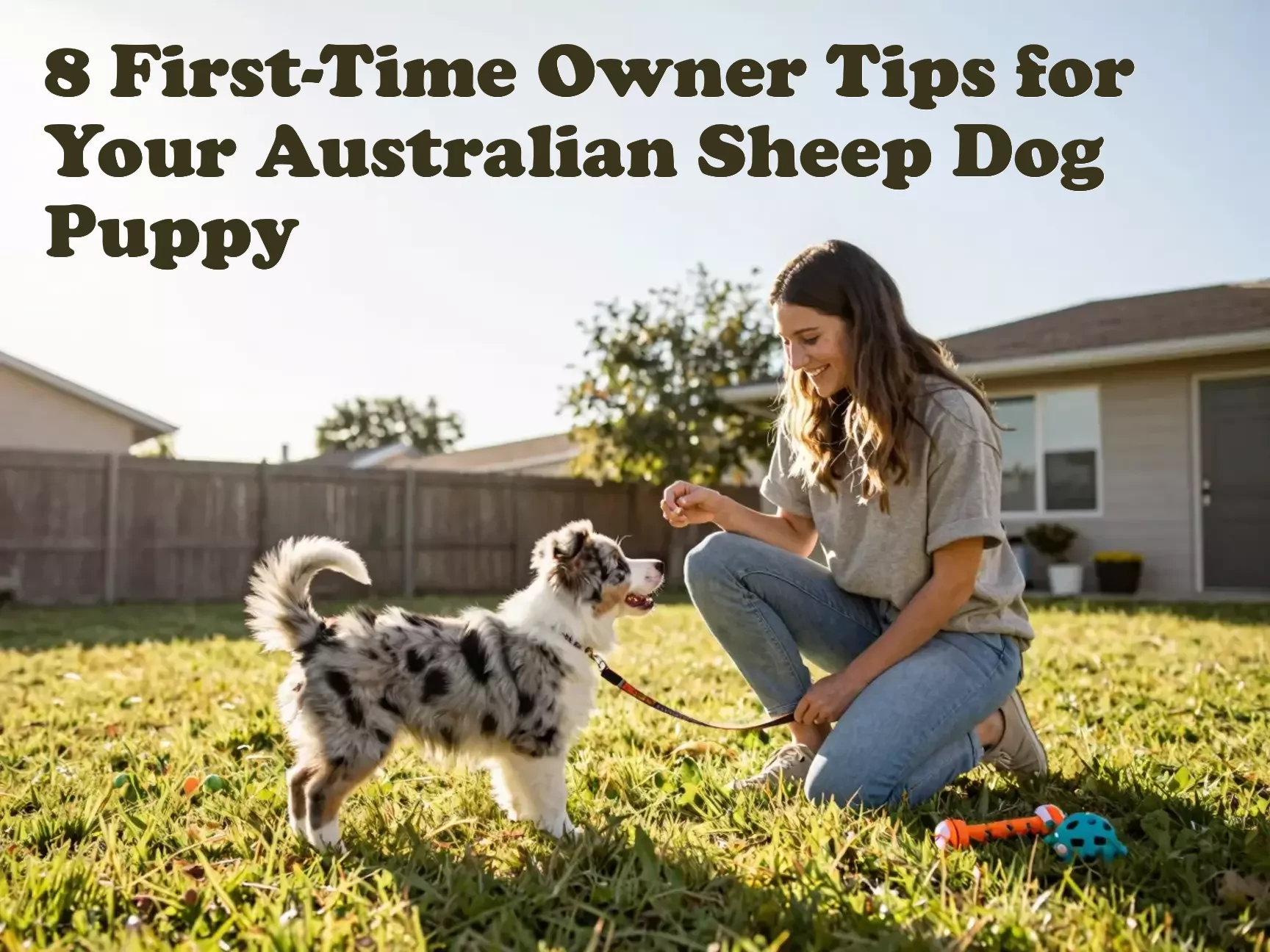
Only 8% of first-time dog owners say they felt fully prepared when they brought their puppy home — and that number drops even lower for high-energy working breeds like the Australian Shepherd. If you’ve just welcomed one of these brilliant, spirited dogs into your life, you already know the feeling: equal parts excitement and “what do I do now?” These 8 First-Time Owner Tips for Your Australian Sheep Dog Puppy are designed to bridge that gap, giving you a clear, actionable roadmap from day one.
Disclosure: This post contains affiliate links. As an Amazon Associate, we earn from qualifying purchases, and at no extra cost to you.
Australian Sheep Dogs — more commonly called Australian Shepherds or “Aussies” — are not your average beginner breed. They’re highly intelligent, intensely loyal, and wired to work. Without the right guidance, that energy can turn into chewed furniture, nonstop barking, and a very frustrated household. But with the right approach, you’ll raise a confident, well-mannered companion who thrives alongside you. Let’s get into it.
Key Takeaways
- 🐾 Time investment is non-negotiable — Australian Shepherd puppies need consistent daily attention, especially in the first weeks at home.
- 🏠 Crate training is your best friend for housebreaking and giving your puppy a safe space.
- 🧠 Early socialization prevents problem behaviors like herding, nipping, and anxiety.
- 🏃 Regular exercise is essential — a bored Aussie is a destructive Aussie.
- 📅 Enroll in obedience classes by 4 months to build good manners and deepen your bond.
Tips 1–4: Building the Right Foundation for Your Australian Sheep Dog Puppy
Getting the first few weeks right sets the tone for your dog’s entire life. These first four tips from our 8 First-Time Owner Tips for Your Australian Sheep Dog Puppy guide focus on establishing structure, safety, and trust.
1. Commit Serious Time in the First Few Weeks
Your new puppy just left everything familiar — their mother, their littermates, the smells and sounds they grew up with. That transition is stressful, even for a confident Aussie pup. The single most important thing you can do early on is simply be present [1].
Plan to take time off work if possible during the first week. If that’s not realistic, arrange your schedule so someone is home with the puppy for most of the day. Here’s what that time investment looks like in practice:
| Time of Day | Activity |
|---|---|
| Morning | Potty break, short play session, feeding |
| Midday | Training practice (5–10 min), nap time in crate |
| Afternoon | Socialization walk or yard time |
| Evening | Grooming check, calm bonding time |
| Night | Crate sleep routine |
💡 Pull Quote: “The hours you invest in your puppy’s first weeks are the foundation everything else is built on. There are no shortcuts here.”
Australian Shepherd puppies bond deeply and quickly. The more quality time you spend during this adjustment window, the faster your puppy builds trust — and the easier every other tip on this list becomes [1].
2. Use a Leash Even in Fenced Areas
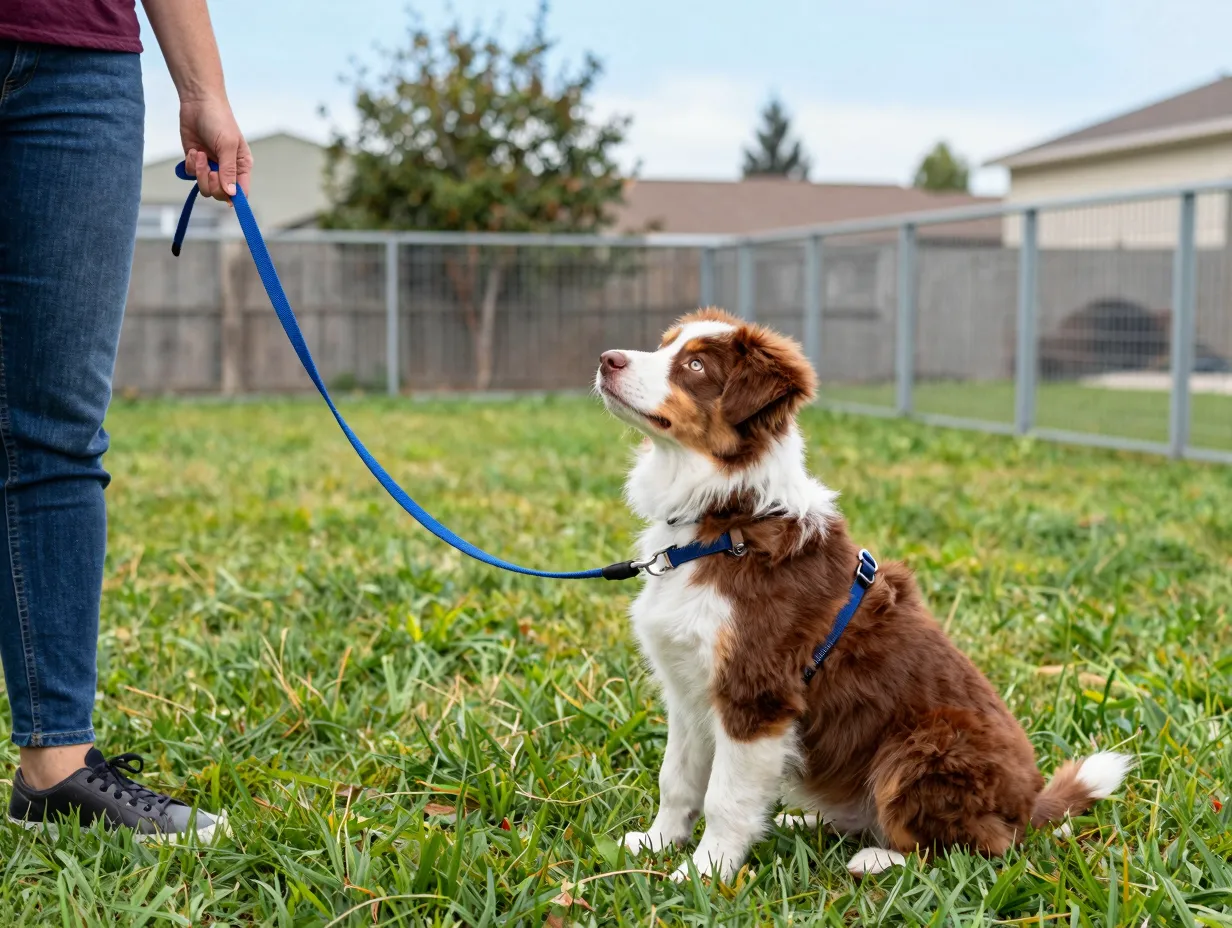
This one surprises a lot of new owners. You have a fenced backyard, so why would you need a leash? The answer is about leadership, not containment [1] [2].
During the first few weeks, keeping your Aussie puppy on a leash — even in enclosed spaces — does several important things:
- It establishes you as the guide and decision-maker in your puppy’s world.
- It keeps you physically connected, which builds attentiveness.
- It prevents your puppy from rehearsing unwanted behaviors like chasing, digging, or darting.
- It gives you the ability to redirect instantly when needed.
Think of the leash less as a restraint and more as a communication tool. Australian Shepherds are bred to stay close to and respond to their handler. Using a leash in the early weeks taps directly into that instinct and reinforces the relationship you’re building [2].
Pro tip: Use a lightweight 6-foot leash indoors too during supervised time. This “umbilical cord” method keeps your puppy from wandering off and getting into trouble while you’re still learning each other’s signals.
3. Start Crate Training from Day One
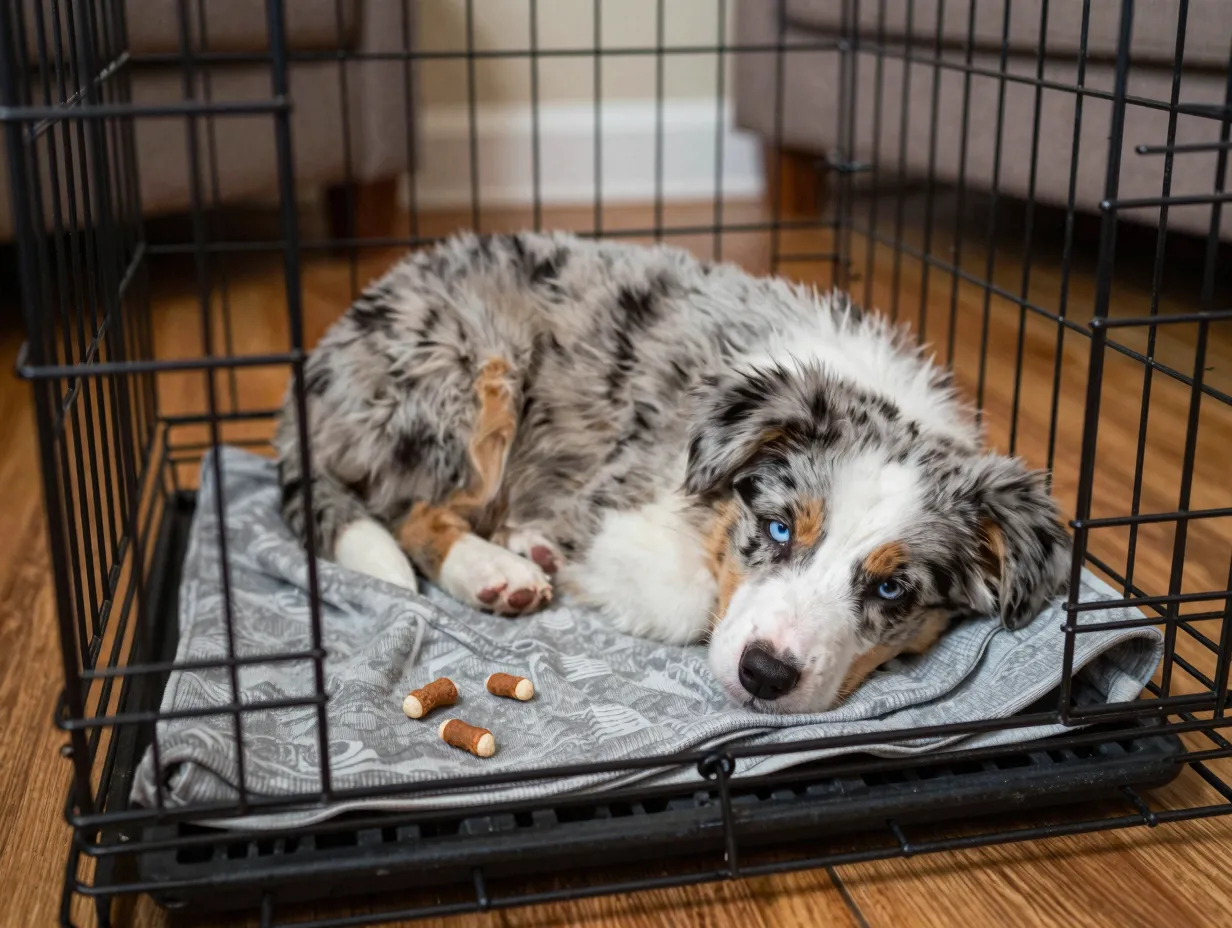
Crate training is one of the most misunderstood tools in puppy raising. Many new owners feel guilty “locking up” their dog — but dogs are naturally den animals. A properly introduced crate becomes a safe retreat, not a punishment [1].
Here’s why crate training works so well for housebreaking:
- Dogs instinctively avoid soiling where they sleep.
- The crate limits your puppy’s access to the house, reducing accident opportunities.
- It gives your puppy a predictable, calm place to rest and decompress.
How to introduce the crate:
- Place the crate in a busy area of your home so your puppy doesn’t feel isolated.
- Put a worn t-shirt inside so it smells like you.
- Toss treats inside without closing the door at first.
- Gradually increase the time with the door closed, always staying calm and positive.
- Never use the crate as punishment — it should always be associated with good things.
A standard schedule for an 8-week-old puppy: crate time should not exceed 2 hours during the day (puppies can’t hold their bladder longer than that). At night, most puppies can stretch to 4–5 hours by 10–12 weeks [1].
4. Master Potty Training with Praise — Not Punishment
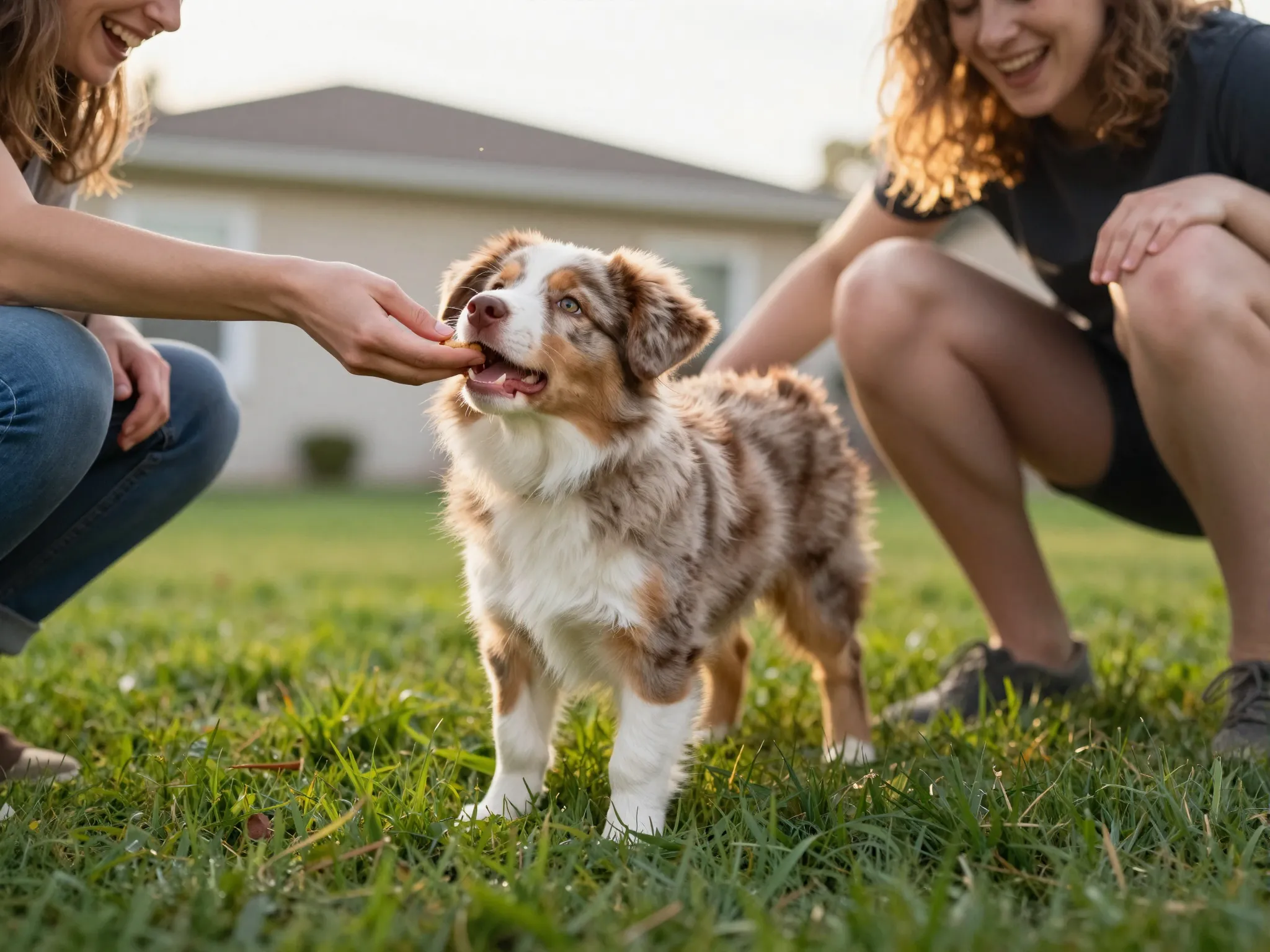
Potty training an Australian Shepherd puppy is straightforward if you follow one golden rule: reward every success, ignore every accident [1].
Here’s the approach that works:
Do this:
- Take your puppy outside every 30–45 minutes when awake.
- Go out immediately after meals, naps, and play sessions.
- Use a consistent phrase like “go potty” so they learn the cue.
- The moment they finish outside, praise enthusiastically and offer a treat.
Avoid this:
- Rubbing their nose in accidents (this only creates fear and confusion).
- Scolding after the fact (puppies don’t connect past actions to present punishment).
- Giving too much freedom too soon before they’re reliably trained.
When accidents happen indoors — and they will — clean them up with an enzymatic cleaner that eliminates the scent. If your puppy can smell the spot, they’ll return to it [1].
🐶 Key insight: Aussies are highly sensitive dogs. Harsh corrections during potty training can damage your bond and create anxiety that makes training harder across the board.
Tips 5–8: Socialization, Training, Exercise, and Grooming for Your Aussie Puppy
The second half of our 8 First-Time Owner Tips for Your Australian Sheep Dog Puppy covers the areas that most directly shape your dog’s long-term personality and behavior.
5. Socialize Early and Often — It Prevents Bigger Problems Later
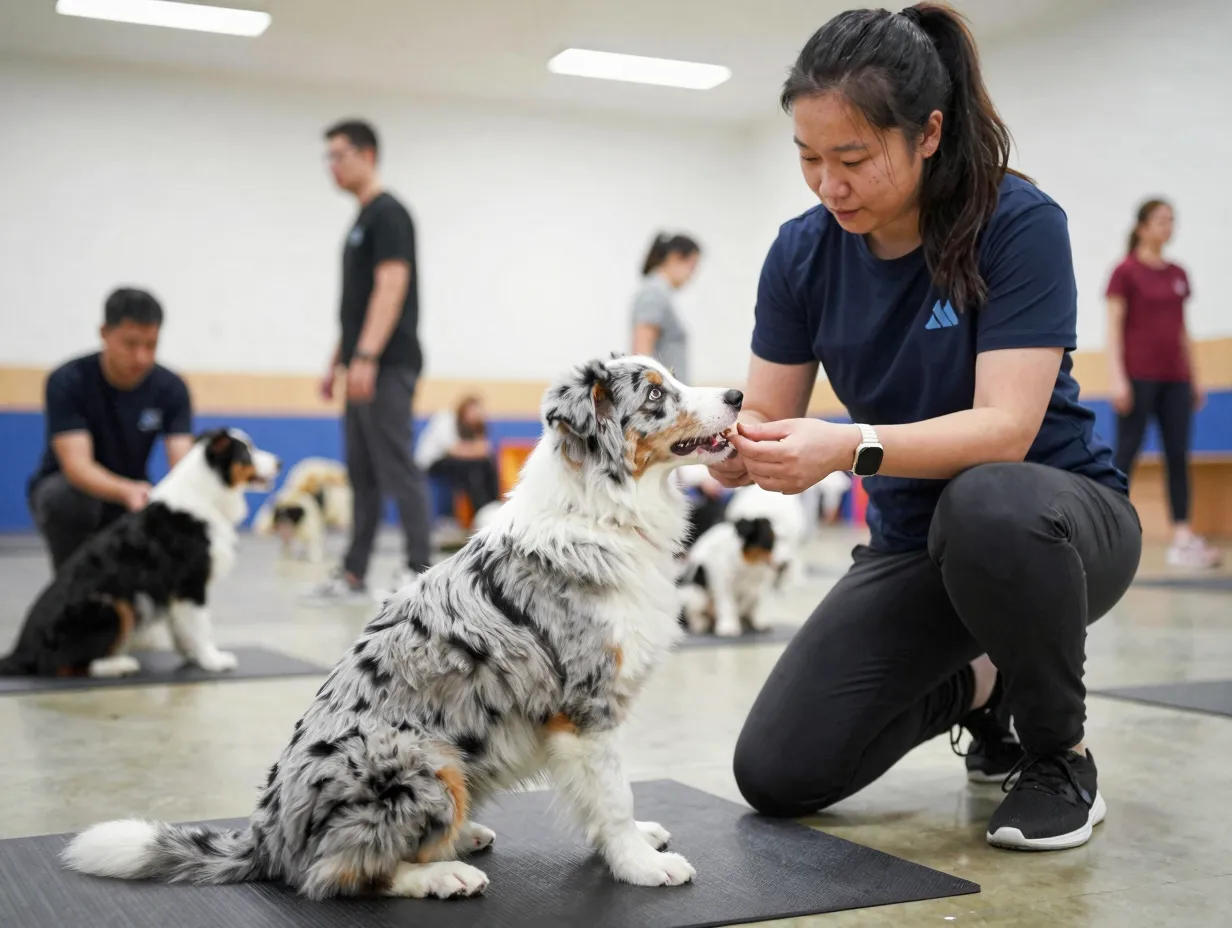
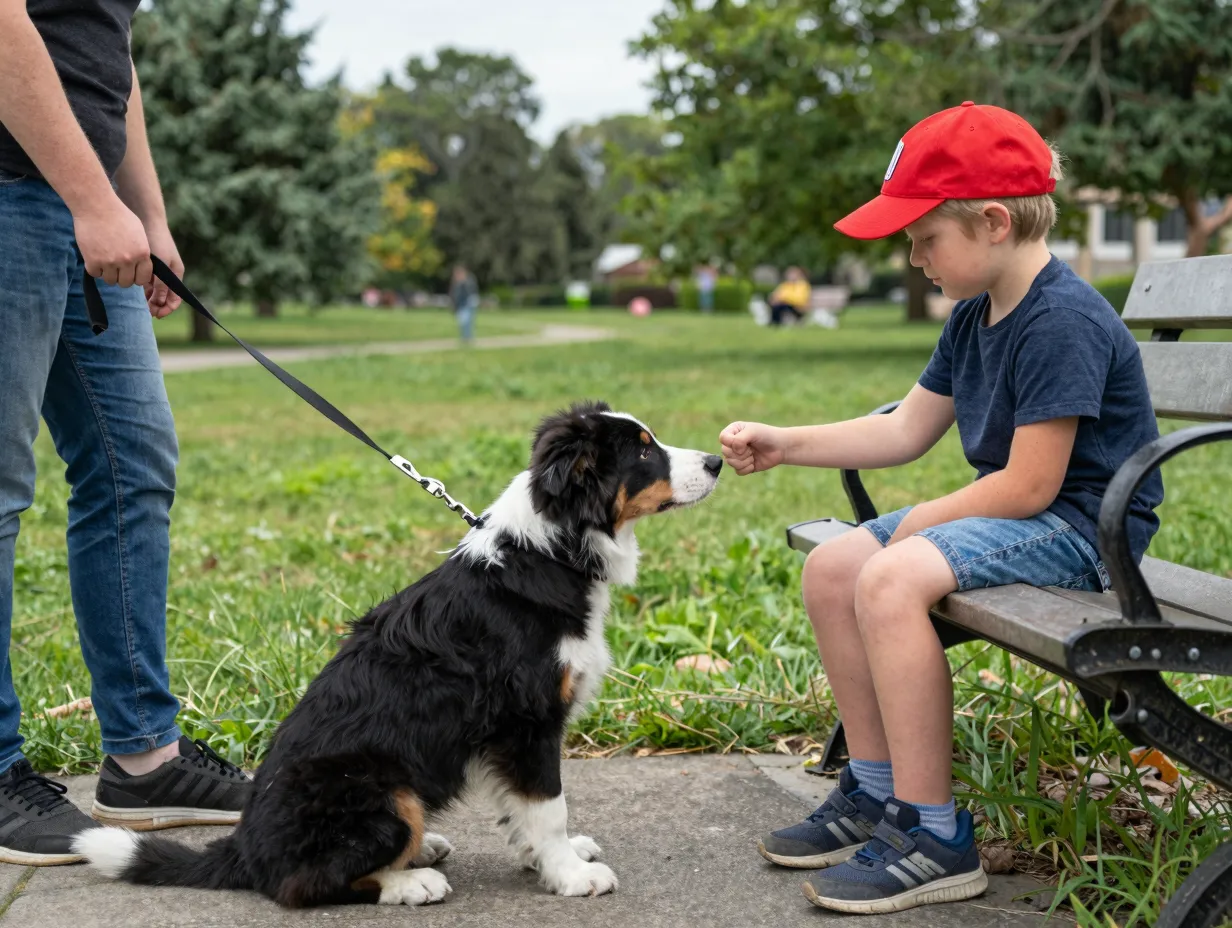
Australian Shepherds have strong herding and protective instincts baked into their DNA. Without proper socialization, those instincts can express themselves as nipping at children’s heels, chasing bikes, barking at strangers, or anxiety around new environments [1].
The socialization window is roughly 3 to 14 weeks of age — this is when your puppy’s brain is most receptive to new experiences. Every positive exposure during this period builds a more confident, adaptable adult dog.
Socialization checklist for your Aussie puppy:
- Introduce to people of different ages, sizes, and appearances (hats, beards, uniforms).
- Expose to different surfaces: grass, gravel, tile, stairs.
- Let them hear different sounds: traffic, children playing, appliances.
- Introduce calmly to other vaccinated dogs.
- Visit different environments: pet stores, parks, quiet streets.
The key word is calm. Don’t force interactions. Let your puppy approach on their own terms, and always pair new experiences with treats and praise [1]. If your puppy shows fear, back up and go slower — flooding them with stimulation they can’t handle creates the opposite of what you want.
💡 Pull Quote: “Socialization isn’t just about being friendly. It’s about building a dog who can handle the world without shutting down or lashing out.”
6. Enroll in Obedience Classes at 4 Months
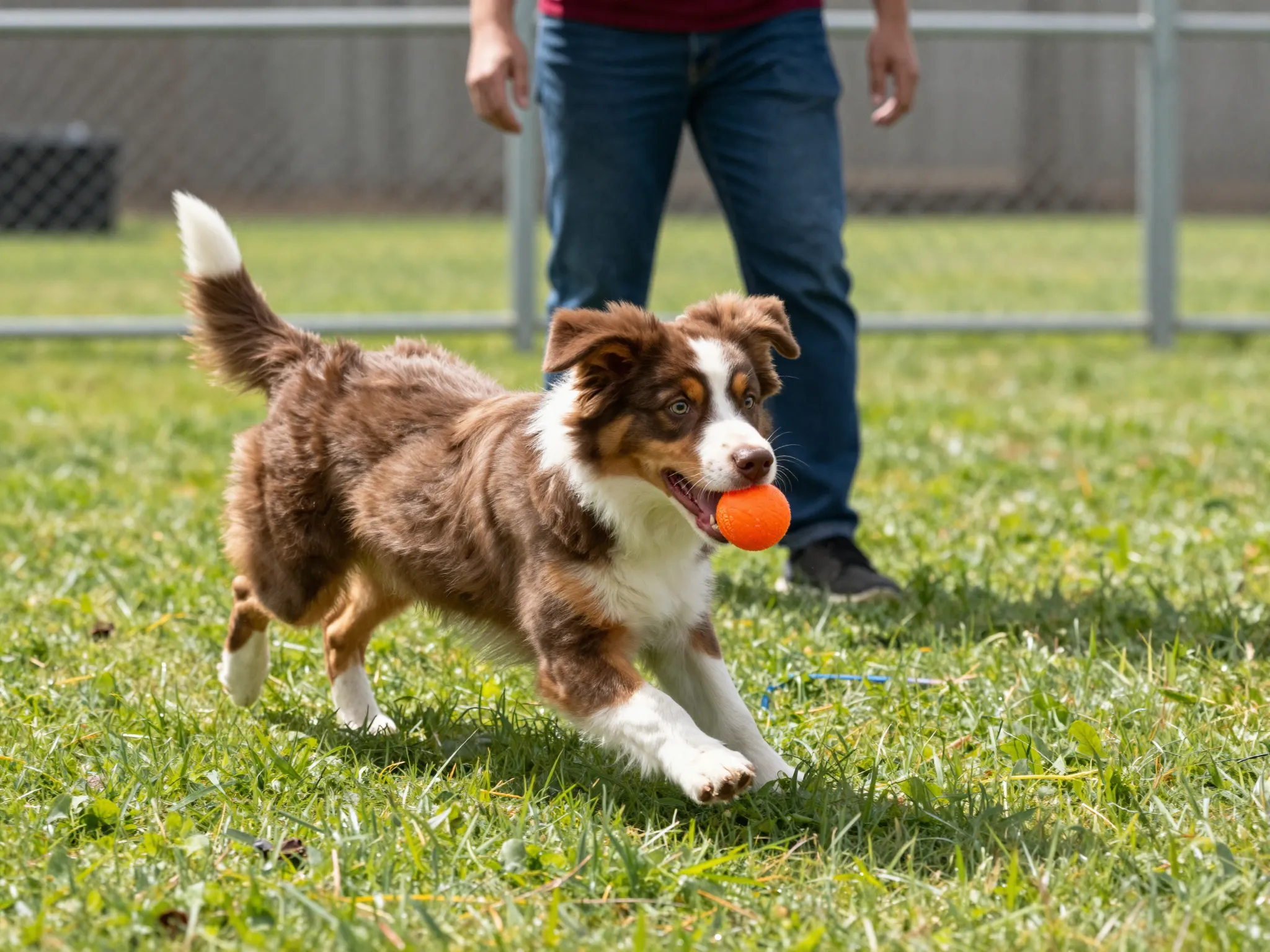
Once your puppy has received their first rabies vaccination (typically around 12–16 weeks), they’re ready for formal group obedience classes. Most programs run for 8 weeks and cover foundational commands like sit, stay, come, leave it, and loose-leash walking [1].
Why group classes specifically?
- They provide structured socialization with other dogs and people.
- A professional trainer can catch habits before they become problems.
- They teach you how to communicate clearly with your dog.
- They deepen the bond between you and your Aussie.
Australian Shepherds are among the most trainable dog breeds in the world — they consistently rank in the top 10 for working intelligence. But that intelligence cuts both ways: a bored, under-stimulated Aussie will find their own entertainment, and you probably won’t like what they choose.
What to look for in a class:
- Positive reinforcement methods (reward-based, not punishment-based).
- Small class sizes (8–10 dogs maximum).
- A certified trainer (CPDT-KA or equivalent credential).
- Puppy-specific curriculum for your dog’s age group.
Between classes, practice every command for 5–10 minutes, twice daily. Short, frequent sessions beat long, infrequent ones every time with this breed [1].
7. Provide Daily Exercise — and Make It Count
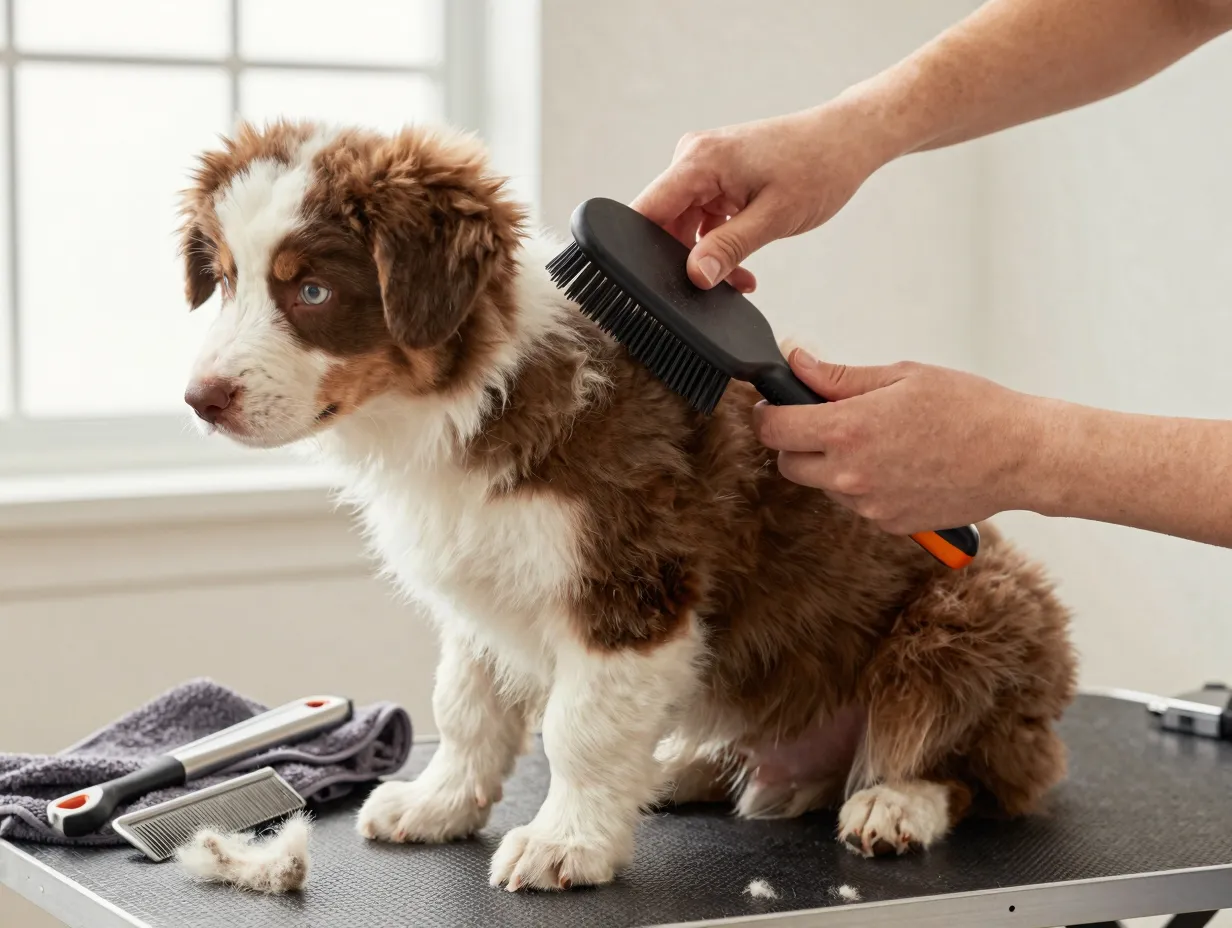
Here’s a truth that catches many first-time Aussie owners off guard: this breed needs more exercise than most people expect. Australian Shepherds were bred to work 8–10 hours a day herding livestock. Your suburban backyard, no matter how large, is not a substitute for real physical and mental stimulation [2].
For a puppy, the rule of thumb is 5 minutes of exercise per month of age, twice a day. So a 3-month-old puppy needs about 15 minutes of dedicated exercise, twice daily. This protects developing joints while still burning energy.
Exercise ideas that work for Aussie puppies:
- Short leash walks in new environments (mental stimulation + physical).
- Controlled fetch sessions in a fenced area.
- Hide-and-seek games that engage their nose and brain.
- Puppy play dates with appropriate, vaccinated dogs.
- Short sprints in the yard followed by calm cool-down time [2].
Signs your puppy isn’t getting enough exercise:
- Excessive chewing or digging.
- Nipping at people more than usual.
- Inability to settle or relax.
- Barking or whining without clear cause.
As your puppy grows into adolescence (6–18 months), you can gradually increase duration and intensity. Adult Aussies typically need 1–2 hours of vigorous exercise daily — so plan for that commitment before you bring one home [2].
8. Keep Up with Grooming and Manage the Teething Stage

Australian Shepherds have a beautiful double coat — and it requires real maintenance. Skipping grooming doesn’t just lead to mats; it leads to skin problems, discomfort, and a dog who hates being touched [2] [3].
Grooming basics for your Aussie puppy:
| Grooming Task | Frequency |
|---|---|
| Brushing | 3–4 times per week (daily during shedding season) |
| Bathing | Every 4–6 weeks or as needed |
| Nail trimming | Every 2–3 weeks |
| Ear checks | Weekly |
| Teeth brushing | 2–3 times per week |
Start grooming sessions early — even before your puppy needs it — so they learn to tolerate and eventually enjoy being handled. Keep sessions short and positive, with plenty of treats [2].
The teething stage (typically 3–6 months) is a separate challenge. Your puppy’s gums hurt, and they will chew on anything within reach. Here’s how to manage it:
- Provide a variety of designated chew toys with different textures.
- Offer frozen treats — ice cubes, frozen carrots, or puppy-safe frozen Kongs — to soothe sore gums [3].
- Redirect immediately when they chew something inappropriate (say “no” calmly, then offer an appropriate toy).
- Keep valuable items out of reach — assume anything at puppy height is a target.
🐾 Pro tip: Rotate chew toys every few days to keep them interesting. Aussies are smart enough to get bored with the same toy quickly.
Grooming your puppy regularly also gives you the opportunity to check for lumps, skin irritation, ear infections, and other health issues early — when they’re easiest to address [2].
Quick Reference: 8 First-Time Owner Tips for Your Australian Sheep Dog Puppy
| # | Tip | Why It Matters |
|---|---|---|
| 1 | Commit serious time early | Builds trust and accelerates adjustment |
| 2 | Use a leash everywhere at first | Establishes leadership and connection |
| 3 | Crate train from day one | Simplifies housebreaking and provides security |
| 4 | Praise potty success, ignore accidents | Builds confidence without fear |
| 5 | Socialize early and calmly | Prevents herding, nipping, and anxiety |
| 6 | Enroll in obedience classes at 4 months | Channels intelligence into good behavior |
| 7 | Provide daily, structured exercise | Prevents destructive behaviors |
| 8 | Groom regularly and manage teething | Maintains health and builds handling tolerance |
Common Mistakes First-Time Aussie Owners Make
Even with the best intentions, new owners fall into predictable traps. Here are the most common ones — and how to avoid them:
❌ Giving too much freedom too soon. Aussie puppies are curious and fast. A puppy who has full run of the house before they’re trained will find trouble. Use baby gates and crate time to limit access until they’ve earned more freedom.
❌ Skipping mental stimulation. Physical exercise alone isn’t enough for this breed. Puzzle feeders, training sessions, and scent games are just as important as walks.
❌ Inconsistent rules. If jumping on the couch is sometimes okay and sometimes not, your puppy will be confused. Every family member needs to enforce the same rules consistently.
❌ Punishing fear responses. If your Aussie is scared of something and you scold them for reacting, you make the fear worse. Instead, stay calm, give them space, and use treats to build positive associations.
❌ Waiting too long to train. “They’re just a puppy” is not a reason to delay training. Every day without structure is a day your puppy is learning their own rules [1].
Conclusion
Raising an Australian Shepherd puppy is one of the most rewarding experiences a dog owner can have — but it demands real commitment, consistency, and patience. These 8 First-Time Owner Tips for Your Australian Sheep Dog Puppy aren’t just suggestions; they’re the building blocks of a dog who is safe, happy, and genuinely enjoyable to live with.
Here are your actionable next steps for 2026:
- Before your puppy comes home: Buy a crate, stock up on enzymatic cleaner, and set up a puppy-safe zone.
- Week one: Start leash training, crate introduction, and potty training immediately.
- Weeks two through four: Begin short daily training sessions and socialization outings.
- Month four: Register for a group obedience class.
- Ongoing: Maintain a consistent grooming schedule and increase exercise as your puppy grows.
The Aussie you raise in these early months will be the dog you live with for the next 12–15 years. Every hour you invest now pays dividends for the rest of your dog’s life. Start strong, stay consistent, and enjoy the ride — because there’s nothing quite like an Australian Shepherd who knows they’re loved and well-led. 🐾
References
[1] Bringing Home An Australian Shepherd Puppy What You Need To Know To Get Ready – https://karenshanley.com/bringing-home-an-australian-shepherd-puppy-what-you-need-to-know-to-get-ready/
[2] New Puppy Care – https://www.australian-shepherd-lovers.com/new-puppy-care.html
[3] Watch – https://www.youtube.com/watch?v=8pY3j7iudhM