
8 Training Secrets For Your Black Labrador Retriever Dog: Expert Methods for Success
Black Labrador Retrievers are among the most beloved family dogs worldwide, but their intelligence and energy can quickly turn into behavioral challenges without proper training. Whether you’re dealing with a rambunctious puppy who seems to have endless energy or an adult dog with ingrained habits, the 8 Training Secrets For Your Black Labrador Retriever Dog revealed in this guide will transform your training approach and deliver remarkable results.

These time-tested methods have helped thousands of dog owners build stronger relationships with their Labs while creating well-behaved, confident companions. From foundational techniques that work in the first few months to advanced strategies for lifelong success, these secrets address the unique characteristics that make Black Labs both wonderful and challenging to train.
Key Takeaways
- The first four months are critical for establishing routines and boundaries that shape your Black Lab‘s behavior for life
- Consistency in training methods and tools is essential for helping your dog learn and generalize behaviors reliably
- Positive reinforcement techniques build trust and engagement more effectively than correction-based approaches
- Daily structure through leash training provides constant, low-key training opportunities during regular activities
- Impulse control development is crucial for managing your Lab’s natural enthusiasm and distractibility
Foundation Training Secrets That Build Success
The foundation of successful Black Labrador training lies in understanding their unique temperament and energy levels. These intelligent, food-motivated dogs thrive on structure and positive interaction, making the first several months crucial for long-term success.
1. Establish Routine and Structure as Your Foundation
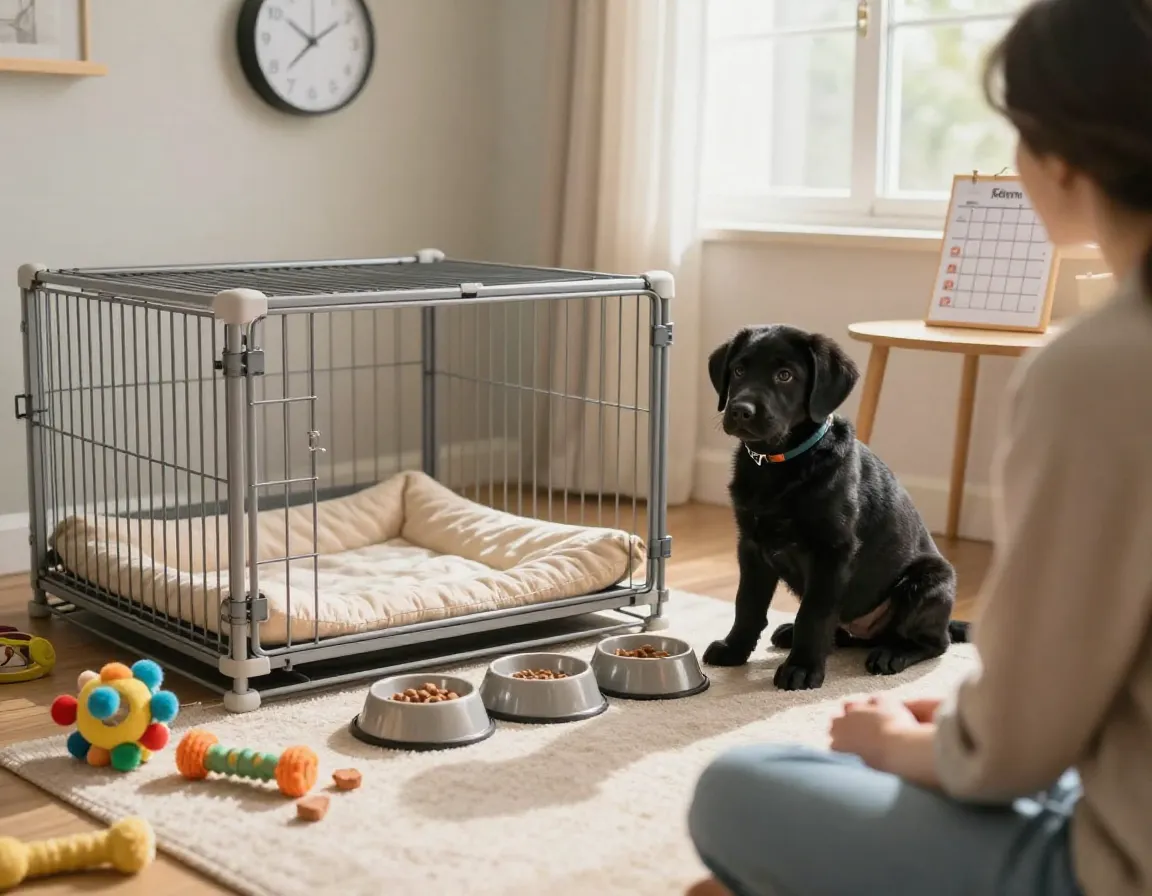
The first four months are absolutely critical for shaping your Black Lab’s behavior and helping them feel safe while understanding boundaries [1]. During this period, your puppy’s brain is developing rapidly, making it the perfect time to establish patterns that will last a lifetime.
Create a daily schedule that includes:
- Consistent meal times (typically 3 times daily for puppies)
- Regular potty breaks every 2-3 hours
- Structured play sessions with clear start and stop times
- Training periods of 5-10 minutes multiple times daily
- Designated rest times in a crate or quiet area
This routine helps your Black Lab understand what’s expected and when, reducing anxiety and behavioral issues. Labs are naturally eager to please, and structure gives them a framework for success.
“Consistency in routine is like giving your Lab a roadmap to good behavior. They know what comes next and can prepare mentally for each activity.”
2. Master the Hour-a-Day Leash Trick

One of the most effective 8 Training Secrets For Your Black Labrador Retriever Dog involves using the “hour-a-day leash trick” by attaching the leash to your waist so the puppy stays close during daily activities [1]. This technique provides consistent, low-key training opportunities without requiring dedicated training sessions.
How to implement this technique:
🔗 Attach a 6-foot leash to your belt or waistband
🏠 Go about normal household activities while your Lab follows
👀 Monitor and correct gently when they pull or get distracted
🎯 Reward good behavior with praise or small treats
⏰ Practice for one hour daily during different activities
This method teaches your Black Lab to:
- Stay close and attentive to you
- Follow your movements naturally
- Respond to gentle leash pressure
- Remain calm during household activities
The beauty of this approach is that it integrates training into your daily routine, making it sustainable long-term.
3. Prioritize Basic Obedience Commands

Basic obedience commands are the easiest to learn and most crucial in your Black Lab’s training journey [2]. These six fundamental commands create the foundation for all future training:
| Command | Purpose | Training Tip |
|---|---|---|
| Sit | Foundation for all other commands | Use treats held above their head |
| Come | Safety and recall | Practice in enclosed areas first |
| Down | Impulse control and relaxation | Lure with treats to ground level |
| Heel | Leash walking and attention | Start with short distances |
| Kennel | Crate training and boundaries | Make crate comfortable and rewarding |
| No | Boundary setting and safety | Use firm but calm voice |
Start with “sit” as it’s the easiest command for Labs to master. Once your dog consistently sits on command, you can use this as a foundation for teaching other behaviors. Practice each command for 5-10 minutes at a time, multiple times throughout the day.
4. Apply Positive Reinforcement Training Methods
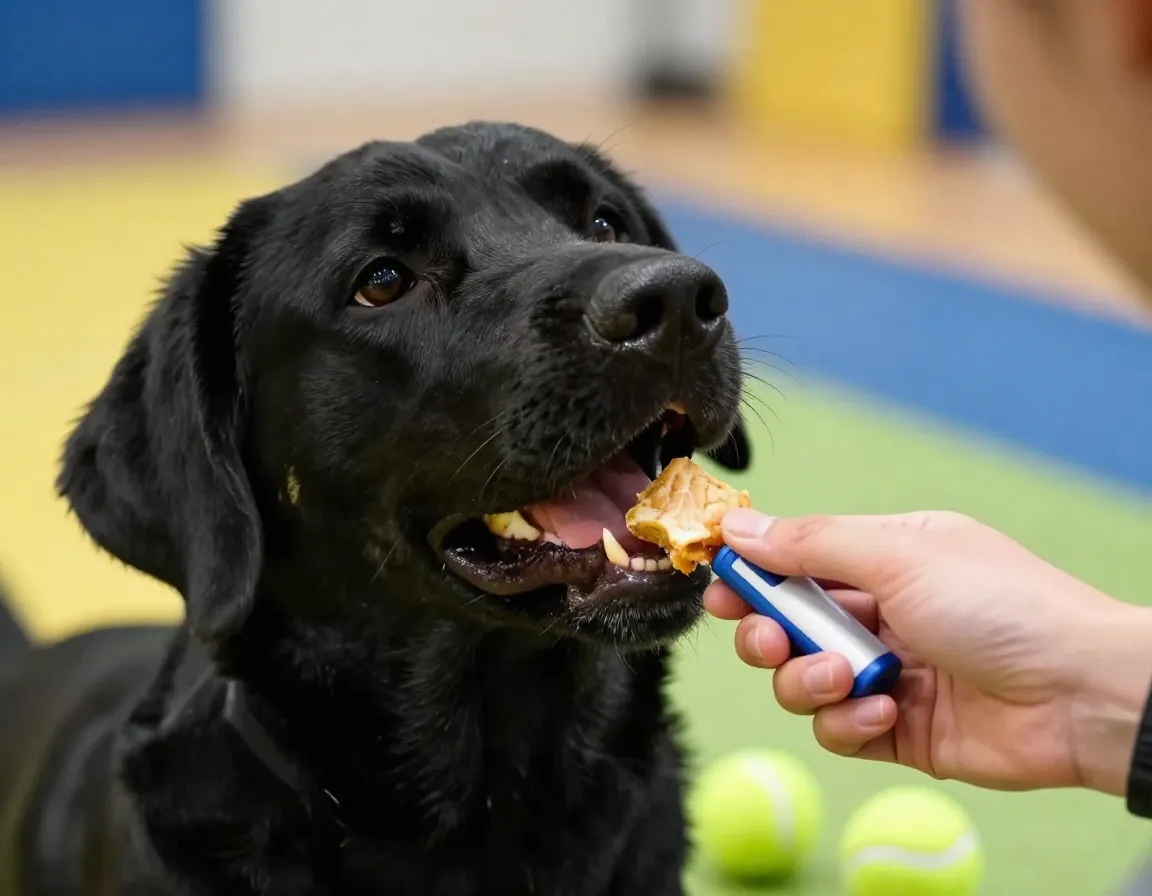
Positive reinforcement training using rewards like treats, praise, or play builds trust and keeps dogs engaged much more effectively than correction-based methods [5][6]. Black Labs are particularly responsive to this approach due to their food motivation and desire to please.
Effective positive reinforcement strategies:
🍖 High-value treats (small pieces of chicken, cheese, or commercial training treats)
🎉 Enthusiastic praise with varied tone and energy
🎾 Play rewards using favorite toys or games
⚡ Immediate timing – reward within 2-3 seconds of desired behavior
🎯 Clear markers – use “yes!” or clicker to mark exact moment
Avoid these common mistakes:
- ❌ Delayed rewards that confuse the connection
- ❌ Using the same reward every time (dogs get bored)
- ❌ Rewarding when the dog is overly excited
- ❌ Inconsistent timing or unclear expectations
Remember that Black Labs are highly food motivated, making treat-based training particularly effective. However, gradually reduce treat frequency as behaviors become reliable, replacing them with praise and life rewards.
Advanced Training Secrets for Long-term Success
Once your Black Lab has mastered the foundation skills, these advanced techniques will help you address more complex behavioral challenges and create a truly well-trained companion.
5. Develop Self-Control Through Impulse Control Games

Developing self-control through impulse control games teaches your Black Lab to resist natural impulses and listen even when distracted [4][6]. This is particularly important for Labs, who can become overly enthusiastic about food, people, and other dogs.
Effective impulse control exercises:
🍖 “Wait” for meals:
- Hold food bowl while dog sits
- Wait for calm, patient behavior
- Release with “okay” command
- Gradually increase wait time
🎾 “Leave it” training:
- Place treat in closed fist
- Wait for dog to stop pawing/sniffing
- Reward when they back away
- Practice with increasingly tempting items
🚪 Door manners:
- Require sit before opening doors
- Dog must wait for permission to go through
- Practice with front door, car doors, and gates
🎯 “Stay” with distractions:
- Start with short stays in quiet environment
- Gradually add movement, sounds, and other distractions
- Always return to release your dog rather than calling them to break the stay
These exercises build mental discipline that transfers to all areas of your Lab’s life, making them calmer and more responsive in exciting situations.
6. Maintain Consistency in Training Methods

Consistency in training methods is essential – using the same tools and approach helps your dog learn and generalize behaviors reliably [3]. This is one of the most overlooked aspects of the 8 Training Secrets For Your Black Labrador Retriever Dog.
Areas where consistency matters most:
📋 Commands and cues:
- Use identical words for each command
- Maintain same hand signals
- Keep tone and energy consistent
- Ensure all family members use same cues
🎯 Training tools:
- Stick with same type of treats during learning phase
- Use consistent leash and collar setup
- Maintain same training location initially
⏰ Training schedule:
- Practice at similar times daily
- Keep session lengths consistent
- Maintain same energy and expectations
👥 Family involvement:
- Train all family members on proper techniques
- Create written guidelines for consistency
- Regular family meetings to discuss progress
Inconsistency confuses dogs and slows learning significantly. When everyone in the household follows the same approach, your Black Lab learns faster and retains training better.
7. Use Redirection for Undesirable Behaviors

Redirection techniques for undesirable behaviors like chewing work better than correction alone by teaching your Lab what TO do rather than just what NOT to do [1]. This positive approach prevents frustration and builds better habits.
Common behavior problems and redirection solutions:
🦴 Inappropriate chewing:
- Provide appropriate chew toys immediately
- Rotate toys to maintain interest
- Use puzzle toys for mental stimulation
- Praise enthusiastically when they choose correct items
🏃 Excessive jumping:
- Turn away and ignore jumping behavior
- Ask for “sit” before giving attention
- Reward calm greetings consistently
- Train alternative greeting behaviors
🔊 Attention-seeking barking:
- Ignore attention-seeking vocalizations
- Redirect to “quiet” command with rewards
- Provide mental stimulation to reduce boredom
- Exercise adequately to reduce excess energy
🍽️ Counter surfing:
- Keep counters completely clear during training
- Provide appropriate food puzzles and enrichment
- Practice “place” command for boundaries
- Reward for staying in designated areas
The key is immediately redirecting to appropriate behavior while making the correct choice more rewarding than the problem behavior.
8. Introduce Socialization in Small Amounts

Introducing socialization in small amounts prevents overwhelming your puppy while building comfort with other dogs and environments [3]. Proper socialization is crucial for Black Labs, who can become overly excited or anxious without adequate exposure.
Structured socialization plan:
🐕 Dog interactions:
- Start with calm, well-trained adult dogs
- Keep initial meetings brief (5-10 minutes)
- Choose neutral territory for meetings
- Always supervise and be ready to redirect
🏙️ Environmental exposure:
- Visit different locations weekly
- Start with quiet environments, gradually increase stimulation
- Practice basic commands in new locations
- Bring high-value treats for positive associations
👥 People socialization:
- Introduce different ages, sizes, and appearances
- Ask people to ignore excited behavior
- Reward calm, polite greetings
- Practice in controlled environments first
🔊 Sound desensitization:
- Play recordings of various sounds at low volume
- Gradually increase volume as dog remains calm
- Pair sounds with positive experiences
- Include urban sounds, other animals, and household noises
Gradual exposure prevents fear-based reactions while building confidence. The goal is creating positive associations rather than just exposure.
Troubleshooting Common Training Challenges
Even with these 8 Training Secrets For Your Black Labrador Retriever Dog, you may encounter specific challenges. Here are solutions for the most common issues:
🎯 Lack of focus during training:
- Reduce session length to 3-5 minutes
- Increase treat value and variety
- Train before meals when hunger increases motivation
- Remove distractions from training environment
⚡ Overexcitement during training:
- Wait for calm behavior before starting
- Use lower-energy rewards initially
- Practice relaxation exercises before training
- Keep sessions shorter until self-control improves
📈 Plateau in progress:
- Vary training locations and contexts
- Increase criteria gradually
- Add new challenges to maintain engagement
- Ensure adequate physical exercise before training
👥 Inconsistent family participation:
- Schedule regular family training sessions
- Create simple written guidelines
- Assign specific responsibilities to each member
- Celebrate successes together
Conclusion
The 8 Training Secrets For Your Black Labrador Retriever Dog outlined in this guide provide a comprehensive framework for developing a well-trained, confident companion. From establishing foundational routines in the critical first four months to implementing advanced impulse control techniques, these methods address the unique characteristics that make Black Labs both wonderful and challenging to train.
Key success factors include maintaining consistency across all family members, using positive reinforcement to build trust and engagement, and providing adequate structure through daily routines and the hour-a-day leash technique. Remember that patience and persistence are essential – Black Labs are intelligent and eager to please, but they also have high energy levels that require proper channeling.
Your next steps:
- Start immediately with routine establishment and basic commands
- Implement the leash technique for one hour daily
- Practice impulse control exercises during meals and greetings
- Involve all family members in consistent training approaches
- Track progress and adjust techniques as needed
With dedication to these proven methods, your Black Labrador Retriever will develop into the well-behaved, confident companion you’ve always wanted. The investment in proper training during the early months pays dividends for years to come, creating a stronger bond and more enjoyable relationship with your four-legged family member.
References
[1] Wild Labradors Puppy Training Secret Guide – https://wildlabradors.net/wild-labradors-puppy-training-secret-guide/
[2] The Basics Of Labrador Retriever Training – https://blackbeltretrievers.com/the-basics-of-labrador-retriever-training/
[3] How To Train A Lab Puppy – https://www.masterclass.com/articles/how-to-train-a-lab-puppy
[4] Labrador Training – https://www.bestmatedogtraining.co.nz/labrador-training
[5] How To Train Your Dog In 2026 A Practical Step By Step Guide – https://www.petmate.com/blogs/petmate-academy/how-to-train-your-dog-in-2026-a-practical-step-by-step-guide
[6] Training A Labrador – https://www.burgesspetcare.com/blog/dogs/training-a-labrador/