8 Proven Ways to Train Your German Shepherd Guard Dog for Maximum Protection
German Shepherds account for nearly 35% of all police and military working dogs in the United States — and that statistic alone tells you everything about this breed’s raw potential as a protection animal. But raw potential without structured training is like a sports car with no steering wheel. If you own a German Shepherd and want to unlock their full protective capability, you need a clear, proven roadmap.
This guide covers the 8 Proven Ways to Train Your German Shepherd Guard Dog for Maximum Protection — a step-by-step framework that blends obedience, socialization, mental conditioning, and specialized protection work. Whether you’re starting with a puppy or refining an adult dog’s skills, these methods are grounded in professional K9 training principles used by handlers worldwide. Let’s get into it.
Key Takeaways 📋
- Obedience always comes first — no German Shepherd should begin protection training without mastering basic and advanced commands.
- Positive reinforcement outperforms punishment in building a confident, reliable guard dog.
- Socialization is not optional — it’s what separates a well-calibrated protector from an unpredictable liability.
- Mental stimulation is just as critical as physical exercise for a focused, effective protection dog.
- A structured daily schedule alternating obedience, rest, socialization, and protection work produces the most consistent results.
The Foundation: Why Structure Matters Before Anything Else
Before we dive into each method, let’s be direct: protection training without obedience is dangerous. A dog that bites on command but won’t stop on command is a legal and safety liability. The 8 Proven Ways to Train Your German Shepherd Guard Dog for Maximum Protection are deliberately sequenced — each builds on the last. Skip steps, and you undermine everything.
💡 Pull Quote: “A protection dog is only as reliable as its obedience. The bite is the last 5% of the job — the other 95% is control.” — Professional K9 Trainer Principle
With that foundation set, here are the eight methods, numbered in the exact order you should approach them.
1. Master Basic Obedience Commands First
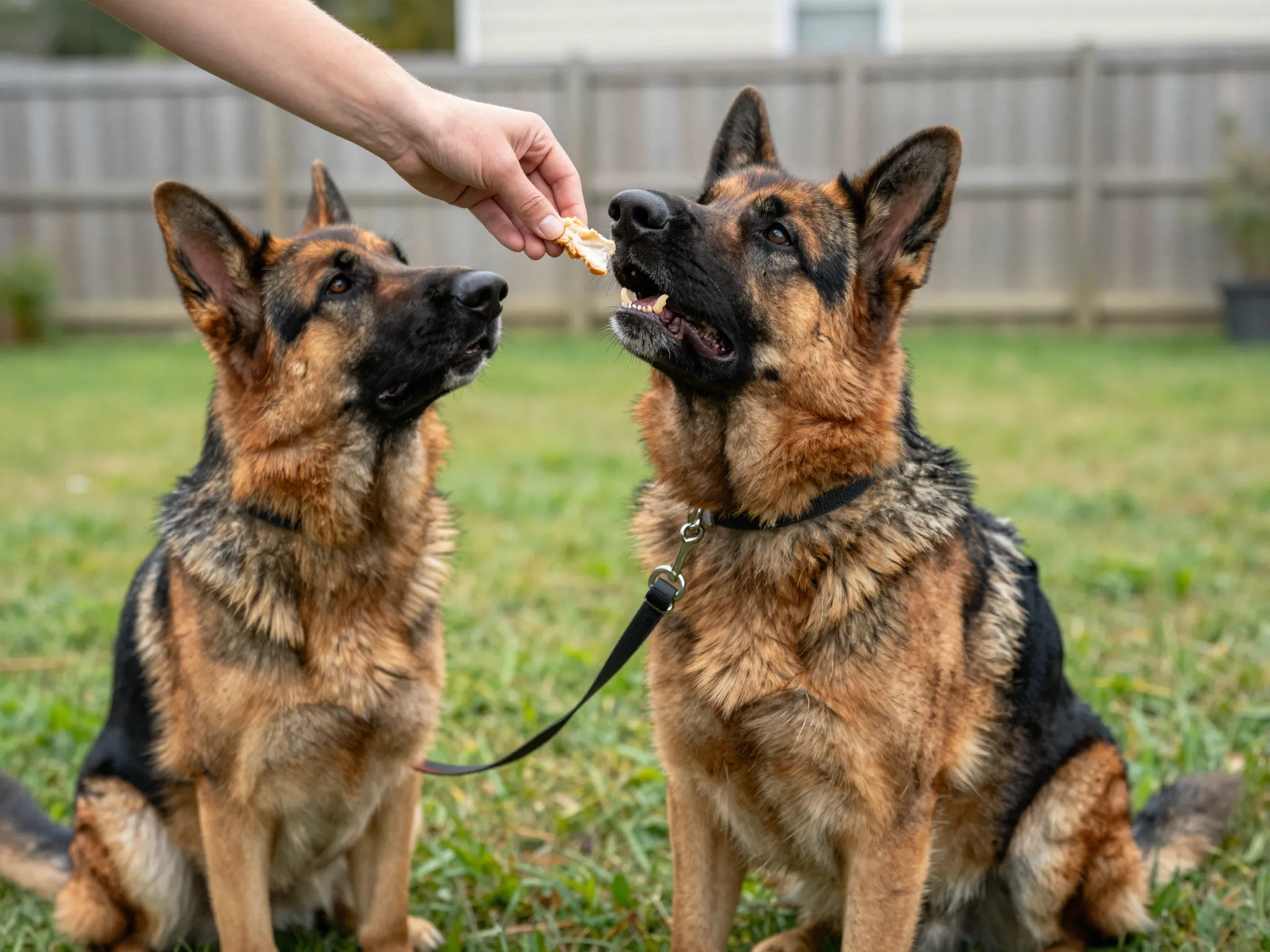
This is non-negotiable. Before your German Shepherd learns a single protection behavior, they must have a rock-solid grasp of four core commands: Sit, Stay, Come, and Heel [2][3].
These commands are not just tricks — they are the control mechanisms that make every other training phase safe and effective. Here’s why each matters in a protection context:
| Command | Protection Application |
|---|---|
| Sit | Stops the dog instantly during a patrol |
| Stay | Holds position while you assess a threat |
| Come | Recalls the dog away from a target |
| Heel | Keeps the dog controlled in public spaces |
How to build this foundation:
- Train in short, focused sessions of 10–15 minutes
- Use high-value treats (chicken, cheese, or commercial training treats)
- Practice in multiple environments — your yard, a park, a parking lot
- Achieve 95%+ reliability before moving to the next training phase [3]
Don’t rush this stage. A German Shepherd that responds to “Come” reliably in a high-distraction environment is worth far more than one that knows ten commands but obeys them only when it feels like it.
2. Use Positive Reinforcement as Your Core Training Philosophy
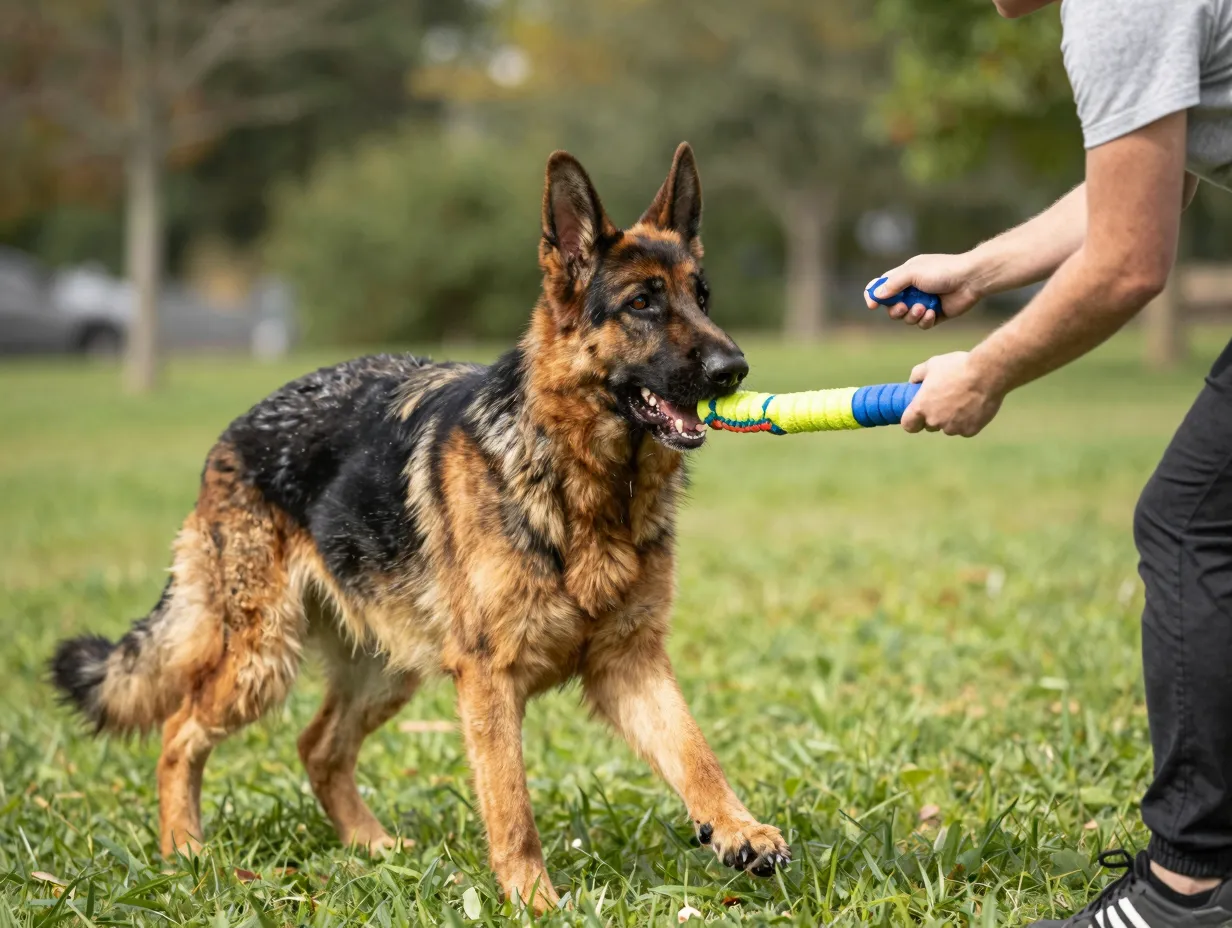
Here’s a truth that some old-school trainers resist: positive reinforcement is not “soft” training — it is the most effective training method available for building a confident, mentally stable protection dog [4].
Punishment-based methods — shock collars used punitively, physical corrections, intimidation — create dogs that obey out of fear. Fear-based compliance is fragile. Under stress (exactly when you need your dog most), a fear-trained dog is more likely to shut down, redirect aggression unpredictably, or become handler-aggressive [4].
What positive reinforcement looks like in practice:
- Mark the desired behavior immediately (use a clicker or a verbal marker like “Yes!”)
- Reward within 1–2 seconds of the marker
- Vary rewards between treats, praise, and play to maintain motivation
- Never punish a dog for not understanding — go back to a simpler step
🐾 Pro Tip: German Shepherds are highly food-motivated AND toy-motivated. Rotate between food rewards and tug-toy play to keep sessions engaging and prevent reward fatigue.
Over 60% of handlers report success using interactive training games to reinforce desired behaviors — turning learning into play dramatically improves retention and enthusiasm [1].
3. Build Advanced Obedience: Off-Leash Control and Distance Commands
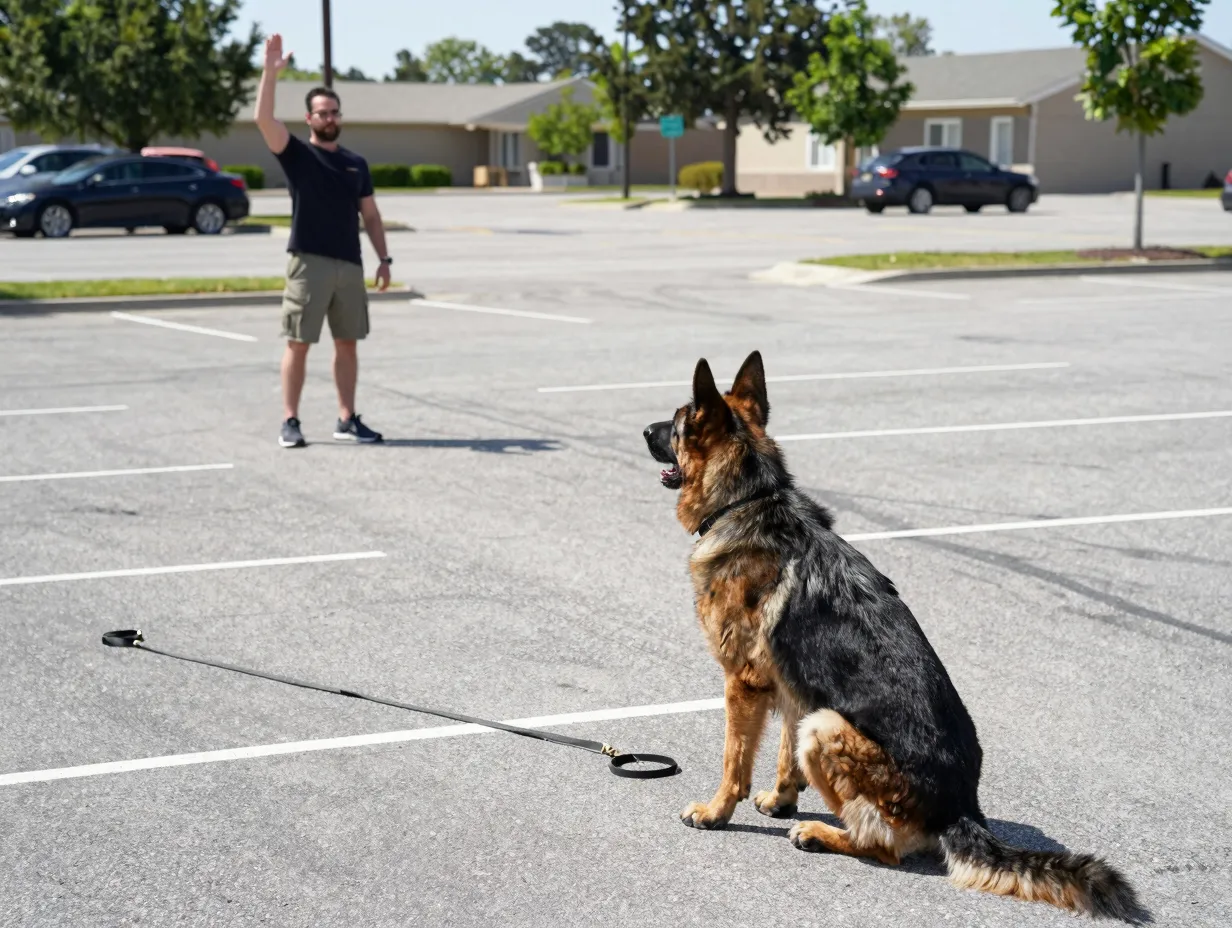
Once basic commands are reliable, you need to level them up significantly before protection work begins. Advanced obedience means your German Shepherd responds correctly:
- Off-leash, without a physical connection to you
- At distance, when you’re 20, 30, or 50 feet away
- Under distraction, with other dogs, people, traffic, and noise present [3]
This phase is where many home trainers stall — and it’s critical not to skip it. A protection dog that only listens when you’re standing right next to them is not a protection dog. They’re a well-behaved pet.
Advanced obedience training progression:
- Phase 1: Practice commands on a long line (15–30 feet) before going fully off-leash
- Phase 2: Introduce distance — give commands from increasing distances
- Phase 3: Add distractions gradually — start with mild (a person walking by) and build to intense (other dogs barking, food on the ground)
- Phase 4: Combine all three — off-leash, distance, and distraction simultaneously
This level of control is what allows you to safely run protection scenarios without risk of losing control of your dog [3].
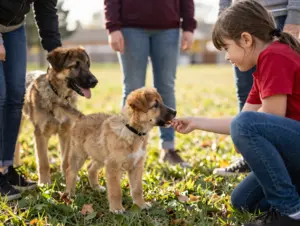
4. Prioritize Socialization to Calibrate Natural Guarding Instincts
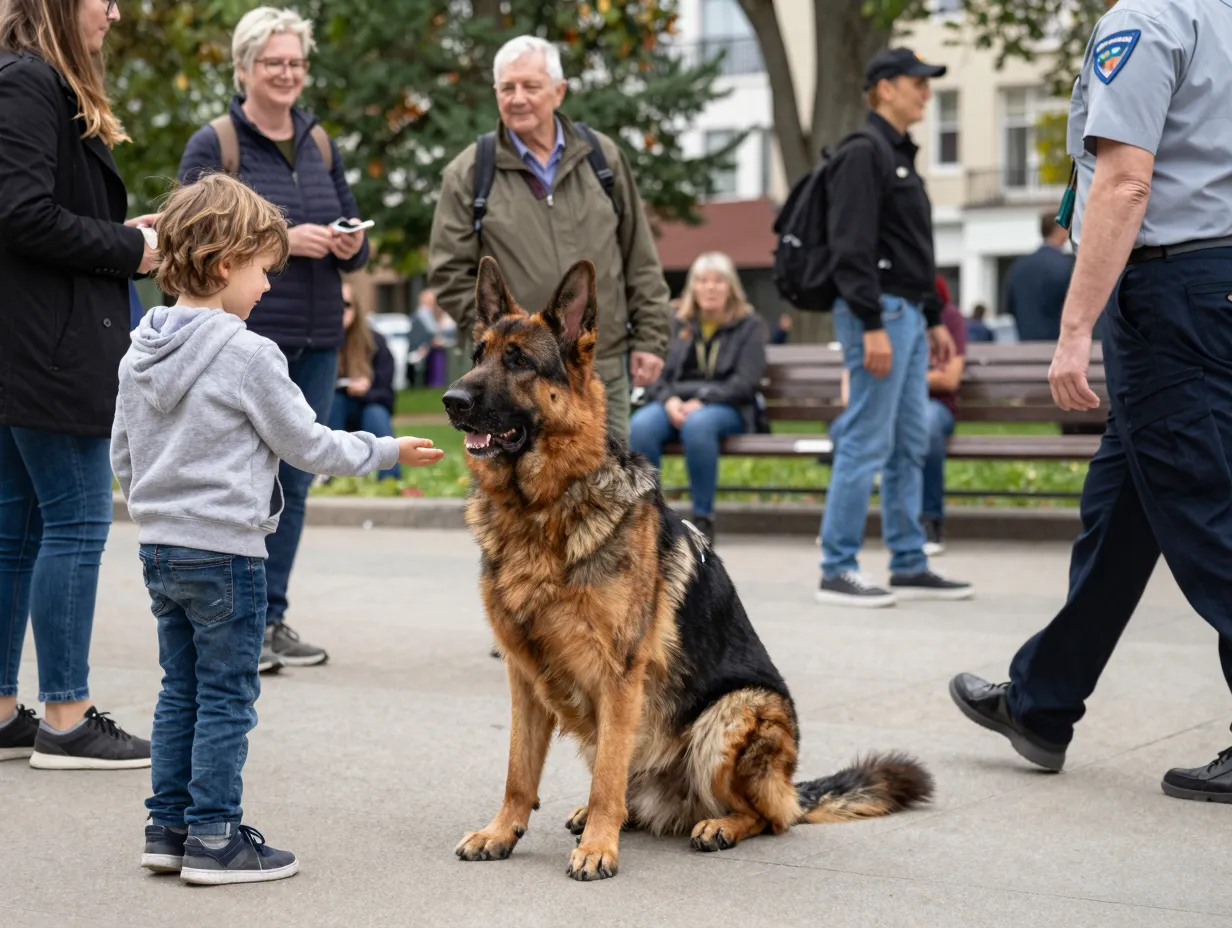
Socialization is the most misunderstood element of guard dog training. Many owners assume that socializing their dog will make them “too friendly” to be protective. The opposite is true.
A well-socialized German Shepherd has a calibrated threat response — they’ve been exposed to enough normal human behavior that they can accurately identify what isn’t normal [1]. An under-socialized dog sees everything as a threat, which leads to:
- ❌ False alerts and unnecessary aggression
- ❌ Unpredictable behavior in public
- ❌ Legal liability for the owner
- ❌ Stress and anxiety that degrades overall performance
Socialization checklist for a protection dog:
- Introduce your dog to at least 10 different people per week in varied settings
- Expose them to diverse environments: busy streets, shopping centers, parks, crowds
- Include children, elderly people, people in uniforms, and people carrying objects
- Pair every new exposure with calm, positive reinforcement
Socialization doesn’t stop at puppyhood. Continue structured social exposure throughout your dog’s working life [1].
5. Develop Mental Strength and Confidence Through Progressive Challenges
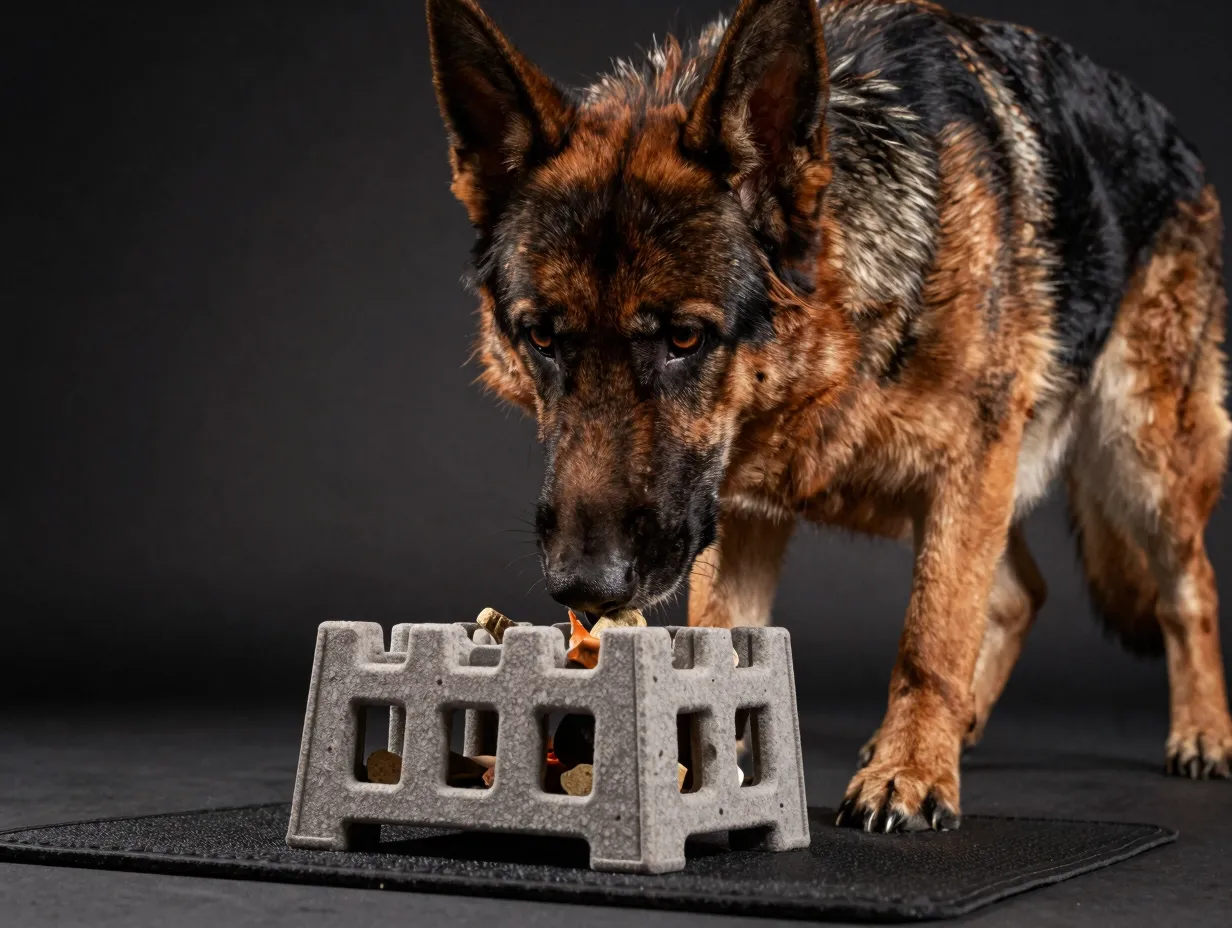
A physically powerful German Shepherd with a weak mental game is not a reliable protection dog. Mental strength — the ability to stay focused, calm, and responsive under pressure — is built deliberately through progressive training challenges [2].
💡 Pull Quote: “The dog that holds its nerve in a chaotic environment is worth ten dogs that only perform in a quiet training yard.”
Mental conditioning strategies:
- Controlled stress exposure: Introduce mildly stressful stimuli (loud noises, sudden movements) and reward calm, focused responses
- Novel environment training: Train in at least 3–4 new locations per week to build adaptability
- Problem-solving games: Hide-and-seek with toys, scent tracking, and puzzle feeders build cognitive resilience
- Duration challenges: Gradually increase the time your dog must maintain a command (Stay for 30 seconds → 1 minute → 5 minutes)
Mental stimulation training is as important as physical exercise — dogs trained for mental focus perform significantly better in disruptive real-world environments, showing reduced anxiety around street noise, crowds, and unexpected events [4].
| Mental Training Type | Benefit for Protection Work |
|---|---|
| Scent tracking | Builds focus and drive |
| Puzzle feeders | Reduces frustration responses |
| Novel environments | Increases adaptability |
| Duration commands | Builds impulse control |
6. Introduce Threat Differentiation Training
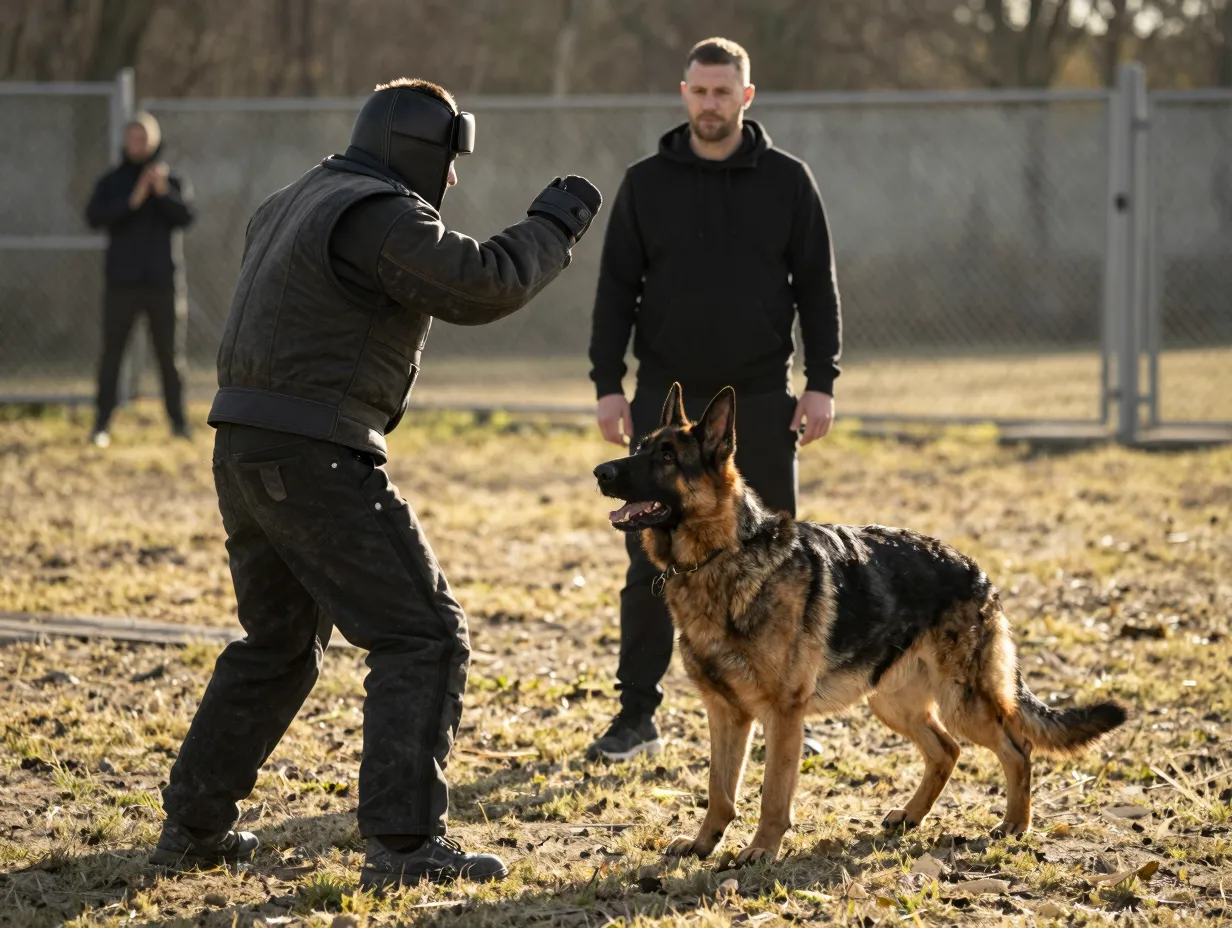
This is where protection training begins to get specialized. Threat differentiation is the ability to distinguish between a friendly, non-threatening approach and a genuinely threatening one — and respond appropriately to each [1].
Without this skill, a guard dog is either too passive (ignores real threats) or too reactive (treats everyone as a threat). Neither is acceptable.
How threat differentiation training works:
- Stage 1 — Friendly approach: A helper approaches calmly, makes no eye contact, moves slowly. The dog should remain neutral or friendly.
- Stage 2 — Ambiguous approach: A helper approaches with slightly unusual body language. The dog should alert (watch, stiffen) but not react aggressively.
- Stage 3 — Threatening approach: A helper approaches aggressively — direct eye contact, fast movement, raised arm. The dog should alert strongly and, on command, respond protectively.
Key rules for this phase:
- Always use a trained decoy/helper — never untrained volunteers
- Keep sessions short (5–10 minutes) to prevent over-arousal
- The dog must be calm and under control before and after each scenario [1]
- Reward appropriate responses, not just aggressive ones
It’s worth noting that personal protection dog (PPD) training is fundamentally different from attack dog or guard dog training — a PPD responds to specific cues from their handler, not to their own judgment alone [5].
7. Implement Interactive Training Games to Reinforce All Skills
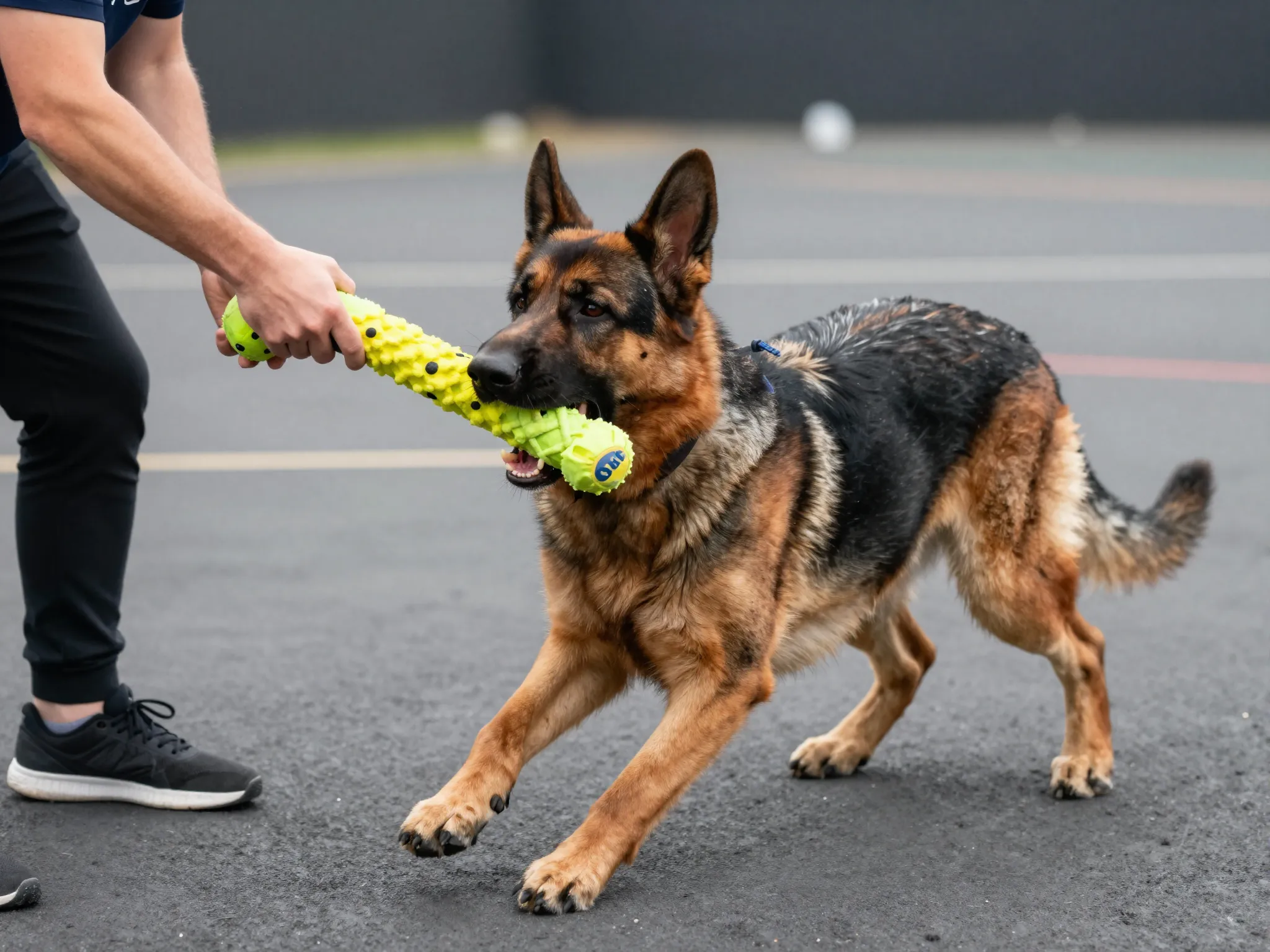
Training doesn’t have to be — and shouldn’t always be — formal and rigid. Interactive training games are one of the most powerful tools in a handler’s arsenal, and the data backs this up: over 60% of handlers report measurable success using game-based reinforcement methods [1].
Games accomplish several things simultaneously:
- ✅ Reinforce commands in a low-pressure context
- ✅ Build the dog’s enthusiasm for training sessions
- ✅ Strengthen the handler-dog bond
- ✅ Develop problem-solving ability and mental agility
Top training games for German Shepherd guard dogs:
- Tug with rules: Tug is a natural drive-builder, but the dog must “Out” (release) on command every time — this builds both drive and control simultaneously
- Find it: Hide a toy or treat and send the dog to find it — builds scent work and independent problem-solving
- Red light, green light: The dog moves with you, then freezes on a signal — builds impulse control and attention
- Recall races: Run away from your dog and call them — makes “Come” the most exciting command they know
- Controlled chase: You move, the dog tracks — builds prey drive in a structured way
Rotate these games throughout the week to keep your dog mentally engaged and eager for every session.
8. Follow a Balanced, Structured Daily Training Schedule
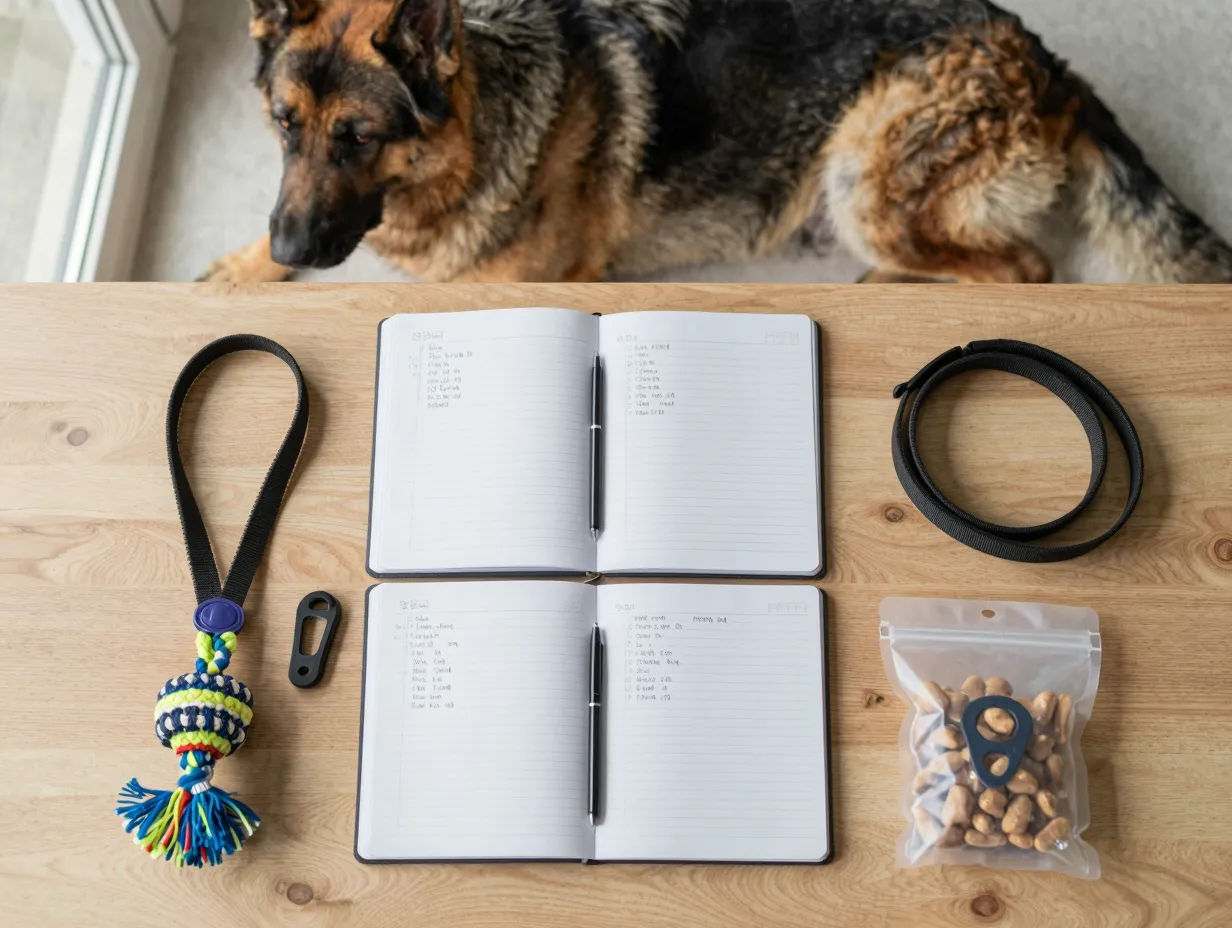
The final piece of the puzzle — and arguably the one that ties all 8 Proven Ways to Train Your German Shepherd Guard Dog for Maximum Protection together — is consistency through a structured daily schedule [1].
Ad hoc training produces ad hoc results. German Shepherds thrive on routine, and a predictable training structure helps them understand what’s expected and when.
Sample balanced daily training schedule:
| Time of Day | Activity | Duration |
|---|---|---|
| Morning (7–8 AM) | Basic and advanced obedience drills | 20–30 min |
| Mid-morning | Physical exercise (running, fetch, hiking) | 30–45 min |
| Afternoon (1–3 PM) | Rest and passive socialization | Unstructured |
| Late afternoon | Mental stimulation games | 15–20 min |
| Evening (6–7 PM) | Protection work and threat differentiation | 15–20 min |
Key scheduling principles:
- Never train protection work when the dog is tired — fatigue leads to sloppy responses and over-arousal
- Always end sessions on a success — finish with a command the dog knows well and reward enthusiastically
- Rest days matter — schedule at least one full rest day per week to prevent burnout and physical strain [3]
- Track progress — keep a simple training log noting what was practiced, the dog’s response level, and any issues
🗓️ Consistency tip: Train at the same times each day when possible. German Shepherds are creatures of habit — predictable schedules reduce anxiety and improve focus.
Bonus: Understanding the Difference Between Guard Dogs and Personal Protection Dogs
Before you commit to a full protection training program, it’s worth clarifying what kind of protection dog you actually need [5]:
| Type | Primary Function | Training Focus |
|---|---|---|
| Guard Dog | Property protection, deterrence | Territorial alerting, perimeter awareness |
| Personal Protection Dog (PPD) | Handler protection in public | Handler-directed responses, public behavior |
| Attack/Police Dog | Law enforcement apprehension | Bite work, criminal apprehension |
Most family protection dogs fall into the PPD category — they need to be safe in public, responsive to handler cues, and capable of protection when directed, not on their own initiative [5]. Understanding this distinction shapes every training decision you make.
Conclusion: Your Action Plan Starts Today
The 8 Proven Ways to Train Your German Shepherd Guard Dog for Maximum Protection aren’t a quick fix — they’re a progressive system that builds a reliable, confident, and controlled protection partner over weeks and months of consistent work.
Here’s your immediate action plan:
- This week: Audit your dog’s current obedience level. Can they Sit, Stay, Come, and Heel reliably in distracting environments? If not, start there.
- Week 2–4: Begin advanced obedience — off-leash work, distance commands, distraction proofing.
- Month 2: Layer in socialization and mental conditioning games simultaneously.
- Month 3+: With a professional trainer or certified decoy, begin structured threat differentiation and protection scenarios.
- Ongoing: Maintain a balanced daily schedule and track your progress weekly.
One final thought: If you’re serious about protection training beyond the basics, invest in a certified professional trainer who specializes in K9 protection work. The methods in this guide give you the framework — a qualified professional gives you the precision. Your German Shepherd has everything it takes to be an extraordinary protection dog. Your job is to build the system that lets them show it.
References
[1] German Shepherd Training Techniques Obedience Protection – https://www.offleashk9training.com/german-shepherd-training-techniques-obedience-protection/
[2] Watch – https://www.youtube.com/watch?v=ag3McOMPIuE
[3] Protection Dog Exercise Training Needs – https://scottsk9.com/protection-dog-exercise-training-needs/
[4] German Shepherd Training Tips – https://wustenbergerland.com/german-shepherd-training-tips/
[5] German Shepherd Protection Training Guide And How Ppd Motivation Is Different From Attack Guard And Police Dogs – https://exclusivedogtraining.com/german-shepherd-protection-training-guide-and-how-ppd-motivation-is-different-from-attack-guard-and-police-dogs/
[6] Watch – https://www.youtube.com/watch?v=jqyRQolUglw