9 Training Secrets for Your Labrador Retriever Black Puppy
Bringing home a black Labrador Retriever puppy is one of the most exciting moments a dog lover can experience — but within 48 hours, that adorable fur ball has chewed your favorite shoes, had three accidents on the carpet, and somehow learned how to open the pantry door. 🐾 Sound familiar? The good news is that black Labs are widely regarded as one of the most trainable breeds on the planet, and with the right approach, you can shape that boundless energy into a well-mannered, joyful companion. In this guide, I’m sharing the 9 Training Secrets for Your Labrador Retriever Black Puppy — proven strategies that combine expert guidance, behavioral science, and real-world practicality to help you and your pup thrive together in 2026.

Key Takeaways
- 🧠 Start early: The window between 8–16 weeks is the most critical period for shaping your black Lab puppy’s behavior and social skills.
- ✅ Consistency beats intensity: Short, frequent training sessions outperform long, sporadic ones every time.
- 🏠 Structure creates confidence: A predictable daily routine reduces anxiety and accelerates learning.
- 🎉 Positive reinforcement is non-negotiable: Reward-based training builds trust and produces lasting results.
- 🐕 Mental stimulation matters as much as physical exercise: A bored Lab is a destructive Lab — keep that brain engaged.
Why Black Labrador Retrievers Are Uniquely Trainable
Before diving into the 9 Training Secrets for Your Labrador Retriever Black Puppy, it helps to understand what makes this breed — and this color variant — so special. Black Labradors are the most common color in the breed and have historically been favored as working dogs, guide dogs, and search-and-rescue animals [2]. Their intelligence, eagerness to please, and food motivation make them highly responsive to structured training.
That said, Labs are also high-energy, mouthy as puppies, and prone to distraction. Without proper guidance, these traits can become challenging. The secrets below address all of these tendencies head-on.
The 9 Training Secrets for Your Labrador Retriever Black Puppy
1. Start Training the Day Your Puppy Comes Home
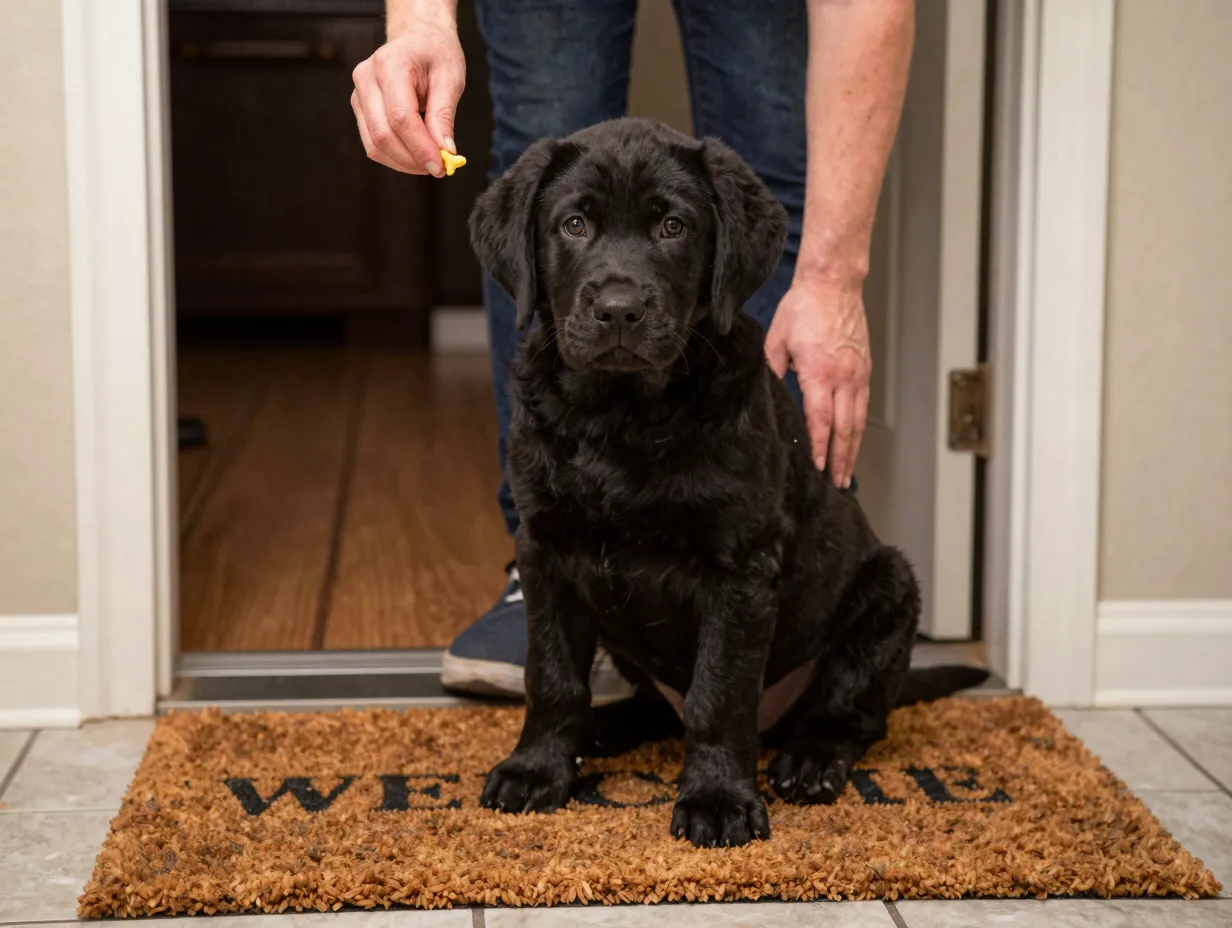
One of the biggest mistakes new owners make is waiting until their puppy is “old enough” to start training. The truth? Training begins the moment your black Lab puppy walks through the door. Every interaction — whether you realize it or not — is teaching your puppy something.
According to the AKC’s puppy milestone timeline, the socialization window between 8 and 16 weeks is the most influential period in a dog’s life [3]. Experiences during this time shape how your puppy responds to people, environments, sounds, and other animals for years to come.
What to do on Day 1:
- Introduce your puppy to its sleeping area, feeding spot, and designated bathroom zone
- Use your puppy’s name consistently and reward any eye contact
- Keep the environment calm and predictable
- Begin basic cue conditioning: say “sit,” gently guide the position, reward immediately
💬 “The puppy that learns the rules of the house on day one is the dog that follows them for life.” — Wild Labradors Training Guide [1]
2. Build a Rock-Solid Daily Routine

Black Lab puppies thrive on predictability. A consistent daily schedule reduces anxiety, speeds up house training, and makes your puppy feel secure [1]. Think of routine as the invisible framework that holds all other training together.
| Time of Day | Activity |
|---|---|
| Morning (7 AM) | Potty break → Breakfast → Short training session |
| Mid-Morning | Playtime → Nap |
| Afternoon | Potty break → Walk or exercise |
| Evening | Dinner → Training session → Calm play |
| Bedtime | Final potty break → Crate time |
Pro tip: Feed your puppy at the same times every day. Predictable feeding leads to predictable elimination — which makes house training dramatically easier [4].
3. Master Crate Training Early
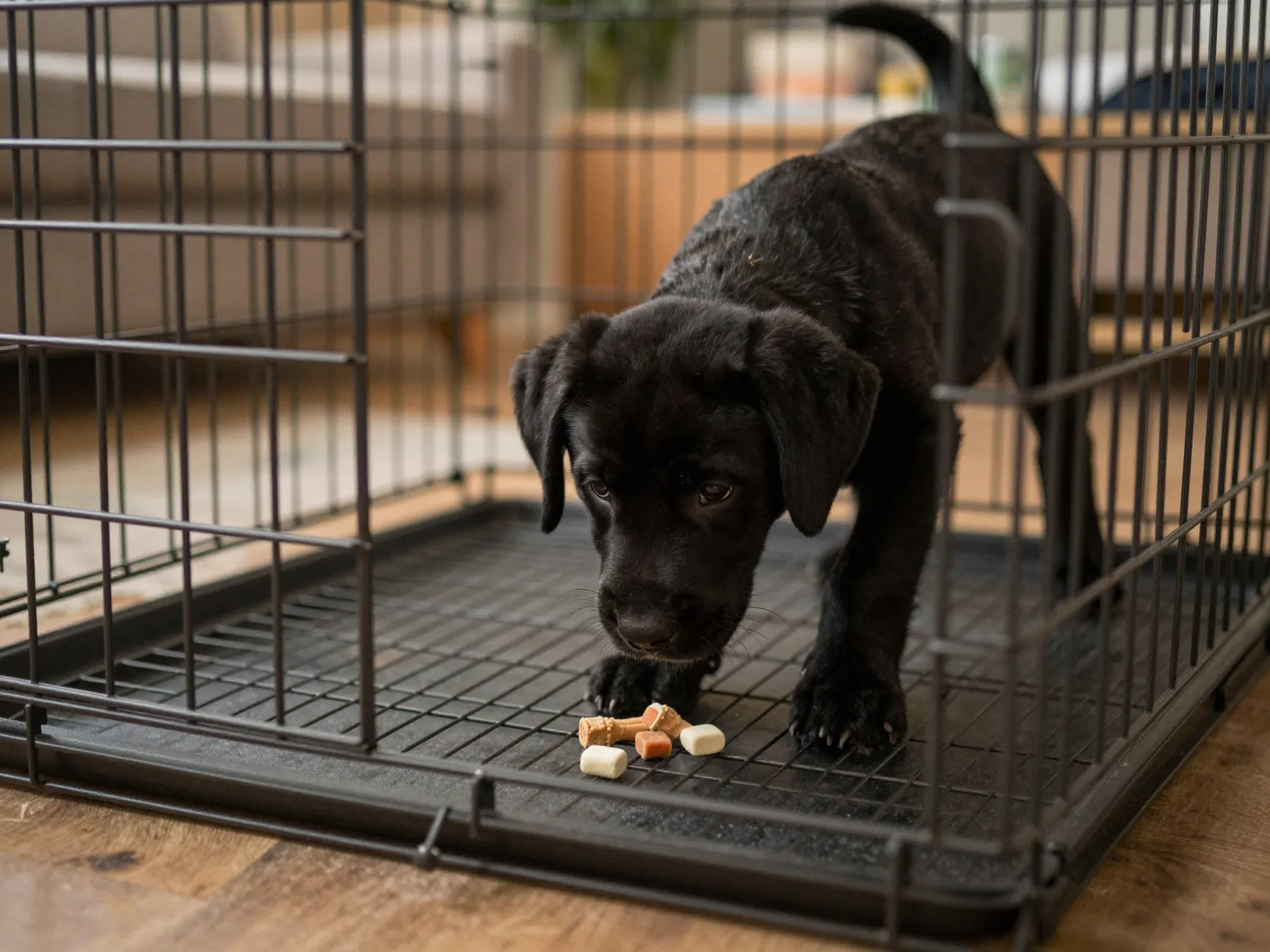
The crate is not a punishment — it is your puppy’s safe haven. When introduced correctly, most Labs genuinely love their crates and voluntarily retreat there to rest. Crate training also accelerates house training because puppies instinctively avoid soiling their sleeping area.
Step-by-step crate introduction:
- Place the crate in a busy area of the home so your puppy doesn’t feel isolated
- Toss treats inside without closing the door — let curiosity do the work
- Begin feeding meals inside the crate
- Gradually increase time with the door closed, starting at just 2–3 minutes
- Build up to overnight stays over 5–7 days
⚠️ Important: Never leave a young puppy in a crate longer than their age in months plus one hour. A 2-month-old puppy should not be crated for more than 3 hours at a stretch [3].
4. Use Positive Reinforcement — Every Single Time
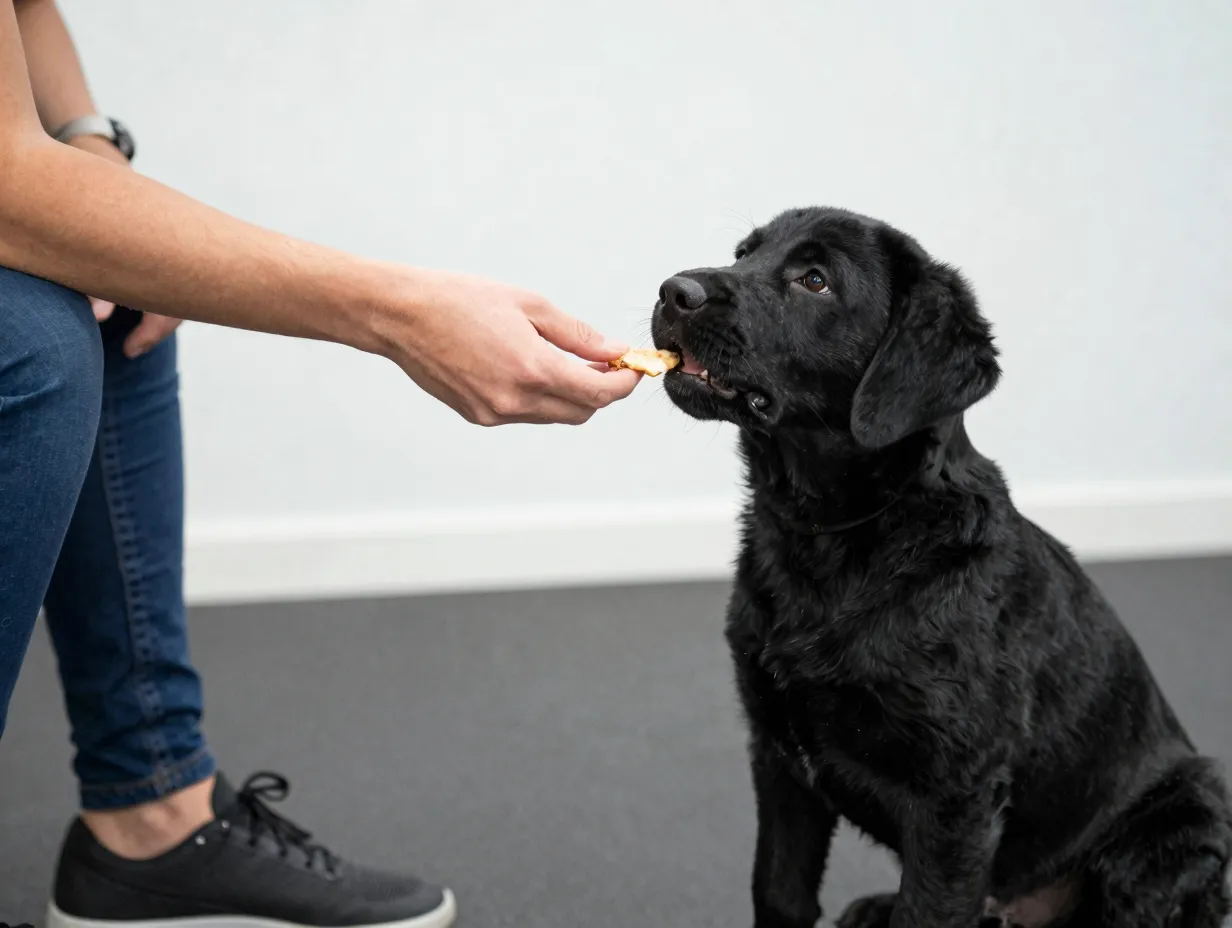
Science is clear on this: reward-based training produces faster learning, stronger retention, and a healthier dog-owner relationship than punishment-based methods. For black Lab puppies — who are highly food-motivated — positive reinforcement is particularly powerful [1].
The reinforcement toolkit:
- 🍗 High-value treats (small pieces of chicken, cheese, or commercial training treats)
- 🎉 Verbal praise (“Yes!” or “Good boy/girl!”)
- 🎾 Toy rewards for play-driven puppies
- 🤝 Physical affection (petting, gentle scratching)
Timing is everything. The reward must come within 1–2 seconds of the desired behavior. Any longer and your puppy loses the connection between the action and the reward.
💡 Mark the exact moment of success with a clicker or a sharp “Yes!” before delivering the treat. This bridges the gap between behavior and reward.
5. Teach the Five Foundation Commands First
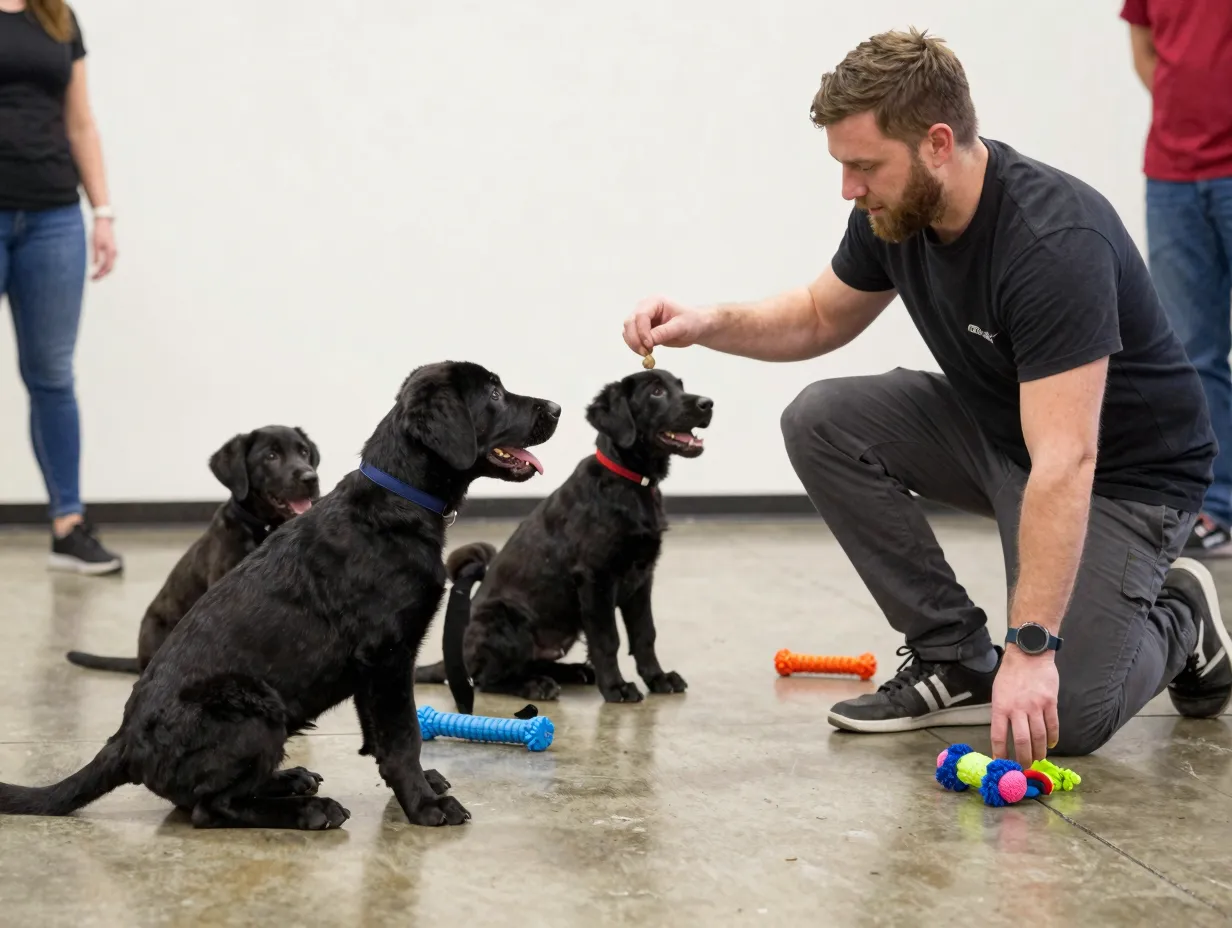
Before moving to advanced skills, lock in these five commands. They form the behavioral foundation every well-trained Lab needs:
- Sit — The gateway command; most puppies learn this within a few sessions
- Stay — Builds impulse control, one of the most valuable skills a Lab can have
- Come (Recall) — A safety command that can literally save your dog’s life
- Down — Promotes calmness and is the basis for many advanced behaviors
- Leave it — Essential for a breed that will put absolutely anything in its mouth
Training session guidelines:
- Keep sessions to 5–10 minutes maximum for young puppies
- Train 2–3 times per day rather than one long session
- End every session on a success — even if you have to make the last task easy
- Rotate through commands to maintain engagement [4]
6. Socialize Aggressively During the Critical Window

Socialization is not optional — it is one of the most important investments you will ever make in your dog’s future. A well-socialized black Lab puppy grows into a confident, adaptable adult. A poorly socialized one can develop fear, reactivity, or aggression.
Socialization checklist for 8–16 weeks:
- ✅ Meet at least 100 different people (children, elderly, men with hats, people in uniforms)
- ✅ Expose to 50+ different sounds (traffic, thunder recordings, vacuum cleaners, crowds)
- ✅ Walk on 10+ different surfaces (grass, gravel, tile, wood, metal grates)
- ✅ Interact with other vaccinated, healthy dogs
- ✅ Visit different environments (pet stores, parks, car rides, vet office for “happy visits”)
⚠️ Safety note: Until your puppy is fully vaccinated, avoid dog parks and areas with unknown dogs. Puppy classes with health-screened participants are a safer option [3].
7. Address Mouthing and Biting Immediately
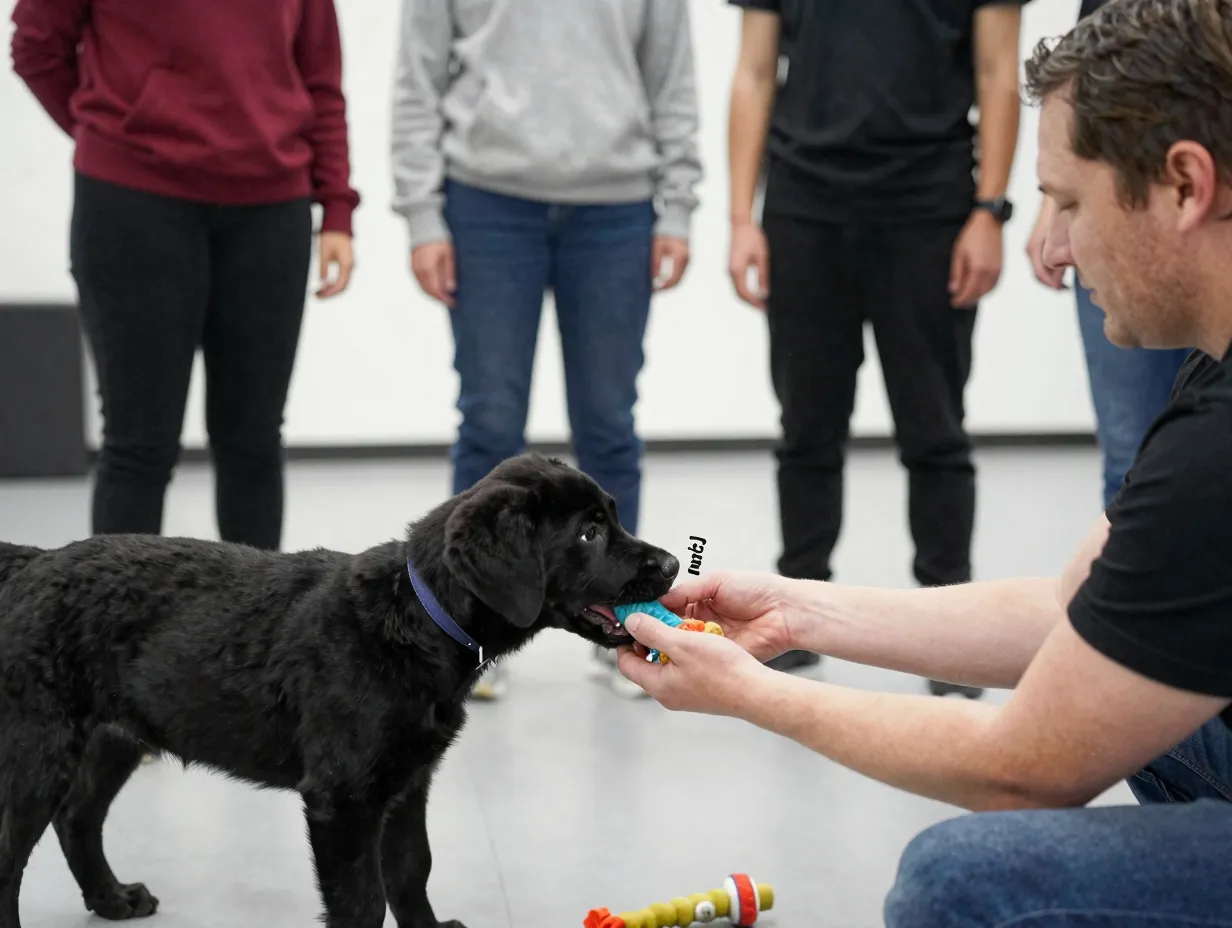
Every black Lab puppy goes through a mouthing phase — it is completely normal. But “normal” does not mean acceptable, and the habits formed now will determine whether your adult 70-pound Lab uses gentle mouth pressure or accidentally injures someone.
The bite inhibition protocol:
- When your puppy bites too hard, let out a sharp “Ouch!” and immediately go still
- If the biting continues, stand up and turn away — remove all attention for 10–15 seconds
- Resume play only when your puppy is calm
- Redirect to appropriate chew toys consistently
- Never use your hands as play objects — this sends mixed signals
Labs have a natural soft mouth developed through generations of retrieving game without damaging it [2]. Bite inhibition training reinforces this genetic tendency. Most puppies show significant improvement within 2–3 weeks of consistent practice [1].
8. Provide Adequate Mental and Physical Stimulation
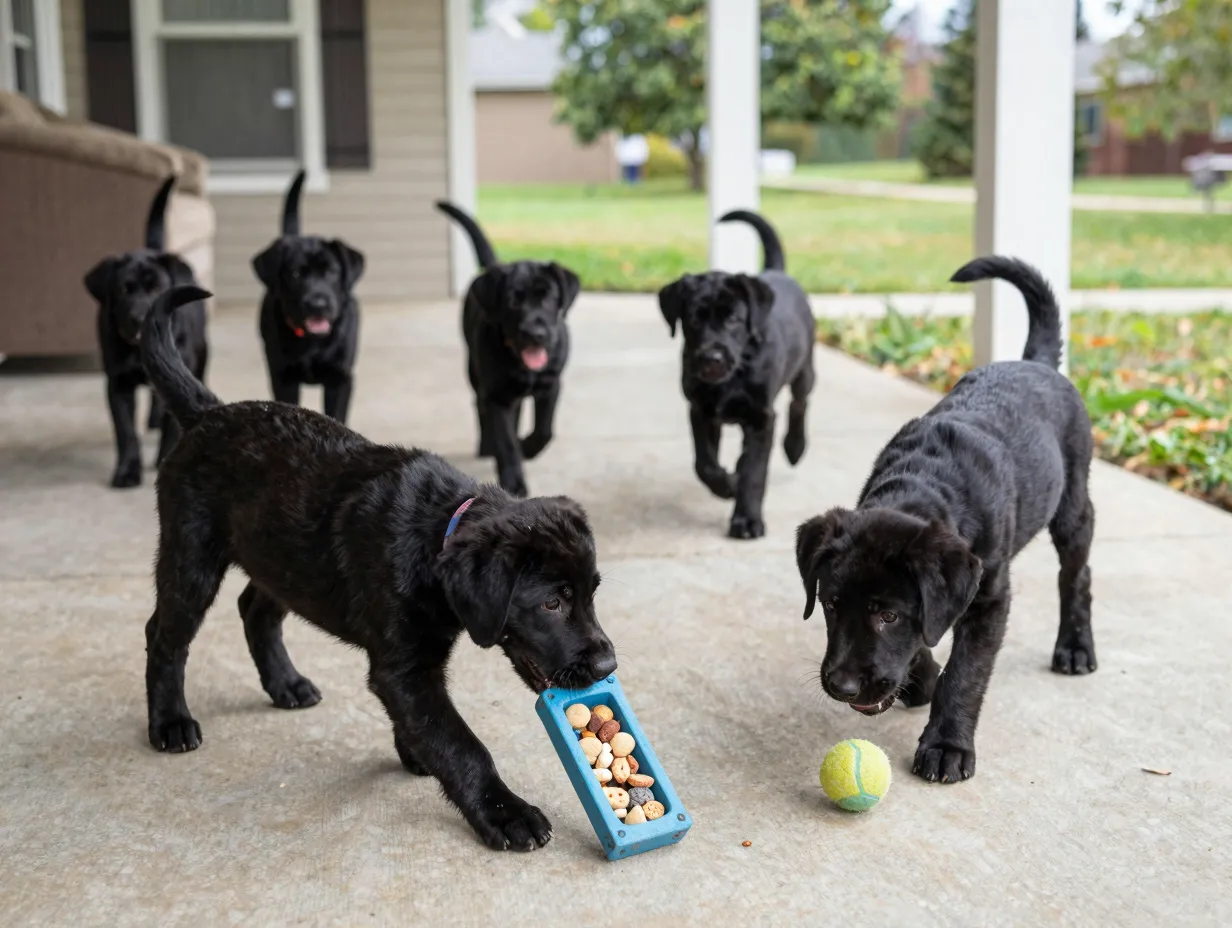
A tired Lab is a good Lab — but the tiredness needs to come from both body and brain. Labrador Retrievers are working dogs with significant exercise and mental stimulation requirements [6]. Failing to meet these needs is the number one cause of destructive behavior in the breed.
Age-appropriate exercise guidelines:
| Age | Daily Exercise |
|---|---|
| 8–12 weeks | 10–15 min gentle play, 2–3 times/day |
| 3–4 months | 15–20 min walks + play sessions |
| 4–6 months | 20–30 min structured activity |
| 6–12 months | 30–45 min (avoid high-impact until growth plates close) |
Mental enrichment ideas:
- 🧩 Puzzle feeders and Kongs stuffed with frozen food
- 👃 Nose work games (hide treats around the house)
- 📚 Learning new commands and tricks
- 🎾 Fetch with training elements built in (sit before each throw)
- 🌍 “Sniff walks” where your puppy sets the pace and explores freely [6]
💡 Ten minutes of nose work can tire a puppy as effectively as a 30-minute walk. Use this when the weather is bad or your puppy needs mental rest.
9. Be Consistent Across All Family Members

This is the secret that most training guides skip — and it may be the most important one of all. Your black Lab puppy is not just learning from you. It is learning from every person in your household, and inconsistency between family members is the fastest way to confuse and slow down your puppy’s progress.
The consistency framework:
- 📋 Create a household rules document — write down every rule (on furniture or off? beg at the table or not?) and post it somewhere visible
- 🗣️ Standardize command words — everyone must use the same word for the same behavior (not “down,” “off,” and “get down” interchangeably)
- 🚫 Enforce rules 100% of the time — if jumping is not allowed, it is not allowed even when Grandma thinks it is cute
- 👨👩👧 Train family members, not just the dog — run a quick orientation session for every person who interacts with your puppy regularly [4]
Common consistency killers:
| Behavior | Why It Confuses Your Puppy |
|---|---|
| Allowing jumping “just this once” | Teaches the puppy that jumping sometimes works |
| Using different command words | Creates ambiguity about what is expected |
| Feeding table scraps occasionally | Reinforces begging behavior intermittently |
| Skipping rules when tired | Teaches the puppy to test boundaries |
Common Training Mistakes to Avoid With Your Black Lab Puppy
Even with the best intentions, new owners fall into predictable traps. Here are the most common ones — and how to sidestep them:
1. Training sessions that are too long. Puppies have short attention spans. Sessions longer than 10 minutes lead to frustration and disengagement for both of you.
2. Repeating commands multiple times. Saying “sit, sit, SIT” teaches your puppy that the first command is optional. Say it once, then gently guide the behavior.
3. Punishing after the fact. If your puppy had an accident 10 minutes ago, scolding now accomplishes nothing. Dogs live in the moment — address behaviors as they happen or not at all.
4. Skipping the recall command. “Come” is a life-saving skill. Many owners neglect it because it seems simple — but it requires dedicated, consistent practice to be reliable under distraction [3].
5. Expecting too much too soon. Your black Lab puppy is doing its absolute best with a developing brain. Patience and realistic expectations are as important as any training technique [4].
Conclusion: Your Action Plan Starts Today
The 9 Training Secrets for Your Labrador Retriever Black Puppy are not magic tricks — they are consistent, science-backed principles that compound over time. The black Lab you raise in the first year will be the dog you live with for the next decade or more. That is both a responsibility and an incredible opportunity.
Here is your action plan for this week:
- ✅ Set up your puppy’s crate and designated potty area today
- ✅ Write down your household rules and share them with every family member
- ✅ Schedule three 5-minute training sessions per day into your calendar
- ✅ Purchase high-value training treats and a clicker
- ✅ Book your puppy into a socialization class for the coming week
- ✅ Use the training tracker above to monitor progress across all nine areas
Your black Lab puppy is one of the most capable, loving, and enthusiastic learners you will ever meet. Give it structure, consistency, and positive reinforcement — and it will reward you with a lifetime of loyalty and joy. 🐾
References
[1] Wild Labradors Puppy Training Secret Guide – https://wildlabradors.net/wild-labradors-puppy-training-secret-guide/
[2] Black Labrador – https://www.thelabradorsite.com/black-labrador/
[3] Train Labrador Retriever Puppy Milestone Timeline – https://www.akc.org/expert-advice/puppy-information/train-labrador-retriever-puppy-milestone-timeline/
[4] How To Raise Care For A Labrador Puppy – https://www.snowypineswhitelabs.com/blog/how-to-raise-care-for-a-labrador-puppy/
[6] Labrador Retriever – https://supertails.com/pages/labrador-retriever